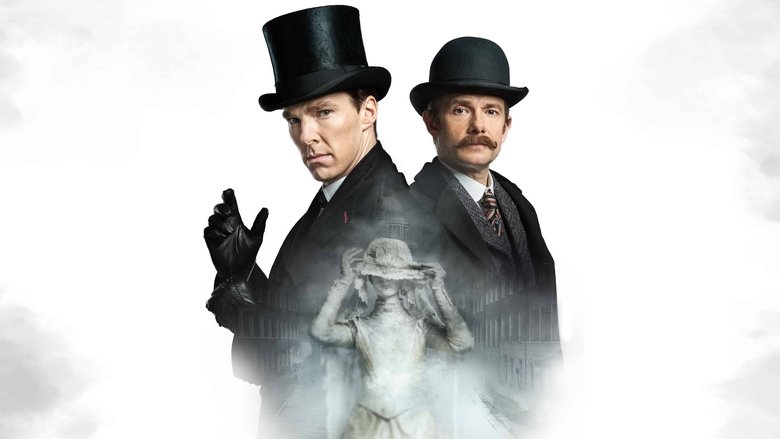
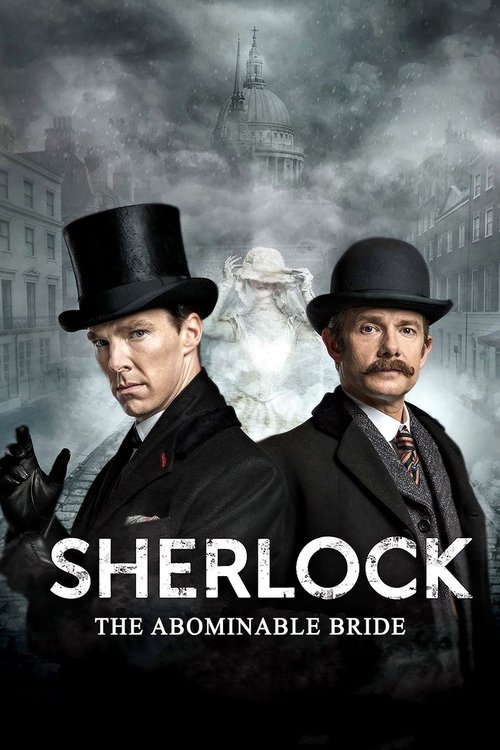
"Welcome to Sherlock 1895!"
Sherlock: The Abominable Bride - Symbolism & Philosophy
Symbols & Motifs
The Abominable Bride (Emelia Ricoletti)
The Bride symbolizes female rage and vengeance against patriarchal oppression. She is a ghostly avenger, a legend created by a secret society of women to enact justice. Her 'resurrection' from the dead is a powerful metaphor for an unseen and underestimated social force rising up to claim its power.
Emelia Ricoletti appears throughout the Victorian narrative, first by seemingly killing herself and then returning to murder her husband and other men. The image of a bride, traditionally a symbol of union and purity, is inverted into a figure of terror and death. The cult of women adopts her ghostly bridal attire as their uniform.
The Reichenbach Falls
The waterfall symbolizes the ultimate confrontation between Sherlock and Moriarty, representing a precipice of death, intellect, and obsession. It is a mental battleground where Sherlock must metaphorically kill his arch-nemesis to free his own mind. In this context, the fall represents not a physical death, but a necessary mental leap to awaken from his drug-induced fantasy.
In the climax of his Mind Palace simulation, Sherlock finds himself fighting Moriarty at the iconic Reichenbach Falls. Moriarty taunts him, saying, "It's not the fall that kills you, Sherlock. It's the landing." Encouraged by Watson, Sherlock chooses to fall, allowing himself to wake up in the present day.
Cocaine (The Seven-Percent Solution)
The use of cocaine symbolizes Sherlock's dangerous method of unlocking his own mind. It is both a tool and a vulnerability. It allows him to access the deep recesses of his Mind Palace to solve the complex puzzle connecting Ricoletti and Moriarty, but it also brings him to the brink of death and makes him susceptible to his inner demons, personified by Moriarty.
The film is framed by Sherlock's drug use. We learn the entire Victorian sequence is the result of an overdose he took on the plane. The narrative repeatedly returns to this, reminding the viewer that the events are not real but a mental projection facilitated by narcotics.
The Five Orange Pips
Borrowed from a Conan Doyle story where they are a symbol of the Ku Klux Klan, the orange pips here serve as a harbinger of death and a warning from the secret society of women. They signify that the victim has been marked for retribution by this unseen, powerful group. The reference subtly links the women's clandestine movement to other secret societies that operate outside the law to enforce their own code of justice.
Sir Eustace Carmichael receives an envelope containing five orange pips, which terrifies him and signals his impending murder at the hands of the "ghostly bride." This plot device is a direct nod to the original Sherlock Holmes short story, "The Five Orange Pips."
Philosophical Questions
Is identity fixed, or is it a story we tell ourselves?
The film constantly plays with layers of reality and fiction. The Victorian Watson, a creation of Sherlock's mind, becomes aware that he is a character in a story written by the 'real' Watson. This self-awareness within a dream raises questions about the nature of consciousness. Furthermore, the final scene suggests the entire modern series could be a story told by the Victorian Holmes. The episode explores the idea that our sense of self is constructed from narratives, whether they are Watson's blogs, Conan Doyle's novels, or the intricate fantasies we build in our own minds.
Can an idea be more dangerous than a person?
The central conflict is Sherlock's attempt to understand how a dead Moriarty can still be a threat. The resolution is that Moriarty himself is gone, but his 'virus'—his network and his plans—lives on. The Ricoletti case mirrors this: Emelia Ricoletti dies, but the "Abominable Bride" as an idea, a symbol of rebellion, is adopted by a movement and becomes unstoppable. The film posits that a powerful idea or ideology can achieve a form of immortality that a physical person cannot, making it a far more enduring and pervasive threat.
Core Meaning
"The Abominable Bride" serves as a deep dive into the labyrinthine mind of Sherlock Holmes, using a Victorian fever dream to dissect his greatest anxieties. At its core, the film explores the nature of memory, trauma, and the internal struggle with addiction. The entire Victorian plot is a construct within Sherlock's "Mind Palace," a drug-induced hallucination he creates to solve the modern-day mystery of how his nemesis, Moriarty, could have returned from the dead. The historical case of the "abominable bride" is a parallel puzzle that Sherlock believes holds the key to understanding Moriarty's posthumous scheme.
Ultimately, the director and writers use this intricate narrative structure to affirm that Moriarty is indeed dead, but his influence and network live on. The film is a complex, metaphorical journey that concludes with Sherlock gaining the crucial insight needed to fight his enemy from beyond the grave, while also forcing him to confront his own self-destructive tendencies.