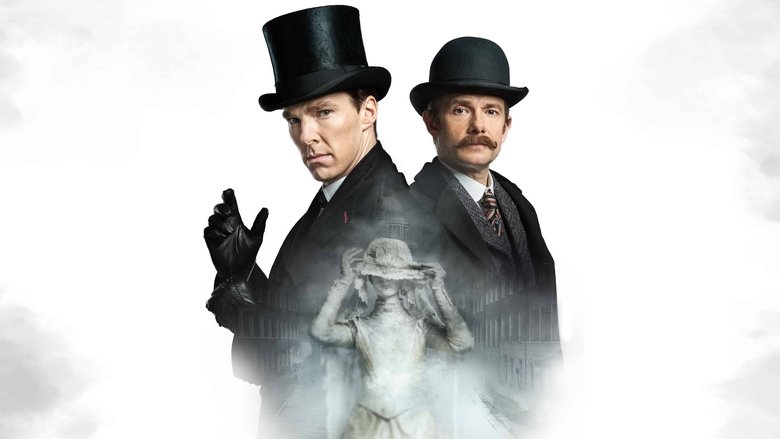
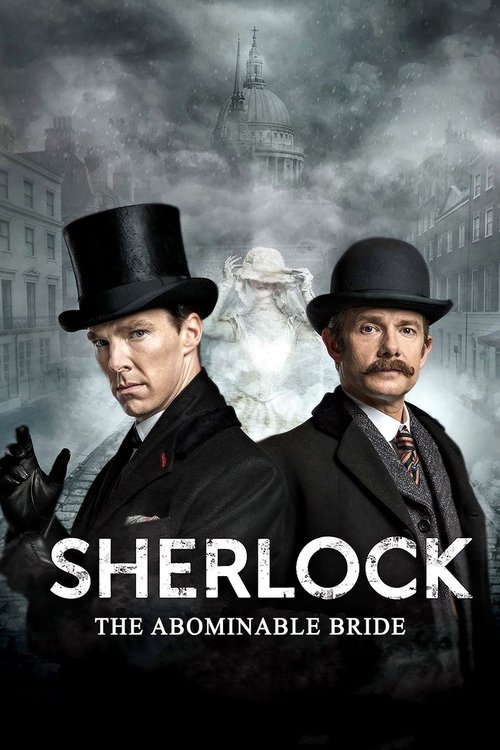
Sherlock: The Abominable Bride
A gothic, mind-bending thriller plunges a familiar detective into a Victorian fog, where the ghostly specter of an impossible crime mirrors the haunting recesses of his own brilliant, troubled mind.
Sherlock: The Abominable Bride

Sherlock: The Abominable Bride

"Welcome to Sherlock 1895!"

01 January 2016 United Kingdom 90 min ⭐ 7.8 (2,300)
Director: Douglas Mackinnon
Cast: Benedict Cumberbatch, Martin Freeman, Una Stubbs, Rupert Graves, Mark Gatiss
Drama Crime Thriller Mystery TV Movie
The Labyrinth of the Mind Feminism and Social Injustice Death and Resurrection Addiction and Self-Destruction

Overview

"Sherlock: The Abominable Bride" transports the modern Sherlock Holmes and Dr. John Watson to an alternate timeline in 1895 London. They are confronted with a seemingly impossible case: Emelia Ricoletti, a bride, opens fire on a public street before taking her own life. However, she inexplicably reappears hours later to murder her husband, leaving Scotland Yard baffled and Holmes intrigued by the puzzle of a killer who operates from beyond the grave.

As Holmes and Watson delve into the mystery of the ghostly bride, they uncover a conspiracy that reaches into the hidden corners of Victorian society. The case becomes increasingly labyrinthine, forcing Holmes to confront not only a cunning adversary but also the ghosts of his own past. The familiar faces of their 21st-century lives appear in Victorian guise, blurring the lines between reality and illusion as the narrative unfolds.
Core Meaning

"The Abominable Bride" serves as a deep dive into the labyrinthine mind of Sherlock Holmes, using a Victorian fever dream to dissect his greatest anxieties. At its core, the film explores the nature of memory, trauma, and the internal struggle with addiction. The entire Victorian plot is a construct within Sherlock's "Mind Palace," a drug-induced hallucination he creates to solve the modern-day mystery of how his nemesis, Moriarty, could have returned from the dead. The historical case of the "abominable bride" is a parallel puzzle that Sherlock believes holds the key to understanding Moriarty's posthumous scheme.

Ultimately, the director and writers use this intricate narrative structure to affirm that Moriarty is indeed dead, but his influence and network live on. The film is a complex, metaphorical journey that concludes with Sherlock gaining the crucial insight needed to fight his enemy from beyond the grave, while also forcing him to confront his own self-destructive tendencies.

Thematic DNA

The Labyrinth of the Mind 35%
Feminism and Social Injustice 30%
Death and Resurrection 25%
Addiction and Self-Destruction 10%

The Labyrinth of the Mind

The episode's primary theme is the exploration of Sherlock's own consciousness. The entire Victorian setting is revealed to be an elaborate construction within his "Mind Palace," fueled by a dangerous mix of drugs. This structure allows the narrative to explore his thought processes, his anxieties, and his internal battle with Moriarty. The transitions between the 19th and 21st centuries highlight the fractured, recursive nature of his mind as he tries to solve a past mystery to understand a present one.

Feminism and Social Injustice

The central mystery of Emelia Ricoletti is revealed to be the work of a secret society of women, akin to the suffragette movement, seeking retribution against the men who have wronged them. This "invisible enemy" represents the oppressed and ignored women of the Victorian era, who have banded together to fight back against a patriarchal society. Sherlock's solving of the case forces him to acknowledge a "war" that men must lose, recognizing the systemic injustice faced by women.

Death and Resurrection

The film is framed around the impossible resurrections of two characters: Emelia Ricoletti in the 19th century and Moriarty in the 21st. Sherlock becomes obsessed with the Ricoletti case because he believes solving how a woman could kill after her own suicide will provide the blueprint for how Moriarty could return after shooting himself. The resolution reveals both "resurrections" are tricks—Ricoletti's was a faked death by a conspiracy, and Moriarty's is a posthumous plan executed by his network—reinforcing the theme that while individuals die, their ideas and influence can survive.

Addiction and Self-Destruction

Sherlock's drug use, a key element from Conan Doyle's original stories, is central to the plot. His journey into the Victorian Mind Palace is induced by a dangerous overdose taken on the plane after his brief exile. This act of self-destruction is portrayed as both a source of his insight and a profound weakness, a vulnerability that Moriarty exploits even as a mental projection. Mycroft's concern over Sherlock's addiction underscores the personal demons the detective must battle alongside his external foes.

Character Analysis

Sherlock Holmes

Benedict Cumberbatch

Archetype: The Byronic Hero
Key Trait: Obsessive Intellect

Motivation

To solve the impossible mystery of how Moriarty could have survived shooting himself. He uses the unsolved Victorian case of Emelia Ricoletti, who also seemingly cheated death, as a mental blueprint to understand his adversary's methods.

Character Arc

Sherlock's arc in this film is entirely internal. At the start, he is exiled and desperate to understand Moriarty's posthumous return. He recklessly plunges into a drug-induced coma to solve a 120-year-old case, believing it holds the answer. Inside his own mind, he confronts his fear of Moriarty, his complex relationship with women, and his own self-destructive nature. By solving the Ricoletti case, he understands that Moriarty is truly dead but has left a network to carry out his plans. He awakens from his trance with a renewed purpose and a clear understanding of the fight ahead, having metaphorically conquered his nemesis within his own mind.

Dr. John Watson

Martin Freeman

Archetype: The Loyal Companion / The Everyman
Key Trait: Steadfast Loyalty

Motivation

To assist Holmes in solving the Ricoletti case and, on a deeper level, to support his friend even within the distorted reality of Sherlock's mind. His motivation is fundamentally centered on his unwavering friendship with Sherlock.

Character Arc

As a character within Sherlock's Mind Palace, the Victorian Watson acts as both a chronicler and a grounding force. He is initially portrayed as a more traditional, slightly bumbling sidekick from his own published stories. However, as the fantasy deepens, he becomes Sherlock's anchor to 'reality' within the dream. In the climactic scene at the Reichenbach Falls, it is Watson who understands he is a mental projection and urges Sherlock to 'wake up' by leaping from the falls, proving his ultimate loyalty and importance to Sherlock's psyche.

James Moriarty

Andrew Scott

Archetype: The Shadow / The Nemesis
Key Trait: Maniacal Genius

Motivation

As a mental construct, his motivation is to destabilize Sherlock, to prove that he is the one puzzle the detective can never solve, and to embody the threat that looms over Sherlock in the real world.

Character Arc

Moriarty in this film is not a physical character but a manifestation of Sherlock's deepest fears and intellectual insecurities within the Mind Palace. He appears to taunt Sherlock, representing the part of the puzzle that Sherlock cannot solve. His 'survival' after shooting himself in the head within the dream mirrors the central question Sherlock is trying to answer. Moriarty's final defeat at the Reichenbach Falls symbolizes Sherlock's mental victory and his acceptance that his nemesis is truly dead, even if his threat remains.

Mary Morstan (Watson)

Amanda Abbington

Archetype: The Astute Ally
Key Trait: Resourceful

Motivation

To assist Mycroft in managing Sherlock, and to independently investigate the strange occurrences, ultimately uncovering the feminist conspiracy at the heart of the mystery.

Character Arc

The Victorian Mary, much like her modern counterpart, is shown to be more than just Watson's wife. She is intelligent, resourceful, and operates with her own agency, working for Mycroft to keep an eye on Sherlock. She is the one who ultimately leads Holmes and Watson to the secret society of women, demonstrating her competence and key role in the investigation. Her character serves to highlight the film's feminist themes, representing a woman who operates effectively within the shadows of a patriarchal world.

Symbols & Motifs

The Abominable Bride (Emelia Ricoletti)

Meaning:

The Bride symbolizes female rage and vengeance against patriarchal oppression. She is a ghostly avenger, a legend created by a secret society of women to enact justice. Her 'resurrection' from the dead is a powerful metaphor for an unseen and underestimated social force rising up to claim its power.

Context:

Emelia Ricoletti appears throughout the Victorian narrative, first by seemingly killing herself and then returning to murder her husband and other men. The image of a bride, traditionally a symbol of union and purity, is inverted into a figure of terror and death. The cult of women adopts her ghostly bridal attire as their uniform.

The Reichenbach Falls

Meaning:

The waterfall symbolizes the ultimate confrontation between Sherlock and Moriarty, representing a precipice of death, intellect, and obsession. It is a mental battleground where Sherlock must metaphorically kill his arch-nemesis to free his own mind. In this context, the fall represents not a physical death, but a necessary mental leap to awaken from his drug-induced fantasy.

Context:

In the climax of his Mind Palace simulation, Sherlock finds himself fighting Moriarty at the iconic Reichenbach Falls. Moriarty taunts him, saying, "It's not the fall that kills you, Sherlock. It's the landing." Encouraged by Watson, Sherlock chooses to fall, allowing himself to wake up in the present day.

Cocaine (The Seven-Percent Solution)

Meaning:

The use of cocaine symbolizes Sherlock's dangerous method of unlocking his own mind. It is both a tool and a vulnerability. It allows him to access the deep recesses of his Mind Palace to solve the complex puzzle connecting Ricoletti and Moriarty, but it also brings him to the brink of death and makes him susceptible to his inner demons, personified by Moriarty.

Context:

The film is framed by Sherlock's drug use. We learn the entire Victorian sequence is the result of an overdose he took on the plane. The narrative repeatedly returns to this, reminding the viewer that the events are not real but a mental projection facilitated by narcotics.

The Five Orange Pips

Meaning:

Borrowed from a Conan Doyle story where they are a symbol of the Ku Klux Klan, the orange pips here serve as a harbinger of death and a warning from the secret society of women. They signify that the victim has been marked for retribution by this unseen, powerful group. The reference subtly links the women's clandestine movement to other secret societies that operate outside the law to enforce their own code of justice.

Context:

Sir Eustace Carmichael receives an envelope containing five orange pips, which terrifies him and signals his impending murder at the hands of the "ghostly bride." This plot device is a direct nod to the original Sherlock Holmes short story, "The Five Orange Pips."

Memorable Quotes

The name is Sherlock Holmes, and the address is 221B Baker Street.

— Sherlock Holmes

Context:

This is said near the beginning of the episode, during the re-enactment of Sherlock and Watson's first meeting in 1895, mirroring the introductions from both the original books and the first episode of the modern series.

Meaning:

This iconic line re-establishes the character in his original, classic Victorian setting. It's a moment of pure fan service that grounds the episode in the world of Arthur Conan Doyle's novels before the narrative begins to deconstruct itself.

It's not the fall that kills you, Sherlock. Of all people, you should know that. It's the landing.

— James Moriarty

Context:

Moriarty says this to Sherlock during their climactic confrontation at the virtual Reichenbach Falls within Sherlock's Mind Palace, just before Sherlock is forced to jump to awaken himself.

Meaning:

This line, delivered by the manifestation of Moriarty in Sherlock's mind, is a powerful psychological taunt. It refers to both Sherlock's faked death in "The Reichenbach Fall" and Moriarty's own suicide. It suggests that the act of dying is irrelevant; what matters is the consequence and the aftermath. For Sherlock, the 'landing' is waking up to reality.

You're Sherlock Holmes. Wear the damn hat.

— John Watson

Context:

This is said by the Victorian Watson to Holmes. The line is a callback to the modern series where John often has to manage Sherlock's public image.

Meaning:

A meta-textual and affectionate line where Watson encourages Sherlock to embrace his iconic persona. It reflects the show's own playful relationship with the source material and the public image of the character, particularly the deerstalker hat, which the modern Sherlock dislikes but the Victorian one wears.

Moriarty is dead. More importantly, I know exactly what he's going to do next.

— Sherlock Holmes

Context:

Sherlock says this to John and Mary in the present day, on the plane, after he has fully awakened from his drug-induced trance and processed the events of his Victorian hallucination.

Meaning:

This is the conclusion of Sherlock's entire mental journey. After solving the Ricoletti case, he has finally understood the nature of Moriarty's return. It confirms Moriarty's physical death but establishes the true threat: a posthumous network executing his plans. This line sets the stage for the subsequent season.

Philosophical Questions

Is identity fixed, or is it a story we tell ourselves?

The film constantly plays with layers of reality and fiction. The Victorian Watson, a creation of Sherlock's mind, becomes aware that he is a character in a story written by the 'real' Watson. This self-awareness within a dream raises questions about the nature of consciousness. Furthermore, the final scene suggests the entire modern series could be a story told by the Victorian Holmes. The episode explores the idea that our sense of self is constructed from narratives, whether they are Watson's blogs, Conan Doyle's novels, or the intricate fantasies we build in our own minds.

Can an idea be more dangerous than a person?

The central conflict is Sherlock's attempt to understand how a dead Moriarty can still be a threat. The resolution is that Moriarty himself is gone, but his 'virus'—his network and his plans—lives on. The Ricoletti case mirrors this: Emelia Ricoletti dies, but the "Abominable Bride" as an idea, a symbol of rebellion, is adopted by a movement and becomes unstoppable. The film posits that a powerful idea or ideology can achieve a form of immortality that a physical person cannot, making it a far more enduring and pervasive threat.

Alternative Interpretations

While the primary interpretation is that the Victorian adventure is a drug-induced hallucination within modern Sherlock's Mind Palace, the final scene offers a more radical, alternative reading. In this final moment, we return to the Victorian Holmes and Watson at 221B Baker Street. Holmes describes his visions of the future, including airplanes and mobile phones, to a skeptical Watson and says he's a man "out of his time." The camera then pulls back to show modern-day Baker Street.

This has led to the theory, even acknowledged by writer Mark Gatiss, that the entire modern "Sherlock" series could be the drug-induced fantasy of the original Victorian Sherlock Holmes. In this interpretation, the modern-day adventures are simply the canonical Holmes imagining what a future version of himself might be like. This reading completely inverts the narrative framework of the show, recasting the entire series as a product of the original character's imagination, rather than a modern adaptation.

Cultural Impact

"The Abominable Bride" was a highly anticipated television event, bridging a long gap between the third and fourth seasons of the globally popular "Sherlock" series. Its broadcast on New Year's Day 2016 was a major ratings success for the BBC and PBS. The episode's most significant impact came from its daring and complex narrative structure. By setting the bulk of the story in the Victorian era—the original setting of Conan Doyle's stories—the creators paid homage to the source material while simultaneously subverting audience expectations.

Critically, the reception was deeply polarized. Many lauded the episode for its cleverness, ambition, and visual flair, praising the performances and the intricate plotting that wove the Victorian mystery into the overarching modern narrative. Others found it convoluted, self-indulgent, and confusing, arguing that the "it was all a dream" twist undermined the emotional stakes of the Victorian story. The treatment of its feminist themes also drew debate, with some critics seeing it as a powerful statement on historical female oppression, while others found it heavy-handed and problematic, particularly the visual comparison of the suffragette group to the KKK.

Despite the divided reviews, the episode won the Primetime Emmy for Outstanding Television Movie, a major accolade that solidified its status as a significant piece of television. In pop culture, it sparked extensive online discussion and debate among the show's massive fanbase, with countless articles and videos dedicated to "explaining" its complex ending and dissecting its numerous Easter eggs. It remains a benchmark for the series' meta-narrative style and its willingness to challenge conventional storytelling.

Audience Reception

Audience reaction to "The Abominable Bride" was intensely divided, mirroring the critical reception. Many fans praised the episode for its creativity, ambition, and the enjoyable novelty of seeing the beloved characters in their original Victorian setting. The performances of Benedict Cumberbatch and Martin Freeman, the witty dialogue, and the gothic horror atmosphere of the Ricoletti case were frequently highlighted as strong points. Fans of the show's intricate plotting and meta-commentary particularly enjoyed the Mind Palace twist and the numerous callbacks and Easter eggs to both the series and the original books.

However, a significant portion of the audience found the plot overly convoluted and confusing. The primary point of criticism was the mid-episode reveal that the Victorian story was a drug-induced dream, which some viewers felt negated the tension and emotional investment in the case. The ending, and the complex, layered nature of the Mind Palace, left many feeling unsatisfied and questioning the narrative's coherence. The handling of the feminist storyline was also a point of contention, with some viewers finding it powerful while others deemed it clumsy or even offensive.

Interesting Facts

  • The episode won the Primetime Emmy Award for Outstanding Television Movie in 2016.
  • The title of the episode is based on a line from Arthur Conan Doyle's story "The Adventure of the Musgrave Ritual," which refers to an unrecorded case: "Ricoletti of the club foot and his abominable wife."
  • The initial scenes showing the Victorian Baker Street, as well as the accompanying music, were intentionally designed to evoke the classic 1980s Granada Television adaptation of Sherlock Holmes starring Jeremy Brett.
  • The obese version of Mycroft in the Victorian setting is a direct reference to his description in the original books, where he is portrayed as considerably larger and less active than Sherlock.
  • The writers, Steven Moffat and Mark Gatiss, had joked about doing a Victorian-set episode for a long time before deciding to make it a standalone special.
  • Many lines of dialogue are lifted verbatim from the original Conan Doyle stories, including Moriarty's warning about fingering loaded firearms in a dressing gown pocket, which comes from "The Final Problem."
  • The solution to the mystery, involving a secret society using a faked death to create a "ghost," draws inspiration from several Doyle stories, including elements similar to "The Problem of Thor Bridge."

Easter Eggs

The Persian Slipper

In the Victorian 221B, Sherlock keeps his tobacco in a Persian slipper on the mantelpiece, a detail taken directly from the original stories by Arthur Conan Doyle. In the modern series, this is updated to cigarettes being kept there.

Jackknife on the Mantlepiece

Sherlock keeps his unanswered mail pinned to the mantelpiece with a jackknife. This is another specific detail about Holmes's domestic habits described in the original Conan Doyle novels.

The Criterion Bar

In the flashback to Holmes and Watson's first meeting, they meet with Mike Stamford at the Criterion Bar. This is the same location where the meeting takes place in the original novel, "A Study in Scarlet."

Redbeard

In the present-day scene on the plane, Mycroft opens Sherlock's notebook and sees the word "Redbeard." This is the name of Sherlock's childhood dog, the death of which was a significant trauma for him, revealed in a later season. Its inclusion here hints at deeper psychological issues at play within Sherlock's mind.

The 'Skull' Painting

Instead of the smiley face with bullet holes on the wall of the modern 221B, the Victorian flat features a painting of a woman at her vanity table which, from a distance, creates the optical illusion of a skull. This is a classic "vanitas" image, symbolizing mortality.

Irene Adler's Photograph

Inside a Victorian Sherlock's pocket watch is a photograph of Irene Adler, referred to as "The Woman." This is a nod to the story "A Scandal in Bohemia," where Holmes keeps her photograph as a memento of the one woman who outwitted him.

⚠️ Spoiler Analysis

Click to reveal detailed analysis with spoilers

Frequently Asked Questions

Explore More About This Movie

Dive deeper into specific aspects of the movie with our detailed analysis pages

Comments (0)

Leave a comment

No comments yet. Be the first to share your thoughts!