"A new sleuth for the 21st century."
Sherlock - Symbolism & Philosophy
Symbols & Motifs
The Deerstalker Hat
The deerstalker symbolizes the public's perception and the myth of "Sherlock Holmes," a persona distinct from the man himself. It represents the caricature he occasionally embraces for effect but largely disdains.
Sherlock rarely wears the hat by choice. He first puts it on for the press in "A Scandal in Belgravia" to play into the media image John's blog has created. Its appearances are often linked to moments when he is performing the role of the great detective, highlighting the gap between his true self and his public legend.
221B Baker Street
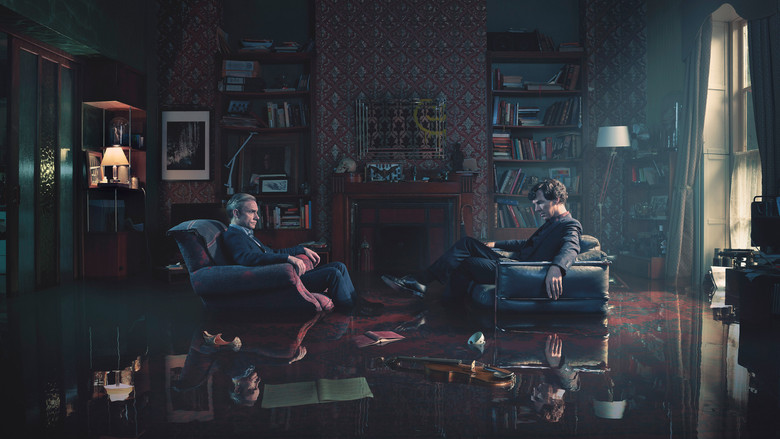
The flat at 221B Baker Street represents sanctuary, friendship, and the heart of Sherlock and John's world. It is the one constant place of stability and belonging for two men who are otherwise outsiders.
From the first episode, the flat is established as their shared home. It's the setting for countless deductions, arguments, and moments of quiet camaraderie. Its messy, cluttered state reflects Sherlock's mind, yet it's also where their partnership is forged. Threats to the flat often symbolize direct threats to their relationship and safety.
The Smiley Face on the Wall
The spray-painted smiley face, often punctuated by bullet holes, symbolizes Sherlock's boredom, his destructive need for mental stimulation, and his playful defiance of convention.
Appearing in the first episode, "A Study in Pink," it's a modern update to the original stories where Holmes would shoot the initials "VR" (Victoria Regina) into the wall. The face becomes a recurring visual in the flat, a testament to the chaotic energy that defines Sherlock's personality when he is not occupied by a case.
Mobile Phones
Mobile phones symbolize the new speed of information, connection, and manipulation in the modern world. They are the primary tools for both deduction and deception, acting as extensions of the characters' minds.
The show's signature visual is the floating text messages on screen. Sherlock uses his phone to receive case information, John uses it to write his blog, and Moriarty uses it to taunt his victims and orchestrate his crimes. Irene Adler's phone, containing state secrets, becomes the ultimate symbol of power and vulnerability in "A Scandal in Belgravia."
Philosophical Questions
Is extreme intellect a gift or a curse?
The series constantly explores the isolation that comes with Sherlock's genius. While his mind allows him to perform incredible feats, it also alienates him from almost everyone he meets. He struggles with boredom, social interaction, and forming meaningful relationships. The show asks whether the benefits of such a powerful mind outweigh the profound loneliness and emotional stunting it can cause, suggesting that without human connection, genius is a hollow and destructive force.
What is the relationship between identity and reputation?
Throughout the series, Sherlock grapples with the public persona created by John's blog. In Season 2, Moriarty's entire plan revolves around destroying Sherlock not by killing him, but by dismantling his reputation and turning him from a celebrated genius into a fraudulent villain. The show questions whether we are who we are, or who people perceive us to be, and examines the fragility of public trust in the media age.
Can a person truly change their fundamental nature?
Sherlock's entire character arc revolves around this question. He starts as a self-proclaimed sociopath who scoffs at sentiment. Over four seasons, he develops deep loyalty and love for his friends, making choices based on emotion rather than pure logic. The series explores whether this is a fundamental change in his nature or simply the discovery of a humanity that was always there, buried under layers of trauma and intellectual defense mechanisms.
Core Meaning
At its heart, "Sherlock" is an exploration of the paradox of genius in the modern world. The series delves into the profound loneliness and isolation that accompany extraordinary intellect, questioning whether a mind like Sherlock's can ever truly connect with others. It argues that humanity, friendship, and emotional connection—often dismissed by Holmes as weaknesses—are not just advantageous but essential for survival and meaning. The complete story arc is a journey of Sherlock's gradual, painful transformation from a detached calculating machine into someone who understands the value of love and loyalty, ultimately suggesting that true strength lies not in intellect alone, but in the heart that guides it.