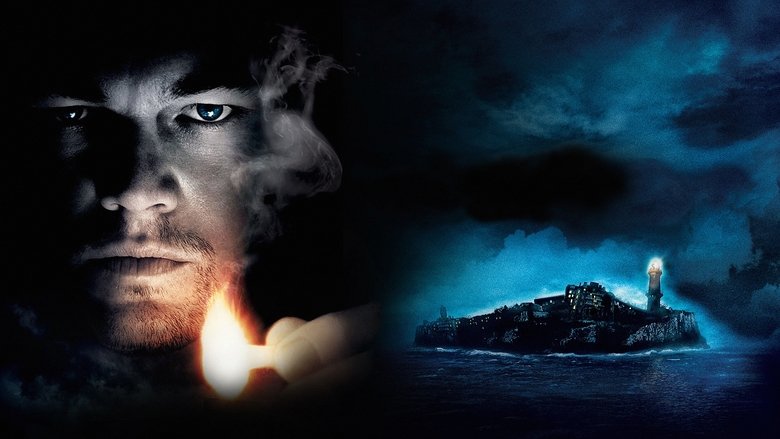

"Some places never let you go."
Shutter Island - Symbolism & Philosophy
Symbols & Motifs
Water
Water symbolizes the repressed, unbearable truth of Andrew's past. It represents the reality of his children's drowning and his wife's role in it, a memory he actively avoids.
Andrew (as Teddy) gets seasick on the ferry to the island and expresses a strong aversion to water throughout the film. The hurricane that traps him on the island is a physical manifestation of his inner turmoil. His visions of his wife, Dolores, often show her sopping wet, a direct link to the traumatic event.
Fire
Fire represents the delusional world Andrew has constructed. It is the false memory of how his wife died—in an apartment fire set by the fictional arsonist, Andrew Laeddis.
Teddy's hallucinations of Dolores are frequently accompanied by fire and ash. In one key dream sequence, she turns to ash in his arms. He sets his wife's ugly tie on fire, symbolizing an attempt to let go of the fantasy she represents. The presence of fire in scenes, like the match strikes or campfires, often indicates that what is being shown is part of Teddy's delusion.
The Lighthouse
The lighthouse symbolizes truth, revelation, and the ultimate confrontation with reality. It is the place Teddy believes the hospital's darkest secrets are hidden, but it is actually where his own secrets will be revealed to him.
Teddy is drawn to the lighthouse throughout the film, believing it to be the location of inhumane psychological experiments. The film's climax occurs in the lighthouse, where Dr. Cawley confronts Teddy with the truth about his identity as Andrew Laeddis.
Rats
Rats can symbolize the feeling of being trapped and manipulated. George Noyce explicitly tells Teddy, "You're a fucking rat in a maze," which points to the constructed nature of his reality and his role as an unwitting subject in an experiment.
During his investigation and particularly in his nightmares and hallucinations, Teddy encounters rats. The most significant reference is when fellow patient George Noyce, in Ward C, directly tells him he is being played, comparing him to a rat in a maze designed specifically for him.
Philosophical Questions
Can we choose our own reality?
The film explores the idea that the human mind can construct an alternate reality to protect itself from unbearable pain. Andrew Laeddis creates the entire persona of Teddy Daniels, complete with a backstory and a mission, to avoid confronting the truth of his family's tragedy. The film's climax and ambiguous ending force us to consider whether he ultimately chooses to retreat back into this delusion or if he consciously chooses oblivion (lobotomy) over living with a monstrous truth. This raises the question of whether a self-imposed, comforting delusion can be preferable to a devastating reality.
What is the nature of identity?
"Shutter Island" fundamentally questions whether identity is a stable, inherent quality or a narrative we construct. Andrew Laeddis's identity is completely fractured by trauma. He is both the grieving husband/father and the murderer; the war hero and the dangerous patient. The film suggests that identity can be shattered and rebuilt, and that the stories we tell ourselves about who we are are essential to our ability to function. Teddy Daniels isn't just a lie; for two years, it has been Andrew's functional identity.
Is redemption possible for monstrous acts?
Andrew's final question, "Which would be worse: to live as a monster, or to die as a good man?", is a profound inquiry into guilt and atonement. Having fully accepted that he is the 'monster' who killed his wife, he is faced with the rest of his life knowing this truth. His decision to feign a relapse and accept a lobotomy can be seen as a form of self-punishment and a tragic attempt at redemption. He cannot undo his actions, but he can erase the man who committed them, ensuring he 'dies' as the 'good man' he wishes he had been.
Core Meaning
"Shutter Island" explores the profound impact of trauma, grief, and guilt on the human psyche. The film delves into the mind's capacity to create elaborate defense mechanisms to protect itself from unbearable truths. Director Martin Scorsese crafts a narrative that questions the nature of reality and delusion, suggesting that memory can be a fluid, unreliable construct. The central message revolves around the devastating consequences of unresolved trauma and the desperate lengths one might go to escape a painful past, ultimately posing the question of whether it's better to live with a monstrous truth or die clinging to a comforting lie.