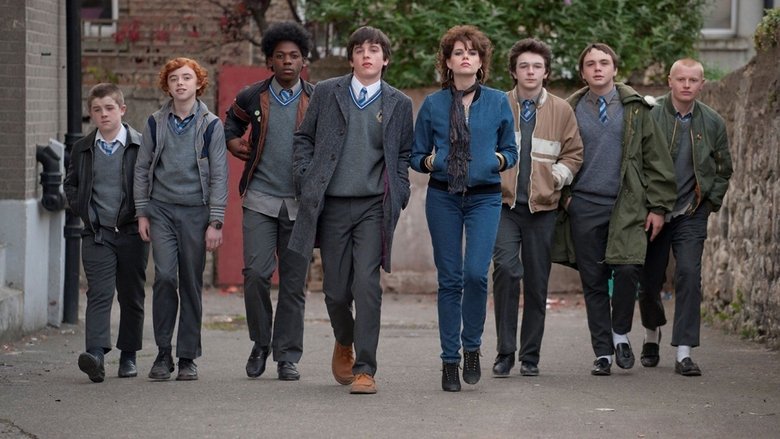
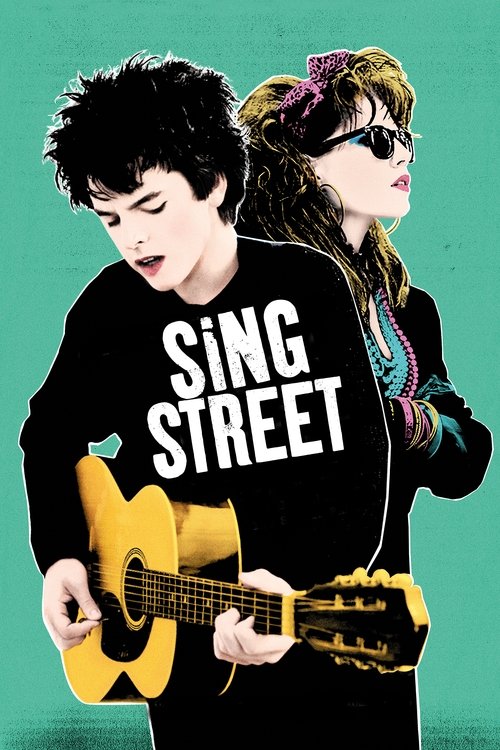
"Boy meets girl. Girl unimpressed. Boy starts band."
Sing Street - Symbolism & Philosophy
Symbols & Motifs
The Changing Fashion and Musical Styles
Symbolizes Conor's journey of self-discovery and artistic evolution. As Brendan introduces him to new bands, Conor's appearance and the band's musical genre shift dramatically, from Duran Duran-inspired New Romanticism to the melancholic cool of The Cure. This isn't just imitation; it's Conor trying on different personas to see which one fits, a visual representation of the trial-and-error process of finding one's own identity.
This is seen throughout the film. After watching a Duran Duran video, the band appears in their first music video with flamboyant makeup and clothes. Later, inspired by The Cure, Conor dyes his hair and adopts a more somber look, leading to the song "A Beautiful Sea." Each change prompts a reaction from his family, his school, and Raphina, marking a new stage in his development.
The Music Videos
The amateur music videos represent the creation of a fantasy world—a reality that the characters can control and perfect, in stark contrast to their chaotic real lives. They are spaces where Conor can be the hero, Raphina can be the star model, and their drab Dublin surroundings can be transformed into an epic backdrop. They embody the film's theme of art as a means of escapism and wish fulfillment.
The band shoots several music videos, starting with "The Riddle of the Model" in a back alley. The most elaborate is the fantasy sequence for "Drive It Like You Stole It," which reimagines the school prom as a 1950s American dreamscape, complete with their families reconciled and their enemies neutralized.
The Boat to London
The small motorboat represents the ultimate leap of faith and the tangible embodiment of the dream of escape. It is a risky, uncertain vessel, symbolizing the precariousness of their future. Sailing into the rough Irish Sea is a metaphor for leaving the 'jet stream' of others and navigating one's own dangerous but liberating path. It is the culmination of every hope and song expressed in the film.
In the final scene, after their triumphant school gig, Conor and Raphina convince Brendan to drive them to the coast. They take Conor's grandfather's boat and head towards London, following the ferry through a storm. The ending is ambiguous, leaving the audience to wonder if this is reality or another fantasy.
Philosophical Questions
Is art primarily a form of escapism or a tool for confronting reality?
The film explores this question through Conor's songwriting. Initially, he forms the band to escape the grim reality of his parents' fighting and his oppressive school. Music is a fantasy world. However, as he develops as an artist, he begins to use his music to directly confront his problems. He writes love songs to process his feelings for Raphina, and his final song, "Brown Shoes," is a direct, public act of rebellion against his tormentor, Brother Baxter. The film suggests that art begins as an escape but matures into a powerful way to engage with and change one's reality.
What is the relationship between authenticity and imitation in forming an identity?
Conor's journey to find his own "look" and "sound" is a series of imitations. He copies Duran Duran, The Cure, and other 80s bands, guided by his brother Brendan. The film doesn't condemn this imitation but portrays it as a necessary and natural phase of artistic and personal development. By trying on different personas, Conor learns what feels right and what doesn't, eventually synthesizing his influences into something unique to him. The film posits that authenticity isn't born in a vacuum but is discovered through the process of engaging with and emulating the art that inspires us.
Does true success lie in the achievement of a goal or in the courage to pursue it?
The ambiguous ending leaves the audience unsure if Conor and Raphina ever "make it" in London. However, the emotional climax of the film is not a record deal or a sold-out concert, but the act of getting into the boat. Brendan cheers for them not because they've succeeded, but because they've taken the risk he never could. The film suggests that the true victory lies in the rebellious, optimistic act of chasing a dream, regardless of the ultimate outcome.
Core Meaning
The core meaning of "Sing Street" revolves around the transformative power of art as a means of escape and self-discovery. Director John Carney explores how creativity, specifically music, can provide a vital outlet for navigating the pain and confusion of adolescence, family turmoil, and societal hardship. The film posits that creating art is not just about gaining fame or impressing someone, but is a fundamental act of rebellion and identity formation. It carries a deeply optimistic message that even in bleak circumstances, like the recession-hit Dublin of the 1980s, one can forge a new identity and a hopeful future through passion, friendship, and the courage to take a risk. The concept of being "happy-sad" is central, suggesting that true art and life involve embracing both joy and melancholy.