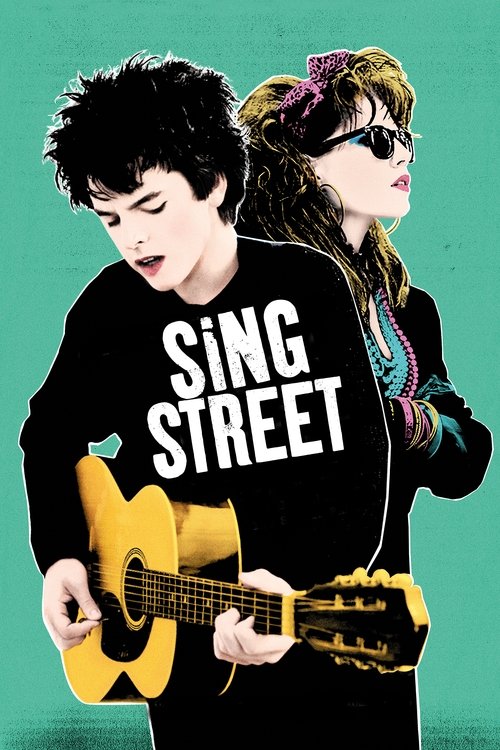
Sing Street
A coming-of-age dramedy that pulses with the vibrant, rebellious heartbeat of 80s synth-pop, painting a happy-sad portrait of first love found within the grey streets of Dublin.
Sing Street

Sing Street

"Boy meets girl. Girl unimpressed. Boy starts band."

11 March 2016 Ireland 105 min ⭐ 7.9 (2,383)
Director: John Carney
Cast: Ferdia Walsh-Peelo, Lucy Boynton, Jack Reynor, Ben Carolan, Mark McKenna
Drama Comedy Romance Music
The Power of Music as Escape and Self-Expression Brotherhood and Mentorship The Pursuit of Dreams Amidst Hardship First Love and Identity Formation
Budget: $4,000,000
Box Office: $13,624,522

Overview

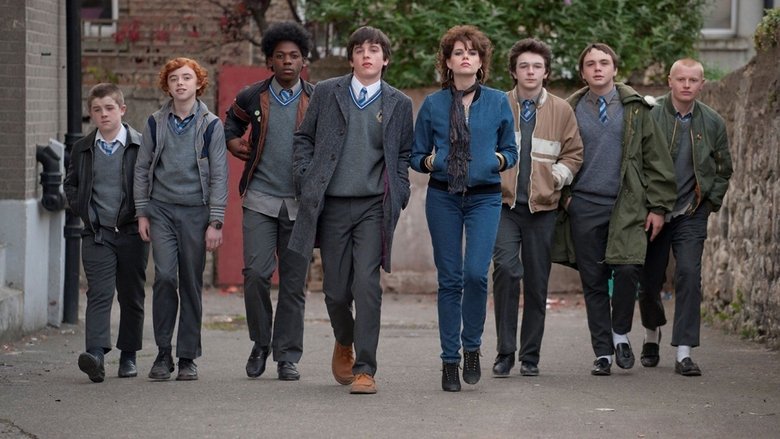
Set in 1980s Dublin, "Sing Street" follows 15-year-old Conor Lalor (Ferdia Walsh-Peelo), who is forced to transfer from his comfortable private school to the rough inner-city Synge Street Christian Brothers School when his parents' marriage and finances crumble. To escape his strained family life and impress the enigmatic aspiring model, Raphina (Lucy Boynton), Conor spontaneously decides to form a band.

With the help of his new friend Darren (Ben Carolan) and the multi-talented Eamon (Mark McKenna), Conor assembles a group of misfit schoolmates. Guided by his wise, music-obsessed older brother Brendan (Jack Reynor), Conor, now calling himself "Cosmo," navigates the worlds of songwriting, outlandish fashion, and amateur music videos. The band, named "Sing Street," becomes Conor's vehicle for self-expression, allowing him to process his feelings about his family, his frustrations with authority, and his burgeoning love for Raphina, all while chasing the dream of escaping to a more hopeful future in London.

Core Meaning

The core meaning of "Sing Street" revolves around the transformative power of art as a means of escape and self-discovery. Director John Carney explores how creativity, specifically music, can provide a vital outlet for navigating the pain and confusion of adolescence, family turmoil, and societal hardship. The film posits that creating art is not just about gaining fame or impressing someone, but is a fundamental act of rebellion and identity formation. It carries a deeply optimistic message that even in bleak circumstances, like the recession-hit Dublin of the 1980s, one can forge a new identity and a hopeful future through passion, friendship, and the courage to take a risk. The concept of being "happy-sad" is central, suggesting that true art and life involve embracing both joy and melancholy.

Thematic DNA

The Power of Music as Escape and Self-Expression 35%
Brotherhood and Mentorship 30%
The Pursuit of Dreams Amidst Hardship 20%
First Love and Identity Formation 15%

The Power of Music as Escape and Self-Expression

Music is the central force in "Sing Street," serving as both a refuge and a tool for growth. For Conor, forming the band is initially a ploy to impress Raphina, but it quickly becomes his primary way of coping with his parents' constant fighting and the oppressive environment of his new school. The process of writing songs allows him to articulate his frustrations and joys. The band's musical style evolves along with Conor's identity, mirroring his journey from covering bands like Duran Duran to finding his own unique voice. Music literally drowns out the sounds of his parents arguing and provides a constructive channel for his teenage angst and rebellion.

Brotherhood and Mentorship

The relationship between Conor and his older brother Brendan is the emotional core of the film. Brendan, a college dropout who feels trapped at home, acts as Conor's musical and spiritual guide. He introduces Conor to influential bands like The Cure and The Jam, teaching him that rock and roll is about attitude and risk. Brendan lives vicariously through Conor's successes, pushing him to be original and pursue the dreams he himself abandoned. His poignant line, "Once, I was a fucking jet engine!" reveals his own pain but also underscores his selfless desire for his younger brother to succeed and escape.

The Pursuit of Dreams Amidst Hardship

Set against the backdrop of Ireland's 1980s economic recession, where mass emigration to London was common, the film is deeply concerned with the theme of escape. Characters like Raphina and the band members all harbor dreams of leaving Dublin for a better life. The band itself becomes a symbol of this hope—a vehicle that could potentially carry them away from their "shithole" town. The film champions a youthful, perhaps naive, optimism, suggesting that one must be bold enough—to "drive it like you stole it"—to seize opportunities and create their own future, even when it seems impossible.

First Love and Identity Formation

Conor's relationship with Raphina is the catalyst for his entire artistic journey. While she initially appears as the cool, unattainable muse, the film reveals her own vulnerabilities and complexities. Their romance is intertwined with their individual processes of self-discovery. Conor changes his musical and fashion style to impress her, but in doing so, he experiments with different identities and ultimately finds his own. Raphina, in turn, is inspired by Conor's earnest passion to believe in her own dreams again. Their relationship embodies the film's "happy-sad" philosophy—it's filled with both idealized romance and real-world heartbreak.

Character Analysis

Conor "Cosmo" Lawlor

Ferdia Walsh-Peelo

Archetype: The Hero / The Ingénu
Key Trait: Adaptable Creativity

Motivation

Initially, his motivation is simple: to get the attention of Raphina. This quickly evolves into a deeper need for self-expression and an escape from the oppressive realities of his home and school life. Ultimately, he is motivated by a desire to create a new life for himself and Raphina, fueled by love and artistic ambition.

Character Arc

Conor begins as a shy, sensitive boy trying to cope with his family's collapse. The need to impress Raphina pushes him out of his comfort zone, and through the process of creating a band, he transforms into the confident and expressive "Cosmo." He learns to stand up to bullies and authority figures, channels his personal pain into his art, and ultimately becomes courageous enough to take a massive risk for his future. His journey is one of finding his voice, both literally and figuratively.

Raphina

Lucy Boynton

Archetype: The Muse / The Love Interest
Key Trait: Aspiring Idealist

Motivation

Her primary motivation is to escape her difficult life in Dublin and become a successful model in London. She is drawn to Conor's genuine passion and creativity, which offers her a more hopeful and authentic path towards that dream than her unreliable older boyfriend.

Character Arc

Raphina is introduced as a mysterious, über-cool aspiring model who appears worldly and confident. Her arc involves the gradual peeling away of this protective facade to reveal a vulnerable young woman with her own troubled family background and shattered dreams. Initially the object of Conor's affection, she becomes his collaborator and is inspired by his optimism to regain hope in her own aspirations, moving from a passive muse to an active participant in their shared dream of escape.

Brendan Lawlor

Jack Reynor

Archetype: The Mentor / The Tragic Hero
Key Trait: Wise Resignation

Motivation

Brendan is motivated by a fierce love for his younger brother and a desire to see him succeed where he failed. He is also driven by a deep-seated frustration with his own inaction and the limitations of their life in Dublin. He wants Conor to break free from the patterns of failure that have defined their family.

Character Arc

Brendan is a college dropout who appears to be a cynical stoner, but is revealed to be the film's philosophical and emotional anchor. He has a deep love and knowledge of music, which he uses to mentor Conor. His arc is largely internal and tragic; he sees his own failed potential but channels his wisdom and frustration into ensuring Conor does not make the same mistakes. His final act of helping Conor and Raphina escape is a moment of profound, selfless love, allowing him to vicariously achieve the freedom he couldn't find for himself.

Eamon

Mark McKenna

Archetype: The Sidekick / The Creator
Key Trait: Musical Prodigy

Motivation

Eamon's motivation is simply the love of playing music. While he shares the general desire to escape Dublin, his primary drive is the creative process itself. He is the technical and musical foundation upon which Conor's lyrical ambitions are built.

Character Arc

Eamon is the quiet, multi-talented musical engine of Sing Street. He can play every instrument and is able to translate Conor's lyrical ideas into fully-formed songs. His arc is subtle; he starts as a reserved boy with a strange love for rabbits and grows into a confident musician and loyal friend. He represents the pure, unadulterated joy of making music, separate from the romantic or rebellious motivations of Conor.

Symbols & Motifs

The Changing Fashion and Musical Styles

Meaning:

Symbolizes Conor's journey of self-discovery and artistic evolution. As Brendan introduces him to new bands, Conor's appearance and the band's musical genre shift dramatically, from Duran Duran-inspired New Romanticism to the melancholic cool of The Cure. This isn't just imitation; it's Conor trying on different personas to see which one fits, a visual representation of the trial-and-error process of finding one's own identity.

Context:

This is seen throughout the film. After watching a Duran Duran video, the band appears in their first music video with flamboyant makeup and clothes. Later, inspired by The Cure, Conor dyes his hair and adopts a more somber look, leading to the song "A Beautiful Sea." Each change prompts a reaction from his family, his school, and Raphina, marking a new stage in his development.

The Music Videos

Meaning:

The amateur music videos represent the creation of a fantasy world—a reality that the characters can control and perfect, in stark contrast to their chaotic real lives. They are spaces where Conor can be the hero, Raphina can be the star model, and their drab Dublin surroundings can be transformed into an epic backdrop. They embody the film's theme of art as a means of escapism and wish fulfillment.

Context:

The band shoots several music videos, starting with "The Riddle of the Model" in a back alley. The most elaborate is the fantasy sequence for "Drive It Like You Stole It," which reimagines the school prom as a 1950s American dreamscape, complete with their families reconciled and their enemies neutralized.

The Boat to London

Meaning:

The small motorboat represents the ultimate leap of faith and the tangible embodiment of the dream of escape. It is a risky, uncertain vessel, symbolizing the precariousness of their future. Sailing into the rough Irish Sea is a metaphor for leaving the 'jet stream' of others and navigating one's own dangerous but liberating path. It is the culmination of every hope and song expressed in the film.

Context:

In the final scene, after their triumphant school gig, Conor and Raphina convince Brendan to drive them to the coast. They take Conor's grandfather's boat and head towards London, following the ferry through a storm. The ending is ambiguous, leaving the audience to wonder if this is reality or another fantasy.

Memorable Quotes

Rock and Roll is a risk. You risk being ridiculed.

— Brendan

Context:

Brendan says this to Conor early in the film while critiquing his attempts at songwriting. He is pushing Conor to move beyond safe imitation and to embrace a more authentic, daring artistic identity.

Meaning:

This is Brendan's core philosophy, which he imparts to Conor. It encapsulates the film's central idea that creating art requires vulnerability and courage. It's not about technical perfection but about having the guts to put yourself out there, whether in music or in life.

Your problem is that you're not happy being sad. But that's what love is, Cosmo. Happy-sad.

— Raphina

Context:

Raphina says this to Conor as they sit by the sea, discussing her complicated feelings and troubled past. It's a moment of profound emotional honesty that deepens their connection and Conor's understanding of the world.

Meaning:

Raphina articulates the film's emotional thesis. The term "happy-sad" defines the bittersweet nature of life, love, and art. It suggests that true emotional depth comes from embracing melancholy and heartbreak alongside joy, a concept that influences Conor's songwriting, particularly his turn towards the style of The Cure.

You're gonna use somebody else's art to get her? Are you kidding?

— Brendan

Context:

Brendan says this after Conor and the band play a cover of a-ha's "Take On Me." He criticizes Conor for relying on existing music instead of creating something personal and new to win Raphina's affection.

Meaning:

This quote is a direct challenge from Brendan for Conor to be original. It highlights the theme of artistic integrity and pushes Conor to stop covering other bands' songs and write his own music to authentically express his feelings for Raphina.

You just moved in my jetstream. And people laugh at me, Conor. The stoner, the college dropout. And they praise you, which is fine! But once, I was a fucking jet engine!

— Brendan

Context:

This emotional outburst occurs during a fight between the brothers. Brendan expresses his jealousy and sorrow that Conor is living the life he once dreamed of, making his sacrifices for Conor's success all the more poignant.

Meaning:

A raw, heartbreaking confession that reveals Brendan's deep-seated pain and frustration over his own lost potential. It reframes his mentorship of Conor not just as brotherly guidance, but as a transfer of his own extinguished ambitions. It's a pivotal moment that adds immense emotional weight to their relationship.

Philosophical Questions

Is art primarily a form of escapism or a tool for confronting reality?

The film explores this question through Conor's songwriting. Initially, he forms the band to escape the grim reality of his parents' fighting and his oppressive school. Music is a fantasy world. However, as he develops as an artist, he begins to use his music to directly confront his problems. He writes love songs to process his feelings for Raphina, and his final song, "Brown Shoes," is a direct, public act of rebellion against his tormentor, Brother Baxter. The film suggests that art begins as an escape but matures into a powerful way to engage with and change one's reality.

What is the relationship between authenticity and imitation in forming an identity?

Conor's journey to find his own "look" and "sound" is a series of imitations. He copies Duran Duran, The Cure, and other 80s bands, guided by his brother Brendan. The film doesn't condemn this imitation but portrays it as a necessary and natural phase of artistic and personal development. By trying on different personas, Conor learns what feels right and what doesn't, eventually synthesizing his influences into something unique to him. The film posits that authenticity isn't born in a vacuum but is discovered through the process of engaging with and emulating the art that inspires us.

Does true success lie in the achievement of a goal or in the courage to pursue it?

The ambiguous ending leaves the audience unsure if Conor and Raphina ever "make it" in London. However, the emotional climax of the film is not a record deal or a sold-out concert, but the act of getting into the boat. Brendan cheers for them not because they've succeeded, but because they've taken the risk he never could. The film suggests that the true victory lies in the rebellious, optimistic act of chasing a dream, regardless of the ultimate outcome.

Alternative Interpretations

The primary area for alternative interpretation in "Sing Street" is its ending. The final scene, where Conor and Raphina brave the stormy Irish Sea in a small boat headed for London, is deliberately stylized to look like a music video. This has led to two main readings:

1. The Literal, Optimistic Reading: In this interpretation, the events happen as shown. It is a triumphant, albeit reckless, leap of faith. Brendan's emotional support and their own determination see them through. The ending is the culmination of the film's 'follow your dreams' ethos—a heartfelt, romantic conclusion where the young heroes escape their troubled lives to start anew.

2. The Fantastical/Metaphorical Reading: Many viewers, and indeed the director John Carney himself, see the ending as ambiguous and potentially a fantasy sequence. Carney stated he wanted the audience to "wonder where the reality ends and the pop video begins." In this view, the journey might be a symbolic representation of Conor's hopes, an idealized fantasy in his head, or a music video he imagines. This interpretation aligns with the film's other fantasy sequences (like the "Drive It Like You Stole It" video) and adds a layer of poignant, "happy-sad" uncertainty. It questions whether such a perfect escape is possible, leaving their actual fate unknown but emphasizing that the courage to dream is what truly matters.

Cultural Impact

"Sing Street" was released to widespread critical acclaim, celebrated as a heartfelt and uplifting tribute to the 1980s. Its creation was rooted in the historical context of the 1980s recession in Ireland, a period of economic hardship and mass emigration that serves as the film's bleak backdrop and the primary motivation for its characters' dreams of escape. The film taps into a universal coming-of-age narrative, but filters it through the specific lens of Dublin's youth culture at the time, heavily influenced by the rise of MTV and British New Wave and synth-pop bands like The Cure, Duran Duran, and The Jam.

While not a blockbuster, the film had a significant cultural resonance, praised for its authenticity, charm, and killer original soundtrack. It reaffirmed director John Carney's reputation, alongside "Once" and "Begin Again," as a master of the modern musical, one where music is organically integrated into the narrative. The film received a Golden Globe nomination for Best Motion Picture – Musical or Comedy. For many critics and audiences, it was a joyous counterpoint to more cynical films, celebrated for its earnest optimism and belief in the redemptive power of art. Like Carney's previous film "Once," "Sing Street" was also adapted into a stage musical, which premiered in 2019, further cementing its place in the cultural landscape.

Audience Reception

"Sing Street" was met with overwhelmingly positive reviews from audiences. It holds high approval ratings on platforms like Rotten Tomatoes and IMDb. Viewers widely praised the film for its charm, warmth, and infectious optimism. The original soundtrack was a standout element, with songs like "Drive It Like You Stole It," "A Beautiful Sea," and "Up" being frequently cited as highlights. The performances of the young cast, particularly Ferdia Walsh-Peelo and Jack Reynor, were lauded for their authenticity and emotional depth. The film's heartfelt depiction of brotherhood and its nostalgic yet sincere celebration of 1980s music and culture resonated strongly with many. The main points of minor criticism tended to focus on the plot's occasional predictability and the feeling that some challenges, like the band's rapid musical proficiency, were resolved a bit too easily. However, most viewers felt that the film's sheer joy and emotional sincerity far outweighed any narrative conventionality.

Interesting Facts

  • The film is semi-autobiographical, based on director John Carney's own experiences attending Synge Street Christian Brothers School in Dublin in the 1980s and forming a band.
  • Ferdia Walsh-Peelo, who plays Conor, and the other young actors who made up the band were mostly unknown musicians with little to no prior acting experience, a deliberate choice by Carney to ensure authenticity.
  • The character of Eamon, the multi-instrumentalist with a love for rabbits, was based on Carney's real-life friend, also named Eamon, who was the bassist in his band and genuinely loved rabbits.
  • Actor Mark McKenna's (Eamon) real-life father is a musician named Eamon.
  • The actors who played the band members could all play their own instruments.
  • Actors Aidan Gillen and Maria Doyle Kennedy, who play Conor's parents, previously played brother and sister in the TV series "Queer as Folk" (1999).
  • The school's tyrannical headmaster, Brother Baxter, was based on a real Christian Brother from Carney's school, whom he described as a "vicious thug."
  • The original songs for the film were co-written by director John Carney and Gary Clark, the frontman of 1980s Scottish band Danny Wilson.

Easter Eggs

The fantasy music video for the song "Drive It Like You Stole It" is visually and thematically inspired by the "Enchantment Under the Sea" dance scene from the 1985 film "Back to the Future."

This is a direct homage to a quintessential 80s film. It reflects the characters' love for the era's pop culture and serves as a form of ultimate wish-fulfillment, where Conor imagines a perfect, Americanized high school dance where all his problems are magically resolved, much like in a Hollywood movie.

During a scene in Raphina's room, a slow piano version of a-ha's "Take On Me" can be heard in the background.

This is a subtle callback to the first song Conor ever sang to Raphina when they met. Its inclusion as an instrumental piece underscores its significance to their relationship, transforming it from a simple cover song into their personal romantic theme.

⚠️ Spoiler Analysis

Click to reveal detailed analysis with spoilers

Frequently Asked Questions

Explore More About This Movie

Dive deeper into specific aspects of the movie with our detailed analysis pages

Comments (0)

Leave a comment

No comments yet. Be the first to share your thoughts!