
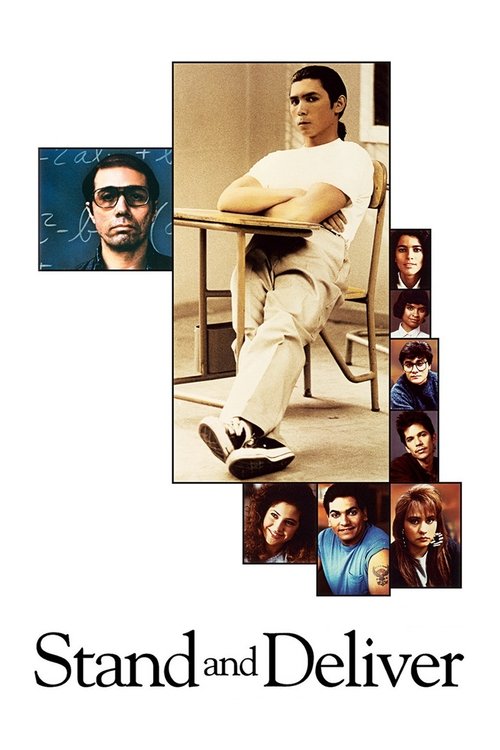
"At a tough school, someone had to take a stand...and someone did. Together, one teacher and one class proved to America they could..."
Stand and Deliver - Ending Explained
⚠️ Spoiler Analysis
The film's climax occurs after the 18 students take the grueling AP Calculus exam and all successfully pass, an unprecedented achievement for Garfield High. However, the triumph is short-lived when the Educational Testing Service (ETS) launches an investigation. The ETS flags the tests because 14 of the students made the exact same highly unusual mistake on a specific calculus problem. Escalante passionately defends his students, arguing that the accusation is rooted in systemic racism—asserting that their scores wouldn't be questioned if they had non-Hispanic surnames and didn't come from a barrio school. He explains that the identical error occurred because they all learned the same flawed method directly from him.
Despite Escalante's defense, the students' scores are invalidated, and they are given only one day to prepare for a harder, alternate version of the exam under intense scrutiny. In a powerful testament to their true mastery of the subject, all the students retake the exam and pass it again. The ending reveals that their success was not a fluke but the result of hard work, exposing the implicit bias of the testing board. The closing text informs the audience that Garfield's AP program continued to grow exponentially in the years following, cementing Escalante's enduring legacy.
Alternative Interpretations
While widely viewed as a straightforward inspirational tale, Stand and Deliver has been the subject of critical academic analysis offering alternative interpretations.
- Respectability Politics and Assimilation: Some critics argue the film subtly promotes assimilation, suggesting that students like Angel must shed their ethnic markers (like gang attire and slang) and adopt mainstream, middle-class aesthetics to be deemed successful and acceptable by society.
- The Savior Trope Recontextualized: Although the film utilizes the familiar savior teacher narrative, Escalante's shared cultural background with his students complicates this trope. It can be read not as an outsider rescuing the marginalized, but as a community lifting itself up from within through shared heritage.
- Systemic Gatekeeping: The Educational Testing Service (ETS) is often viewed as a mere bureaucratic obstacle in the plot. However, a deeper reading posits the ETS as a direct manifestation of structural racism, purposefully designed to police academic boundaries and maintain the socioeconomic status quo against minority advancement.