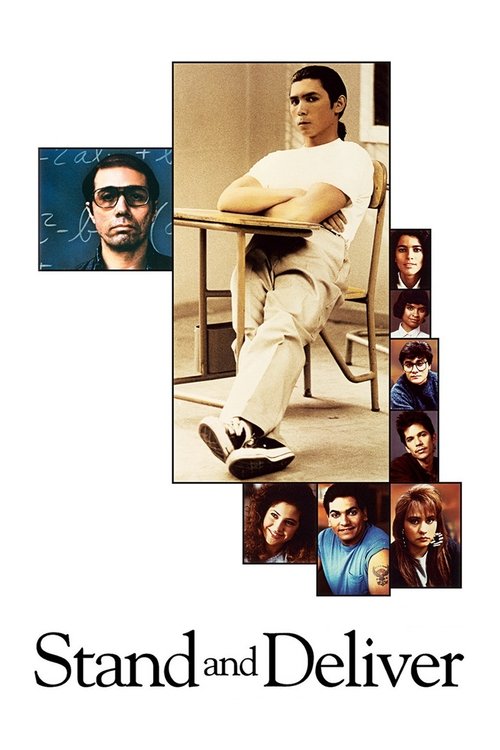
Stand and Deliver
An uplifting biographical drama where the sterile chalk dust of a neglected classroom transforms into stardust. Through grit and unwavering belief, a fiercely dedicated teacher shatters systemic ceilings, proving that unyielding desire is the ultimate mathematical constant.
Stand and Deliver

Stand and Deliver

"At a tough school, someone had to take a stand...and someone did. Together, one teacher and one class proved to America they could..."

11 March 1988 United States of America 103 min ⭐ 7.6 (428)
Director: Ramón Menéndez
Cast: Edward James Olmos, Lou Diamond Phillips, Rosanna DeSoto, Andy Garcia, Estelle Harris
Drama
The Power of Ganas and Expectations Overcoming Systemic Prejudice Cultural Pride and Identity Individualism vs. Community
Box Office: $13,994,920

Overview

In the early 1980s, Jaime Escalante leaves a comfortable career to teach at James A. Garfield High School in East Los Angeles. Originally hired to teach computer science, he discovers the school lacks computers and is reassigned to teach basic math to a classroom of working-class, gang-affiliated Latino students. Escalante quickly realizes that the educational administration has entirely given up on these teenagers, expecting nothing but failure and eventual dropout.

Refusing to capitulate to the school's low standards, Escalante introduces the concept of ganas (desire) and pushes his students to master Advanced Placement Calculus. Through unorthodox teaching methods, cultural humor, and relentless dedication, he challenges the students to rise above the socioeconomic barriers, gang violence, and family pressures that threaten to define their futures. The students commit to grueling summer sessions and early morning classes, gradually transforming into brilliant mathematicians.

When the students finally take the AP exam, their unprecedented success attracts the suspicion of the Educational Testing Service. Accused of cheating due to their backgrounds and identical test errors, the students and their mentor are thrust into a battle against systemic prejudice. They must fight to prove that their triumph is the result of genuine brilliance and hard work, rather than deceit.


Core Meaning

The core message of Stand and Deliver revolves around the transformative power of expectations and the concept of ganas (desire). Director Ramón Menéndez aimed to dismantle the systemic racism and classism ingrained in the American educational system, illustrating that academic genius is not restricted by zip code, ethnicity, or socioeconomic background. The film carries the empowering message that when marginalized youth are given genuine support, connected to their cultural heritage, and held to high standards, they can overcome seemingly insurmountable institutional barriers.

Thematic DNA

The Power of Ganas and Expectations 35%
Overcoming Systemic Prejudice 30%
Cultural Pride and Identity 20%
Individualism vs. Community 15%

The Power of Ganas and Expectations

Escalante's central philosophy is that students will rise to the level of expectations set for them. By demanding excellence and instilling ganas, he transforms apathetic teenagers into calculus scholars, proving that motivation outweighs innate privilege.

Overcoming Systemic Prejudice

The film highlights institutional racism, particularly through the Educational Testing Service's refusal to believe that inner-city Hispanic students could pass a rigorous AP exam without cheating, reflecting the inherent biases of the academic establishment.

Cultural Pride and Identity

Escalante consistently connects mathematical concepts to the students' heritage, such as referencing the Mayans' invention of the zero, to foster a sense of inherent cultural intelligence and pride.

Individualism vs. Community

The students constantly navigate the tension between their individual academic ambitions and the communal pull of gang affiliations, family duties (like working in the family restaurant), and the socioeconomic realities of East Los Angeles.

Character Analysis

Jaime Escalante

Edward James Olmos

Archetype: Mentor
Key Trait: Relentless determination and sarcastic humor

Motivation

To prove that his Hispanic, inner-city students are just as capable of academic greatness as any affluent students, provided they have ganas.

Character Arc

Escalante evolves from an overwhelmed new teacher into a fiercely dedicated father figure who risks his own health and personal life to ensure his students' success against all odds.

Angel Guzman

Lou Diamond Phillips

Archetype: Antihero to Hero
Key Trait: Secretly brilliant but heavily guarded

Motivation

To escape the violent gang life and secure a future without losing face or respect among his street-tough peers.

Character Arc

Angel transitions from a defiant gang member who hides his intelligence to a dedicated calculus student seeking a viable way out of the barrio.

Dr. Ramirez

Andy Garcia

Archetype: Institutional Antagonist
Key Trait: Bureaucratic and implicitly biased

Motivation

To ensure the integrity of the Advanced Placement exams and investigate statistical anomalies.

Character Arc

Represents the bureaucratic doubt of the educational system. Though initially skeptical and accusatory, he is forced to accept the students' genuine success after they pass the retest.

Fabiola Escalante

Rosanna DeSoto

Archetype: Supporter
Key Trait: Patient and fiercely supportive

Motivation

To protect her family and ensure her husband survives the immense stress he places upon himself.

Character Arc

Fabiola remains a steady presence throughout the film, grounding Jaime as his obsession with his students' success begins to take a severe toll on his physical health.

Symbols & Motifs

The Apple and the Meat Cleaver

Meaning:

This combination symbolizes the disruption of traditional, sterile educational methods. It represents Escalante's willingness to use shock value and street-level visuals to reach his students.

Context:

Used in an early scene where Escalante chops an apple with a meat cleaver to dramatically explain fractions to an unruly, inattentive classroom.

Angel's Wardrobe

Meaning:

Angel's clothing is a visual metaphor for his internal transformation, shifting from gang identity to a focus on mainstream academic success.

Context:

Over the course of the film, Angel transitions from wearing a hairnet and gang-affiliated baggy clothing to neatly pressed shirts as he dedicates himself entirely to calculus.

The Concept of Zero

Meaning:

The zero symbolizes the innate intellectual legacy of the Latino students, challenging the idea that advanced mathematics is exclusively a European achievement.

Context:

Escalante shares the historical fact that the Mayans first contemplated the concept of zero, telling his students that math is in their blood.

Memorable Quotes

You're going to work harder here than you've ever worked anywhere else. And the only thing I ask from you is ganas. Desire.

— Jaime Escalante

Context:

Escalante says this while laying down the intense ground rules for his new Advanced Placement Calculus class.

Meaning:

This is the central thesis of the film, establishing that raw drive and motivation are more critical to success than innate talent or socioeconomic privilege.

Students will rise to the level of expectations, Señor Molina.

— Jaime Escalante

Context:

Escalante argues with the school administration, demanding the right to teach AP Calculus despite their belief that the students aren't ready.

Meaning:

Encapsulates the pedagogical philosophy that low standards breed low achievement, while demanding excellence fosters greatness.

You're already geeks, you just don't know it yet.

— Jaime Escalante

Context:

Escalante's witty response to Angel when the student expresses fear that taking calculus will ruin his tough reputation on the streets.

Meaning:

Reframes intelligence and academic focus as a positive trait rather than a social stigma to be feared.

Did you know that neither the Greeks nor the Romans were capable of using the concept of zero? It was your ancestors, the Mayans, who first contemplated the zero.

— Jaime Escalante

Context:

Escalante uses this historical fact early in the semester to capture the students' attention and prove that mathematics is naturally a part of their identity.

Meaning:

A crucial moment of instilling cultural pride, directly connecting the students' ancestral heritage to the subject they are struggling to learn.

Philosophical Questions

Is standardized testing an objective measure of intelligence, or a tool for systemic gatekeeping?

The film challenges the inherent biases of the Educational Testing Service, questioning if institutions are fundamentally designed to doubt the success of marginalized groups and protect the privileges of the elite.

How much of an individual's success is determined by the expectations placed upon them?

Through the concept of ganas and Escalante's belief that 'students will rise to the level of expectations', the film explores the powerful psychological impact of self-fulfilling prophecies in education and society.

Does achieving success in a mainstream system require the sacrifice of one's cultural identity?

The film navigates this through characters like Angel, exploring whether adopting the behaviors and dress of the dominant culture is a necessary compromise for upward mobility, or if one can succeed while retaining their roots.

Alternative Interpretations

While widely viewed as a straightforward inspirational tale, Stand and Deliver has been the subject of critical academic analysis offering alternative interpretations.

  • Respectability Politics and Assimilation: Some critics argue the film subtly promotes assimilation, suggesting that students like Angel must shed their ethnic markers (like gang attire and slang) and adopt mainstream, middle-class aesthetics to be deemed successful and acceptable by society.
  • The Savior Trope Recontextualized: Although the film utilizes the familiar savior teacher narrative, Escalante's shared cultural background with his students complicates this trope. It can be read not as an outsider rescuing the marginalized, but as a community lifting itself up from within through shared heritage.
  • Systemic Gatekeeping: The Educational Testing Service (ETS) is often viewed as a mere bureaucratic obstacle in the plot. However, a deeper reading posits the ETS as a direct manifestation of structural racism, purposefully designed to police academic boundaries and maintain the socioeconomic status quo against minority advancement.

Cultural Impact

Stand and Deliver profoundly impacted the landscape of educational cinema, effectively popularizing the inspirational teacher subgenre that would later pave the way for films like Dangerous Minds and Freedom Writers. Historically, the film shed a national spotlight on the real-life triumphs at Garfield High School, sparking a nationwide dialogue about the critical need to expand Advanced Placement programs and STEM education in minority and low-income school districts.

Culturally, the film was a watershed moment for Latino representation in Hollywood. Instead of focusing solely on gang violence, drug cartels, or poverty, it centered entirely on intellectual triumph, community resilience, and academic excellence. Edward James Olmos's transformative performance cemented Jaime Escalante as an American cultural hero. In 2011, the Library of Congress officially recognized its enduring legacy by selecting the film for preservation in the National Film Registry.

Audience Reception

Stand and Deliver was met with overwhelming acclaim from both audiences and critics, earning an impressive box office return for an independent film and achieving timeless status as an educational classic. Audiences widely praised Edward James Olmos's immersive, Oscar-nominated performance and the deeply inspirational tone of the narrative. The film was celebrated for providing an authentic, empathetic look at working-class Latino life in East Los Angeles during the 1980s.

Main points of criticism generally focused on the film's reliance on standard Hollywood dramatization techniques. Critics noted that compressing years of Escalante's arduous work building the math program into a single academic year made the narrative somewhat formulaic. However, the overarching verdict remains highly positive, with viewers continually moved by its message of resilience, making it a staple in classrooms across America decades after its release.

Interesting Facts

  • The real Jaime Escalante praised the film but stated it was '90% truth, 10% drama', noting that building the calculus program took several years in reality, not just one.
  • Edward James Olmos gained significant weight, thinned his hair, and meticulously studied Escalante to portray him accurately, earning a Best Actor Academy Award nomination for his performance.
  • The film was selected for preservation in the United States National Film Registry by the Library of Congress in 2011 for being culturally, historically, or aesthetically significant.
  • Instead of a mild heart attack as depicted in the film for dramatic effect, the real Jaime Escalante actually suffered from a severe gallbladder inflammation during this intense period of teaching.
  • The movie's title was changed to 'Stand and Deliver' by Warner Bros. after acquiring distribution rights, and they added the popular Mr. Mister song of the same name to the end credits.

Easter Eggs

Genuine 1982 AP Calculus Problems

The math equations written on the chalkboards during the crucial testing and studying scenes are the actual problems from the 1982 AP exam, adding a layer of historical authenticity for keen-eyed mathematicians.

License Plate '2+2=5'

Escalante's license plate serves as a visual metaphor for his teaching philosophy: challenging limits, breaking standard mathematical expectations, and thinking outside the conventional box.

Pi Symbol with a Sombrero

A small chalkboard doodle in the background shows a Pi symbol wearing a sombrero. This is a subtle visual nod to Escalante's real-life fusion of high-level mathematics with Hispanic cultural humor to reach his students.

⚠️ Spoiler Analysis

Click to reveal detailed analysis with spoilers

Frequently Asked Questions

Explore More About This Movie

Dive deeper into specific aspects of the movie with our detailed analysis pages

Comments (0)

Leave a comment

No comments yet. Be the first to share your thoughts!