
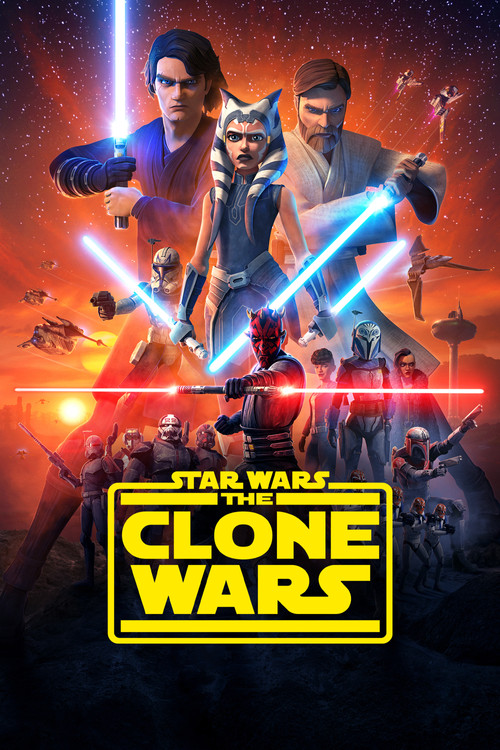
Star Wars: The Clone Wars - Symbolism & Philosophy
Symbols & Motifs
Clone Trooper Helmets
The helmets symbolize the tension between uniformity and individuality. Initially, they represent the clones' role as an anonymous, mass-produced army. As the series progresses, troopers customize their helmets with unique markings and colors, transforming them into expressions of personal identity, unit pride, and loyalty—such as the 332nd Company painting their helmets in honor of Ahsoka Tano. The final shot of the series, showing Darth Vader reflected in a discarded helmet, brings the symbol full circle, representing the death of that individuality and the faceless oppression of the new Empire.
Used throughout the entire series. In early seasons, the standard helmets emphasize their role as a uniform army. In later seasons, customized helmets become prevalent, particularly with Captain Rex and his 501st Legion. The symbol's meaning culminates in the final episode, "Victory and Death," where the helmets mark the graves of fallen troopers.
The Darksaber
The Darksaber symbolizes leadership and power within Mandalorian culture. Unlike a Jedi's lightsaber, which is a tool of peace, the Darksaber is a symbol of authority that must be won through combat. Its possession grants the wielder the right to rule Mandalore. It represents the turbulent political landscape of the planet, caught between its pacifist government and the warrior traditions of groups like Death Watch.
The Darksaber is introduced in Season 2 in the possession of Pre Vizsla, the leader of Death Watch. It plays a key role in the Mandalorian story arcs, eventually being claimed by Darth Maul in Season 5 when he defeats Vizsla, using it to seize control of the planet. Its journey continues into Star Wars Rebels and The Mandalorian.
The Mortis Monolith
The Mortis Monolith, a giant crystalline structure, symbolizes the mysteries of the Force and the concept of destiny versus free will. It is the conduit to a mystical realm where the cosmic Force is embodied by three powerful beings: the Father, the Son, and the Daughter. The events on Mortis serve as a microcosm of the entire Skywalker saga, forcing Anakin to confront his destiny as the Chosen One and the darkness that lies within him.
This symbol is central to the "Mortis Arc" in Season 3 (Episodes 15-17). Anakin, Obi-Wan, and Ahsoka are drawn into the monolith, where they undergo trials that test their connection to the Force and foreshadow Anakin's tragic future.
Philosophical Questions
Are we defined by our origins or by our choices?
This question is the central philosophical conflict for the clone troopers. Created in a lab for the sole purpose of fighting and dying, they are initially seen as identical and disposable. However, through characters like Rex, Fives, and Echo, the series argues that one's creation does not dictate one's destiny. The clones make choices to be individuals—giving themselves names, adopting unique beliefs, and forming deep bonds of brotherhood. The tragic arc of Fives, who discovers the inhibitor chip conspiracy and dies trying to expose it, is the ultimate expression of this theme: he chooses to fight for his and his brothers' free will, proving that he is more than just his programming, even if the galaxy refuses to see it.
Can one uphold pacifist ideals while actively participating in war?
The series constantly places the Jedi in this philosophical bind. As keepers of the peace, their core philosophy is one of negotiation and defense, yet the war forces them into the role of generals leading an army. This contradiction is explored through the actions of many Jedi. Obi-Wan Kenobi clings to diplomacy wherever possible, while others, like Pong Krell, embrace the violence and lose their way. The entire conflict is shown to be a corrupting influence on the Jedi Order, forcing them to compromise their principles to achieve victory, a compromise that ultimately weakens them from within and makes them vulnerable to the Sith's machinations.
What is the nature of true loyalty?
The Clone Wars examines loyalty on multiple levels. Is it loyalty to an institution (the Jedi Order, the Republic), to an ideal, or to individuals? Ahsoka Tano's journey is a profound exploration of this question. Her loyalty to the Jedi Order is shattered when they betray her trust. She ultimately chooses loyalty to her own moral code and to the people she cares for, like Captain Rex. Similarly, Rex's arc shows him shifting his loyalty from the abstract concept of the Republic to the tangible well-being of his brothers and his Jedi friends. The series suggests that true loyalty is not blind obedience, but a conscious choice rooted in trust and personal connection.
Core Meaning
The core meaning of Star Wars: The Clone Wars is an exploration of how war corrupts ideals and forges identities, often with tragic consequences. The series, created by George Lucas, serves as a bridge between the prequel films, aiming to show that the fall of a democracy is not a sudden event but a slow erosion of principles. It posits that even in a conflict with seemingly clear heroes and villains, the lines of morality become blurred, and the very act of fighting can compromise the values one seeks to defend. The show deeply examines the inherent tragedy of the Jedi's position as generals in an army of manufactured soldiers, forcing them to sacrifice their pacifist philosophies. Ultimately, it delivers a powerful message about the loss of innocence—for its characters like Ahsoka Tano, for the clone troopers who discover their individuality only to have it stripped away, and for the galaxy itself as it slides from a hopeful Republic into a tyrannical Empire.