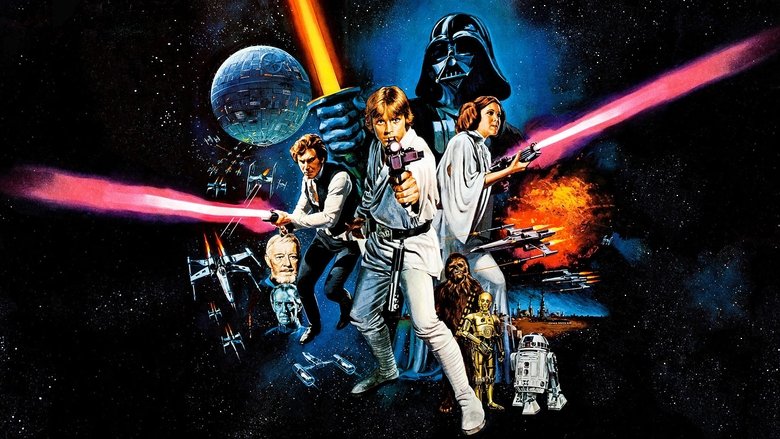
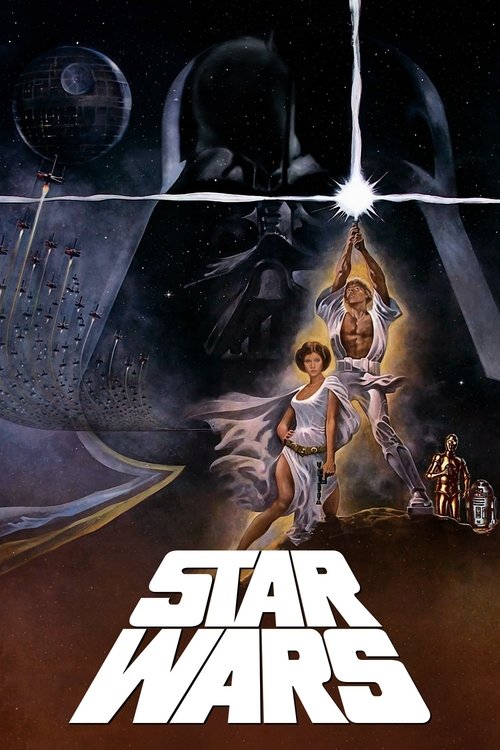
Star Wars
A cosmic fairy tale of swashbuckling adventure and mythic destiny, igniting a sense of hopeful rebellion against the vast, sterile darkness of technological tyranny.
Star Wars
Star Wars

"A long time ago in a galaxy far, far away..."

25 May 1977 United States of America 121 min ⭐ 8.2 (21,533)
Director: George Lucas
Cast: Mark Hamill, Harrison Ford, Carrie Fisher, Peter Cushing, Alec Guinness
Action Adventure Science Fiction
The Hero's Journey Good vs. Evil Technology vs. Nature/Spirituality Hope and Rebellion
Budget: $11,000,000
Box Office: $775,398,007

Star Wars - Ending Explained

⚠️ Spoiler Analysis

The overarching plot of "Star Wars" follows the Rebels' desperate attempt to destroy the Empire's Death Star. After Princess Leia is captured, the droids R2-D2 and C-3PO escape with the station's blueprints to Tatooine. They lead Luke Skywalker to Obi-Wan Kenobi, who reveals Luke's Jedi heritage and gives him his father's lightsaber. After discovering his family has been killed by Imperial stormtroopers, Luke agrees to join Obi-Wan's mission.

They hire Han Solo and Chewbacca, but upon arriving at their destination of Alderaan, they find the planet has been destroyed by the Death Star. They are captured and brought aboard the battle station, where they mount a rescue of Princess Leia. The mission's key turning point is Obi-Wan Kenobi's sacrifice during a duel with his former apprentice, Darth Vader. Obi-Wan allows Vader to strike him down, vanishing and becoming one with the Force. This act allows the heroes to escape.

The climax is the Battle of Yavin, where Rebel X-wing fighters attack the Death Star. The plans reveal a single, tiny vulnerability: a thermal exhaust port. One by one, the Rebel pilots are shot down by Imperial TIE fighters, led by Vader himself. Just as Vader is about to destroy Luke's ship, Han Solo returns unexpectedly in the Millennium Falcon, clearing the way for Luke. Hearing Obi-Wan's disembodied voice urging him to "Use the Force," Luke turns off his targeting computer and takes a one-in-a-million shot, firing his proton torpedoes into the port. The shot triggers a chain reaction that completely destroys the Death Star. The film concludes with Luke and Han being awarded medals by Leia for their heroism, securing a monumental victory for the Rebellion.

Alternative Interpretations

While on the surface a straightforward space fantasy, "Star Wars" has been subject to numerous alternative interpretations. One of the most prominent is a political allegory. Some critics and viewers in the 1970s saw the conflict between the small, resourceful Rebel Alliance and the large, technologically superior Galactic Empire as a parallel to the Vietnam War, with the Rebels representing the Viet Cong and the Empire representing the United States. George Lucas himself has acknowledged this influence in his notes. Others have interpreted the Empire as a stand-in for various totalitarian regimes, including Nazi Germany (reflected in the stormtrooper uniforms and imperial officer aesthetics) or even the Nixon administration.

Another significant interpretation is mythological and religious. George Lucas was heavily influenced by the work of mythologist Joseph Campbell, particularly his book "The Hero with a Thousand Faces." The film closely follows Campbell's monomyth structure, which can be seen as an exploration of universal archetypes and psychological development. The Force has also been interpreted in various religious contexts, with some seeing it as an analog for Taoist principles, Buddhist concepts of mindfulness, or a generalized form of pantheism or deism.