
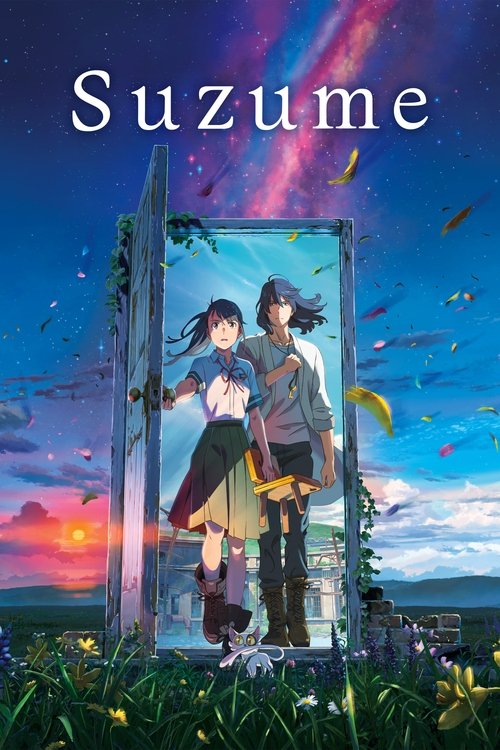
すずめの戸締まり
"On the other side of the door, was time in its entirety."
Suzume - Symbolism & Philosophy
Symbols & Motifs
Doors
The doors symbolize mystical gateways between the world of the living and the "Ever-After," a realm of spirits and memories where time exists simultaneously. They also represent portals to past tragedies and collective trauma. The act of closing them is a metaphor for confronting and processing grief, acknowledging the past to prevent future disasters, and restoring balance.
These doors are found in abandoned, forgotten places across Japan—ruins of schools, amusement parks, and homes—locations filled with the memories of people who are no longer there. Suzume and Souta must find these doors before the destructive "Worm" can escape from the Ever-After and cause earthquakes.
The Three-Legged Chair
The chair, a memento from Suzume's late mother, symbolizes her unresolved grief and the missing piece in her life. Its three legs represent her brokenness and imperfection, yet also her resilience and ability to stand despite her loss. When Souta is transformed into the chair, it becomes a vessel for her past trauma and her present mission, physically linking her journey of healing to her most cherished memory of her mother.
Daijin turns Souta into the chair early in the film. This forces Suzume to literally carry the weight of her past with her on her journey. In the film's emotional climax, Suzume gives the three-legged chair to her younger, grieving self in the Ever-After, symbolizing self-comfort and acceptance.
The Worm
The Worm is a physical manifestation of the immense, destructive energy of nature, specifically representing the power of earthquakes. It is based on the Japanese mythological creature, the Namazu, a giant catfish held down by a god to prevent it from causing earthquakes. It is not inherently evil, but a chaotic natural force that becomes devastating when its connection to the human world is opened through the doors.
The Worm emerges from the doors in abandoned locations and threatens to fall upon Japan, causing massive earthquakes. Suzume and Souta's primary mission is to seal the doors to prevent the Worm from fully emerging and wreaking havoc, as it did during historical events like the 1923 Great Kantō earthquake.
Daijin and Sadaijin (The Cats)
The two cats, Daijin (the small white cat) and Sadaijin (the large black cat), are the keystones—divine beings meant to seal the Worm. According to director Makoto Shinkai, they symbolize nature itself: amoral, unpredictable, and operating outside human concepts of good and evil. Daijin's behavior is childlike and chaotic; it seeks love and affection from Suzume but is indifferent to the destruction it causes. They represent the balance of nature's creative and destructive forces, akin to yin and yang.
Suzume frees Daijin from his role as the western keystone at the beginning of the film. Daijin then follows Suzume across Japan, inadvertently leading her to open doors while also passing his keystone responsibility onto Souta. Sadaijin, the eastern keystone, appears later to help restore balance. In the end, both cats willingly return to their dormant keystone forms to seal the Worm once more.
Butterflies
Butterflies appear frequently throughout the film, often associated with Suzume's dreams and the Ever-After. In Japanese culture, butterflies can symbolize souls, metamorphosis, love, joy, and resilience. In the context of the film, they represent Suzume's connection to the spiritual world and her own personal transformation (metamorphosis) as she confronts her past and grows into a courageous young woman. They are also linked to the spirit of her late mother.
The film opens with a dream sequence of young Suzume in the Ever-After, surrounded by butterflies as a mysterious figure approaches. They reappear at key moments, such as hovering over Suzume's bed, indicating her deep connection to the other realm and the lingering presence of her mother's memory.
Philosophical Questions
What is our responsibility to the memories of abandoned places and forgotten people?
The film explores this question through the ritual of closing doors. Before a door can be locked, Suzume must listen to and acknowledge the everyday lives, joys, and sorrows of the people who once inhabited that space. It suggests a philosophical duty to remember, arguing that the collective memory of humanity is a force that brings peace and stability to the land itself. The film posits that forgetting is not a neutral act, but one that can lead to decay and disaster, making remembrance an active, ongoing responsibility for the living.
How can one find hope and a future after experiencing catastrophic loss?
"Suzume" tackles this question through its protagonist's journey. Having lost her mother in a tsunami, Suzume is trapped in a state of arrested grief. The film proposes that healing is not a passive process, but an active journey—a literal and metaphorical road trip. Hope is found not in erasing the past, but in confronting it. The climax, where adult Suzume comforts her child self with the words, "You will grow up. The light will come, and you will meet wonderful people," serves as the film's core thesis: the future is not a betrayal of the past, but a promise that one can carry loss and still find love and light.
Can humanity truly control or coexist with the overwhelming and amoral forces of nature?
The Worm is depicted not as an evil monster to be vanquished, but as a raw, natural force that is simply part of the world. The "Closers" do not seek to destroy it, but to seal it away, acknowledging that it cannot be eliminated. This reflects a Shinto-influenced worldview where nature is divine, powerful, and operates beyond human morality. The film suggests that humanity's role is not one of dominance over nature, but of respectful stewardship and the performance of rituals (closing the doors) to maintain a fragile balance. It asks us to accept that disasters will happen and that our response should be one of resilience and remembrance rather than a futile quest for total control.
Core Meaning
The core meaning of "Suzume" revolves around the process of confronting and healing from collective and personal trauma, particularly in the context of the 2011 Tōhoku earthquake and tsunami that deeply impacted Japan. Director Makoto Shinkai has stated that the disaster changed his worldview, compelling him to address it directly in his work rather than through metaphor. The film explores how a nation and an individual can process grief and loss. The act of "closing doors" is a powerful metaphor for acknowledging the memories of those who lived in now-abandoned places, paying respects to the past, and finding the strength to move forward.
It emphasizes the importance of human connection, memory, and responsibility. By traveling across Japan and meeting people from different walks of life, Suzume learns that she is not alone in her grief and that kindness can be found even in the face of immense tragedy. The film ultimately carries a message of hope, resilience, and the idea that while disasters are an inevitable part of life, it is the act of remembering, honoring the past, and embracing the future that allows individuals and society to heal and grow.