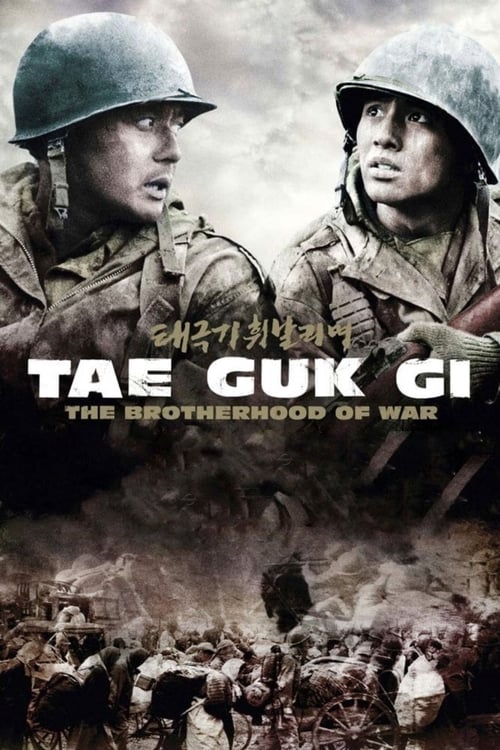
태극기 휘날리며
"One country, one family… divided by war."
Tae Guk Gi: The Brotherhood of War - Symbolism & Philosophy
Symbols & Motifs
The Taegukgi (South Korean Flag)
The flag represents the nation and the ideals for which the soldiers are supposedly fighting. However, as the film progresses, the flag becomes an ironic symbol. The war fought under it tears the nation and the film's central brotherhood apart. The title itself poses the question of what it truly means to fight for one's country when doing so destroys the very fabric of that society: its families.
The flag is a constant visual motif throughout the film, seen on uniforms and in military encampments. Jin-tae's quest for the Medal of Honor, which features the Taeguk symbol, is central to the plot, linking the national symbol directly to his tragic transformation.
Jin-seok's Fountain Pen
The silver fountain pen symbolizes the brothers' bond, Jin-tae's hopes for his brother's future, and the life of education and peace that the war destroyed. It represents the promise of a better life that Jin-tae works tirelessly to provide for Jin-seok.
In the beginning, Jin-tae gives the pen to Jin-seok as a gift. The pen is lost during the war. At the very end of the film, the elderly Jin-seok is given the excavated belongings of his brother, and among them is the pen, bringing the story full circle and triggering his final, emotional breakdown.
The Unfinished Shoes
The pair of shoes that Jin-tae was crafting for Jin-seok before the war represents his deferred dreams and his dedication to his family. They are a tangible reminder of his role as a provider and protector, and the simple, peaceful life he wished to return to. They symbolize his promise to his brother, a promise that the war prevented him from fulfilling in person.
The shoes are shown in the beginning as Jin-tae carefully works on them. At the end of the film's main narrative (in the 1950s), the surviving Jin-seok returns home and finds the completed shoes, a heartbreaking testament to his brother's enduring love and sacrifice.
Philosophical Questions
Can familial love survive the absolute corruption of war?
The film places the powerful bond between two brothers at the center of the most brutal and dehumanizing environment imaginable. It constantly tests their relationship, pushing it to the breaking point through violence, misunderstanding, and trauma. Jin-tae's love for his brother is the catalyst for his descent into violence, creating a paradox where the act of protecting his family is what ultimately poisons their bond. The film's tragic conclusion suggests that while this love can be rediscovered, it cannot escape the devastating and permanent scars of war.
What defines an 'enemy' in a civil war?
"Tae Guk Gi" deliberately blurs the moral lines between North and South. It shows atrocities committed by both sides, from the execution of suspected communist sympathizers by South Korean militias to the brutality of North Korean soldiers. When Jin-tae, a South Korean war hero, defects and becomes a ruthless North Korean commander, the film forces the audience to question the very concept of an enemy. It suggests that in a civil war, the 'enemy' is not a foreign other, but a reflection of oneself—a 'brother'—and that the true enemy is the ideology that forces them to fight.
Do noble ends justify monstrous means?
Jin-tae embarks on his journey with a noble goal: to save his brother. To achieve this, he volunteers for suicide missions and becomes a merciless killer. The film asks whether his laudable goal justifies the monstrous person he becomes. Jin-seok's horrified reactions serve as the moral compass, suggesting that the means have corrupted the ends entirely. He no longer sees a hero saving him, but a monster he doesn't recognize, implying that losing one's humanity is too high a price to pay for any goal, no matter how noble.
Core Meaning
The core meaning of "Tae Guk Gi: The Brotherhood of War" is a profound anti-war statement that explores how conflict dehumanizes individuals and destroys the most fundamental human bonds. Director Kang Je-kyu's primary message is not about the politics or ideologies of the Korean War, but about its devastating human cost. The film uses the central relationship between two brothers as a microcosm for the tragic division of the Korean peninsula itself—a nation of brothers turned against each other. The director's intent was to move beyond a simple narrative of good versus evil and show the atrocities and suffering inflicted by both sides, questioning the very definition of 'enemy' in a civil war. Ultimately, the film suggests that in the face of such brutality, the only allegiance that truly matters is the one to family, and it mourns the loss of a generation whose dreams were obliterated by a conflict they did not choose.