
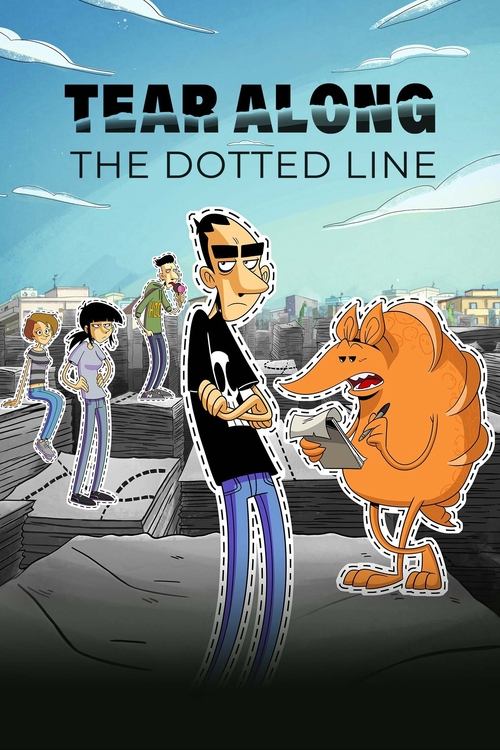
Strappare lungo i bordi
Tear Along the Dotted Line - Symbolism & Philosophy
Symbols & Motifs
The Dotted Line
Represents the rigid societal expectations and the "correct" life path that individuals feel they must follow to be successful.
Introduced in the opening, it serves as the central metaphor for Zero's life. He realizes that by trying too hard not to tear the paper, he never actually made anything of his life, whereas tearing and making mistakes is what creates a unique silhouette.
The Armadillo
A personification of Zero's subconscious, conscience, and paralyzing cynicism.
Voiced by Valerio Mastandrea, the Armadillo appears whenever Zero faces a decision or feels guilt, often sabotaging his chances at happiness under the guise of protecting him from disappointment.
The Blade of Grass
A symbol of human insignificance and the liberation that comes from not being the "lead character" in everyone else's lives.
Sarah uses this metaphor to tell Zero that he doesn't have the weight of the world on his shoulders; he is just one blade of grass in a field, and he shouldn't feel responsible for things beyond his control.
The Robotic Voice
Symbolizes emotional distance, trauma, and the inability to fully grasp someone else's internal reality.
Alice's voice is filtered and robotic throughout Zero's flashbacks because he has subconsciously dehumanized her to cope with his own guilt and the distance between them. In the final episode, her "real" voice is restored when the truth is faced.
Philosophical Questions
Are we responsible for the happiness of others?
The series explores the boundary between empathy and messianic ego, questioning whether Zero's guilt over Alice is a sign of love or a delusion that he had the power to change her fate.
Is it better to fail at a plan or to have no plan at all?
Through the 'dotted line' metaphor, the show asks if the structure we impose on our lives is a helpful guide or a cage that turns inevitable deviations into perceived tragedies.
Core Meaning
At its heart, the series is a deconstruction of generational anxiety and the myth of a "perfect path." Through the metaphor of the "dotted line," Zerocalcare suggests that the pressure to conform to societal expectations of success and happiness often leads to a paralyzing fear of failure. The ultimate message is one of humility and acceptance: accepting that we cannot control the outcomes of others' lives, that our "mistakes" are what make us human, and that there is a quiet comfort in acknowledging our own insignificance in the grander scheme of things—being just a "blade of grass in a field."