Tear Along the Dotted Line
Strappare lungo i bordi
Overview
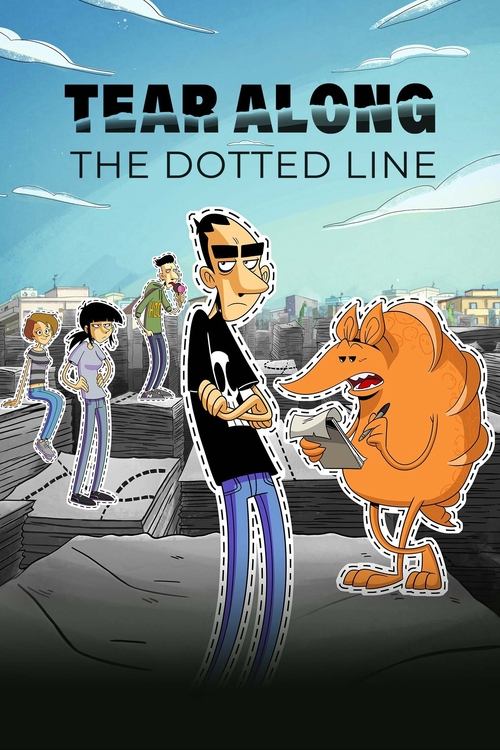
Tear Along the Dotted Line (Original Title: Strappare lungo i bordi) is a poignant and frenetically paced animated miniseries written and directed by the celebrated Italian cartoonist Zerocalcare. The story centers on Zero, a neurotic artist living in the Rebibbia neighborhood of Rome, who is accompanied by his anthropomorphic armadillo conscience. The narrative is framed around a train journey Zero takes with his two best friends, Sarah and Secco, toward the town of Biella. As they travel, Zero's hyperactive mind weaves through a series of non-linear flashbacks that reconstruct his childhood, his struggle with professional precarity, and his complicated, long-standing relationship with a girl named Alice.
nThe series masterfully balances sharp-witted observational comedy with a deep, existential undercurrent. While the early episodes focus on the relatable minutiae of adult life—from the paralyzing choice of ordering a pizza to the stress of social media interactions—the overarching plot gradually builds toward a heavy emotional core. The show uses Zero's idiosyncratic perspective to explore how memory can be both a sanctuary and a prison, ultimately transforming a seemingly lighthearted road trip into a profound meditation on loss, missed opportunities, and the realization that one is not the center of the universe.
Core Meaning
At its heart, the series is a deconstruction of generational anxiety and the myth of a "perfect path." Through the metaphor of the "dotted line," Zerocalcare suggests that the pressure to conform to societal expectations of success and happiness often leads to a paralyzing fear of failure. The ultimate message is one of humility and acceptance: accepting that we cannot control the outcomes of others' lives, that our "mistakes" are what make us human, and that there is a quiet comfort in acknowledging our own insignificance in the grander scheme of things—being just a "blade of grass in a field."
Thematic DNA
The Fear of Failure
The series explores the crippling anxiety that comes from trying to follow a pre-determined life path (the "dotted line"). Zero's inability to make simple decisions reflects a broader generational paralysis caused by the fear that any single mistake will permanently ruin his future.
Ego vs. Insignificance
A recurring tension exists between Zero's tendency to view himself as the protagonist of a tragic film and Sarah's grounded reminder that he is not responsible for the entire world. This develops into the "blade of grass" philosophy, moving from self-centered guilt to collective empathy.
Memory and Subjectivity
The series uses animation to show how we reconstruct the past. In the first five episodes, Zero voices every character, highlighting his subjective and often self-serving interpretation of reality. The shift to authentic voices in the finale signifies the breaking of his internal bubble and the acceptance of external truth.
Friendship and Support
Throughout the trip and flashbacks, the bond between the trio serves as the show's emotional anchor. It highlights how friends act as mirrors, often seeing the truths about us—and our surroundings—that we are too anxious or self-absorbed to notice.
Character Analysis
Zero
Zerocalcare
Motivation
Driven by a desire to avoid pain and disappointment, Zero often chooses inaction over risk, motivated by a deep-seated fear that he is inherently flawed or failing to meet expectations.
Character Arc
Zero begins as a man paralyzed by his own neuroses, obsessing over past mistakes and the "dotted line." His journey across the series is an evolution from self-absorption and internal monologue to a painful but necessary external awareness. By the finale, he accepts his own limitations and the fact that he cannot save everyone, finding a bittersweet peace in the "mess" he has made.
The Armadillo
Valerio Mastandrea
Motivation
To keep Zero in a state of "safe" stagnation by constantly highlighting potential failures and criticizing every impulse toward vulnerability.
Character Arc
The Armadillo remains largely consistent as the voice of Zero's anxiety, but his presence becomes more intrusive as the secret of the trip nears revelation. In the final moments, he calls for a "truce," allowing Zero to experience raw grief without the filter of cynical commentary.
Sarah
Chiara Gioncardi
Motivation
To protect her friends and pursue her dreams of teaching, while managing the quiet disappointment of adult reality.
Character Arc
Sarah serves as the pragmatic counterpoint to Zero's spiraling thoughts. While she struggles with her own unfulfilled career goals, she maintains a clarity that Zero lacks. Her arc reaches its peak in episode 6 when she finally breaks Zero's internal narrative, forcing him to see the world as it is, not as he imagines it.
Secco
Paolo Vivio
Motivation
Finding immediate gratification (usually ice cream) to avoid engaging with the overwhelming complexity of life, though he is deeply loyal to his friends.
Character Arc
Secco appears as a simple, ice-cream-obsessed slacker, but the final episodes reveal a depth of empathy and memory that challenges Zero's assumption that he is the only one who truly feels or remembers. He represents a different way of coping with life's absurdity: acceptance through simplicity.
Symbols & Motifs
The Dotted Line
Represents the rigid societal expectations and the "correct" life path that individuals feel they must follow to be successful.
Introduced in the opening, it serves as the central metaphor for Zero's life. He realizes that by trying too hard not to tear the paper, he never actually made anything of his life, whereas tearing and making mistakes is what creates a unique silhouette.
The Armadillo
A personification of Zero's subconscious, conscience, and paralyzing cynicism.
Voiced by Valerio Mastandrea, the Armadillo appears whenever Zero faces a decision or feels guilt, often sabotaging his chances at happiness under the guise of protecting him from disappointment.
The Blade of Grass
A symbol of human insignificance and the liberation that comes from not being the "lead character" in everyone else's lives.
Sarah uses this metaphor to tell Zero that he doesn't have the weight of the world on his shoulders; he is just one blade of grass in a field, and he shouldn't feel responsible for things beyond his control.
The Robotic Voice
Symbolizes emotional distance, trauma, and the inability to fully grasp someone else's internal reality.
Alice's voice is filtered and robotic throughout Zero's flashbacks because he has subconsciously dehumanized her to cope with his own guilt and the distance between them. In the final episode, her "real" voice is restored when the truth is faced.
Memorable Quotes
È inutile che vivi fuori se sei morto dentro.
— Zero (quoting Kaos One)
Context:
Introduced in Episode 1 and repeated as a reflection of Zero's internal state throughout the series.
Meaning:
A central mantra of the show, expressing the despair of feeling hollow and directionless while maintaining a functional exterior.
Annamo a pijà un gelato?
— Secco
Context:
Secco says this repeatedly, most poignantly during moments of high tension or tragedy.
Meaning:
While appearing as a comedic non-sequitur, it symbolizes the simple, grounding actions that help people survive when life becomes too heavy to bear.
Siamo fili d'erba in un prato, Zero.
— Sarah
Context:
Episode 6, during a climactic conversation where Sarah humbles Zero's overwhelming guilt.
Meaning:
The core philosophical revelation of the series: we are small, we are not the protagonists of everyone else's lives, and that is okay.
Episode Highlights
Episode 1
Introduces Zero's neurotic world, his Armadillo conscience, and the paralyzing difficulty of picking a movie on Netflix or a pizza at a restaurant.
Sets the "dotted line" metaphor and establishes the fast-paced, internal monologue style that defines the series.
Episode 4
Zero describes the "domains" of his messy apartment using Game of Thrones metaphors, transforming his domestic clutter into a battle for survival.
A masterclass in visual storytelling and pop-culture integration, highlighting Zero's detachment from reality.
Episode 5
Zero recalls a night spent comforting Alice after a breakup, nearly sharing a transformative kiss but pulling away at the last second.
The emotional turning point where Zero's "fear of tearing the paper" is shown to have real, heartbreaking consequences in his relationships.
Episode 6
The trio attends Alice's funeral in Biella. The subjective narration breaks, and characters finally speak with their own voices.
The series finale that reveals the show was never just a comedy, providing a devastating analysis of grief and the "blade of grass" philosophy.
Philosophical Questions
Are we responsible for the happiness of others?
The series explores the boundary between empathy and messianic ego, questioning whether Zero's guilt over Alice is a sign of love or a delusion that he had the power to change her fate.
Is it better to fail at a plan or to have no plan at all?
Through the 'dotted line' metaphor, the show asks if the structure we impose on our lives is a helpful guide or a cage that turns inevitable deviations into perceived tragedies.
Alternative Interpretations
While most see the ending as a hopeful message of acceptance, some critics have interpreted the show as a critique of the 'cynical ego.' In this reading, Zero's initial humor isn't just a defense mechanism but a form of narcissism that prevents him from truly seeing the people around him until it's too late. Another interpretation focuses on the 'digital ghost' aspect, viewing the series as a commentary on how modern communication (MSN, social media) creates illusions of closeness while facilitating emotional distance and missed connections.
Cultural Impact
Upon its release, Tear Along the Dotted Line became a cultural phenomenon in Italy, reaching the #1 spot on Netflix and sparking a nationwide conversation about mental health, suicide, and the 'millennial' condition. Critics hailed it as a landmark in Italian animation, praising its authentic use of the Romanesco dialect and its ability to translate the specific anxieties of a generation into a universal language. It revitalized interest in Zerocalcare's graphic novels internationally and established a new standard for adult animation in Europe, blending crude humor with high philosophical stakes.
Audience Reception
The series received near-universal acclaim, boasting a 100% score on Rotten Tomatoes (limited reviews) and an 8.6/10 on IMDb. Audiences were particularly moved by the "emotional gut punch" of the final two episodes, which many felt was unexpected given the show's early comedic tone. The main point of criticism among some international viewers was the extremely fast pace of the dialogue, which required close attention to subtitles, though fans argued this perfectly captured the chaotic speed of an anxious mind.
Interesting Facts
- Zerocalcare voiced every single character in the first five episodes (in the original Italian version) to represent the protagonist's subjective worldview.
- The character 'Cinghiale' (Boar) is a real friend of Zerocalcare who appears in his comics but had to be relegated to a background cameo in the series.
- The English dub features a British cast to capture the specific 'working class' and regional nuances of the original Romanesco dialect.
- The soundtrack features an original theme by Italian punk-songwriter Giancane.
- The title literally translates to 'Tearing Along the Edges,' though 'Dotted Line' was chosen for the English release to preserve the metaphor.
Easter Eggs
Shinji Coniglio (Shinji Rabbit)
A recurring reference to Shinji Ikari from Neon Genesis Evangelion, whom Zero despises for being a "crybaby." It's a meta-commentary on Zero's own tendency to wallow in self-pity.
Maicol & Mirco Wallpaper
Zero's phone wallpaper features a comic by Maicol & Mirco with the caption 'Chi è felice è complice' (Whoever is happy is an accomplice), a nod to the creator's real-life influences.
Street Fighter 8-bit Battle
In Episode 1, Zero's argument with an elderly lady in a public bathroom is depicted as a retro 8-bit fighting game, with the lady resembling Dhalsim.
⚠️ Spoiler Analysis
Click to reveal detailed analysis with spoilers
Frequently Asked Questions
Explore More About This Movie
Dive deeper into specific aspects of the movie with our detailed analysis pages
Comments (0)
No comments yet. Be the first to share your thoughts!