
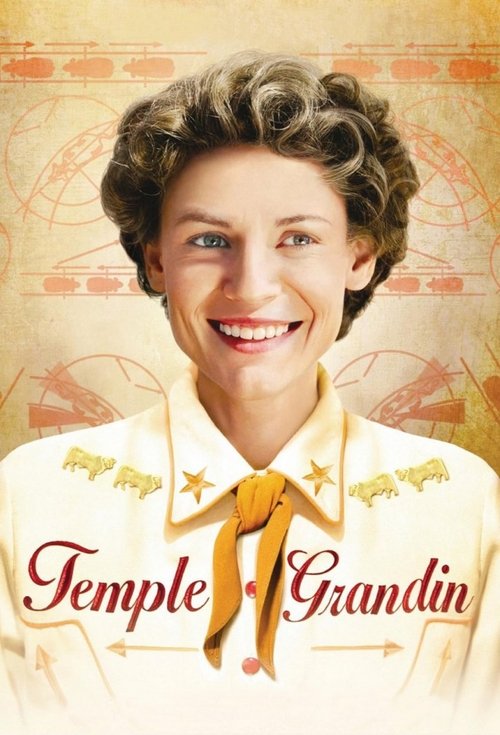
"Autism gave her a vision. She gave it a voice."
Temple Grandin - Symbolism & Philosophy
Symbols & Motifs
Doors
Doors symbolize transitions, opportunities, and overcoming fears. Dr. Carlock first introduces the metaphor, telling Temple to think of challenges as new doors to walk through. This becomes a recurring motif representing her progress.
Temple's journey is framed by her relationship with doors. Initially, she has an intense fear of automatic sliding doors, seeing them as guillotines, which represents her anxiety and sensory overload. By the end of the film, having achieved professional success and personal growth, she confidently strides through a set of automatic doors at a supermarket, symbolizing her passage into a new, more independent phase of life. The final shot of her looking at a door that reflects an optical illusion reinforces this idea of seeing new possibilities.
The Squeeze Machine
The "squeeze machine" or "hug box" symbolizes the need for comfort and control in a world that is sensorially overwhelming. It is a physical manifestation of her need for deep pressure to calm her anxiety, a substitute for the human touch she cannot tolerate. It represents her ingenuity in creating solutions tailored to her own needs, turning a personal struggle into a therapeutic innovation.
Inspired by the squeeze chutes used to calm cattle on her aunt's ranch, Temple builds the first version of the machine for herself during an anxiety attack. It becomes a central point of conflict at college when administrators misunderstand its purpose, but she proves its therapeutic value through a scientific study, demonstrating her ability to translate her personal experience into objective data.
Visual Thinking (Drawings and Animations)
The film's visual effects, which animate Temple's thoughts and schematics, symbolize the power and clarity of neurodivergent thinking. Her mind is not a chaotic mess but a precise, photographic, and logical system. These visuals represent her unique intelligence and problem-solving ability.
Throughout the film, director Mick Jackson uses animations and on-screen diagrams to show the audience how Temple thinks. When she designs a cattle dip or a slaughterhouse system, we see the blueprints and 3D models come to life in her mind's eye. This technique is crucial for translating her internal world externally, making her perspective accessible and demonstrating its effectiveness. The real Temple Grandin praised this aspect of the film for its accuracy.
Philosophical Questions
What is the nature of intelligence and "normalcy"?
The film fundamentally challenges conventional definitions of intelligence. Temple struggles with abstract concepts taught in traditional ways but possesses a brilliant visual and systematic mind that allows her to solve complex engineering problems. Her story forces the audience to question whether "normalcy" is a valid concept or simply a dominant mode of perception. It suggests that society often fails to recognize and cultivate forms of intelligence that don't fit a standard mold, and that true progress comes from embracing a diversity of minds.
What is the ethical responsibility of humans towards animals?
The film explores humanity's relationship with the animals raised for food. Through Temple's unique empathetic connection with cattle, it forces a confrontation with the reality of industrial agriculture. Her philosophy, "Nature is cruel, but we don't have to be," poses a direct ethical question: what do we owe the creatures under our care? The film argues that this responsibility extends beyond simple sustenance to include providing a life free from unnecessary fear and a death that is as humane as possible, framing animal welfare as a moral imperative.
How does sensory experience shape one's reality?
"Temple Grandin" is a deep dive into how a different sensory reality creates a different world. For Temple, loud noises are painful, hugs are overwhelming, and automatic doors are terrifying. The film uses sound design and visual cues to immerse the viewer in her sensory experience. This raises the philosophical question of whether there is an objective reality, or if reality is purely a product of our individual sensory perception. It demonstrates that the world is not a fixed entity but is experienced in vastly different ways depending on one's neurological wiring.
Core Meaning
The core meaning of "Temple Grandin" is a powerful assertion that neurodiversity is a vital part of human experience, not a deficit. The film champions the idea that different ways of thinking, like Temple's visual cognition, can lead to profound insights and innovations that neurotypical minds might miss. Director Mick Jackson sought to convey that what is often perceived as a disability can be a unique strength. The film carries a message of perseverance, empathy, and the importance of mentorship in unlocking human potential. It argues for seeing the world from different perspectives and extending respect and humane treatment to all living creatures, challenging the audience to redefine their understanding of "normalcy" and intelligence.