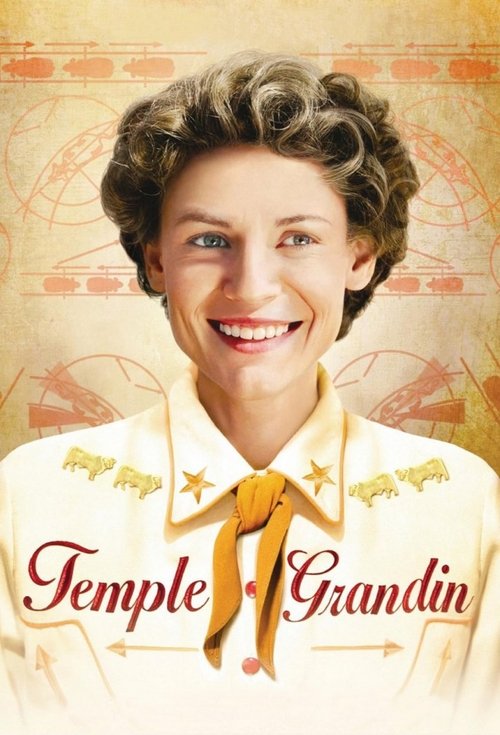
Temple Grandin
"Autism gave her a vision. She gave it a voice."
Overview
"Temple Grandin" chronicles the life of an autistic woman who became one of the most recognized experts in the field of animal husbandry. The film follows Temple (Claire Danes) from her challenging school days, where she was misunderstood by peers and teachers, to her transformative time spent at her aunt's Arizona ranch. It was there she first observed the calming effect of squeeze chutes on cattle, an insight that would become central to both her personal coping mechanisms and her professional career.
The narrative showcases her unique ability to "think in pictures," a cognitive trait she uses to understand the world and empathize with animals. Despite facing rampant sexism in the male-dominated cattle industry and constant prejudice due to her autism, Temple's perseverance and intellect lead her to revolutionize livestock handling practices. With the support of her mother (Julia Ormond), her aunt (Catherine O'Hara), and a compassionate science teacher, Dr. Carlock (David Strathairn), she designs more humane systems for ranches and slaughterhouses, proving that being different is not being less.
Core Meaning
The core meaning of "Temple Grandin" is a powerful assertion that neurodiversity is a vital part of human experience, not a deficit. The film champions the idea that different ways of thinking, like Temple's visual cognition, can lead to profound insights and innovations that neurotypical minds might miss. Director Mick Jackson sought to convey that what is often perceived as a disability can be a unique strength. The film carries a message of perseverance, empathy, and the importance of mentorship in unlocking human potential. It argues for seeing the world from different perspectives and extending respect and humane treatment to all living creatures, challenging the audience to redefine their understanding of "normalcy" and intelligence.
Thematic DNA
Neurodiversity and Perception
The film's central theme is the exploration of neurodiversity, specifically autism. It visualizes Temple's unique cognitive process of "thinking in pictures," using on-screen graphics and animations to represent her thoughts. This technique allows the audience to understand her perspective, not as a lesser way of thinking, but simply a different one. The film argues that this different perception is what allows her to see details and patterns others miss, which becomes her greatest asset. Her mother's steadfast belief that Temple is "different, but not less" encapsulates this theme.
Perseverance Against Adversity
Temple faces immense obstacles throughout her life. In an era when autism was poorly understood and often misdiagnosed as schizophrenia resulting from poor mothering, she was at risk of institutionalization. She endures bullying from classmates, skepticism from professors, and blatant sexism from the men in the cattle industry. Yet, she consistently pushes forward, using her intelligence and unwavering focus to prove her detractors wrong, from validating her "squeeze machine" with a science experiment to revolutionizing the design of livestock facilities.
Animal Welfare and Empathy
Through her unique sensory experiences, Temple develops a profound empathy for animals, particularly cattle. She observes how they react to fear and stress, seeing the world from their perspective. This empathy is the driving force behind her life's work. The film posits her famous credo, "Nature is cruel, but we don't have to be. We owe them some respect." This theme connects her personal journey with a broader ethical argument for the humane treatment of animals, suggesting her autism gives her a unique insight into their suffering.
The Importance of Mentorship
The film highlights how crucial support and mentorship are in enabling potential. Temple's success is not achieved in a vacuum. Her mother, Eustacia, fights against medical advice to give her an education. Her Aunt Ann provides a nurturing environment where her interests can flourish. Most significantly, her high school science teacher, Dr. Carlock, recognizes her unique intelligence, challenges her to apply it, and teaches her to see obstacles as "doors" to new opportunities. These figures are instrumental in helping her navigate a world not built for her.
Character Analysis
Temple Grandin
Claire Danes
Motivation
Her primary motivation is to understand and solve problems, driven by her intensely logical and visual mind. This is coupled with a deep empathy for animals, compelling her to alleviate their fear and suffering. She is also motivated by a desire to prove her capabilities and earn respect in a world that consistently underestimates her.
Character Arc
Temple begins as a non-verbal, overwhelmed child misunderstood by the medical establishment. Through the course of the film, she learns to navigate social conventions and harnesses her unique visual thinking. She transforms from a socially isolated young woman into a confident, pioneering scientist and advocate who revolutionizes an entire industry and, by the end, finds her voice as a spokesperson for the autistic community. Claire Danes's performance was lauded for capturing this seamless progression.
Eustacia Cutler
Julia Ormond
Motivation
Her motivation is her fierce, protective love for her daughter and her absolute refusal to accept the bleak prognosis given by doctors. She is driven by the belief that Temple is "different, but not less" and deserves every opportunity to succeed.
Character Arc
Eustacia starts as a mother fighting against a dismissive medical system that blames her for her daughter's autism. Her journey is one of unwavering advocacy and tough love. She pushes Temple to speak, to attend school, and to face the world, refusing to let her be defined by her diagnosis. Her arc is less about personal change and more about the relentless, successful fulfillment of her mission to ensure her daughter has a full life.
Dr. Carlock
David Strathairn
Motivation
As a passionate educator, his motivation is to unlock the potential in his students. He is driven by curiosity and a genuine appreciation for Temple's unique way of seeing the world, wanting to help her channel her talents constructively.
Character Arc
Dr. Carlock is Temple's high school science teacher. He is the first educator to see past her social awkwardness and recognize the brilliance of her mind. His role is to challenge and inspire her, providing the intellectual validation she needs. He teaches her the crucial lesson of viewing obstacles as "doors" to new places, a metaphor she carries throughout her life. His influence is profound and lasting, even after his death in the film.
Aunt Ann
Catherine O'Hara
Motivation
Ann is motivated by familial love and a practical, open-minded acceptance of Temple's personality. She provides a safe harbor and encourages Temple's passions without trying to change who she is fundamentally.
Character Arc
Aunt Ann provides the crucial environment where Temple can thrive. On her Arizona ranch, away from the judgment of school, Temple is free to explore her interests. Ann is patient and accepting, giving Temple the space and support to build her first squeeze machine and develop her affinity for cattle. She acts as a bridge, explaining Temple's needs to others, such as when she defends the squeeze machine to the college faculty.
Symbols & Motifs
Doors
Doors symbolize transitions, opportunities, and overcoming fears. Dr. Carlock first introduces the metaphor, telling Temple to think of challenges as new doors to walk through. This becomes a recurring motif representing her progress.
Temple's journey is framed by her relationship with doors. Initially, she has an intense fear of automatic sliding doors, seeing them as guillotines, which represents her anxiety and sensory overload. By the end of the film, having achieved professional success and personal growth, she confidently strides through a set of automatic doors at a supermarket, symbolizing her passage into a new, more independent phase of life. The final shot of her looking at a door that reflects an optical illusion reinforces this idea of seeing new possibilities.
The Squeeze Machine
The "squeeze machine" or "hug box" symbolizes the need for comfort and control in a world that is sensorially overwhelming. It is a physical manifestation of her need for deep pressure to calm her anxiety, a substitute for the human touch she cannot tolerate. It represents her ingenuity in creating solutions tailored to her own needs, turning a personal struggle into a therapeutic innovation.
Inspired by the squeeze chutes used to calm cattle on her aunt's ranch, Temple builds the first version of the machine for herself during an anxiety attack. It becomes a central point of conflict at college when administrators misunderstand its purpose, but she proves its therapeutic value through a scientific study, demonstrating her ability to translate her personal experience into objective data.
Visual Thinking (Drawings and Animations)
The film's visual effects, which animate Temple's thoughts and schematics, symbolize the power and clarity of neurodivergent thinking. Her mind is not a chaotic mess but a precise, photographic, and logical system. These visuals represent her unique intelligence and problem-solving ability.
Throughout the film, director Mick Jackson uses animations and on-screen diagrams to show the audience how Temple thinks. When she designs a cattle dip or a slaughterhouse system, we see the blueprints and 3D models come to life in her mind's eye. This technique is crucial for translating her internal world externally, making her perspective accessible and demonstrating its effectiveness. The real Temple Grandin praised this aspect of the film for its accuracy.
Memorable Quotes
My name is Temple Grandin. I'm not like other people. I think in pictures and I connect them.
— Temple Grandin
Context:
This is part of the opening narration, spoken by Temple as she stands in a room with an optical illusion. It sets the stage for the entire film, which uses visual effects to illustrate her way of thinking.
Meaning:
This opening line establishes the film's central theme and Temple's unique perspective. It immediately defines her identity not by her diagnosis, but by her cognitive strength, inviting the audience to see the world through her eyes.
Different, but not less.
— Eustacia Cutler
Context:
Eustacia says this to Dr. Carlock when discussing Temple's unique challenges and abilities. It crystallizes her lifelong mission to ensure her daughter is treated with dignity and given the same opportunities as anyone else.
Meaning:
This is the philosophical core of the movie. It is a powerful statement against stigmatization and a call for the acceptance of neurodiversity. It argues that variations in human minds should be valued, not seen as hierarchical.
Nature is cruel, but we don't have to be. We owe them some respect.
— Temple Grandin
Context:
Temple says this while explaining her motivations for redesigning slaughterhouses. She recognizes the reality of the cattle industry but insists on a standard of humane treatment rooted in respect for the animals.
Meaning:
This quote encapsulates Temple's entire philosophy regarding animal welfare. It's a pragmatic and ethical argument that while death is a part of nature and the food system, humans have a moral obligation to minimize fear and suffering in the animals they raise.
A door opened and I went through it.
— Temple Grandin
Context:
This is part of her speech at the National Autism Convention at the end of the film. She uses the metaphor of the door to summarize her journey and inspire others, marking her transition into an advocate for the autistic community.
Meaning:
This reflects the crucial lesson she learned from her mentor, Dr. Carlock, about viewing challenges as opportunities. It signifies her growth and her conscious decision to embrace new experiences and push past her fears.
Philosophical Questions
What is the nature of intelligence and "normalcy"?
The film fundamentally challenges conventional definitions of intelligence. Temple struggles with abstract concepts taught in traditional ways but possesses a brilliant visual and systematic mind that allows her to solve complex engineering problems. Her story forces the audience to question whether "normalcy" is a valid concept or simply a dominant mode of perception. It suggests that society often fails to recognize and cultivate forms of intelligence that don't fit a standard mold, and that true progress comes from embracing a diversity of minds.
What is the ethical responsibility of humans towards animals?
The film explores humanity's relationship with the animals raised for food. Through Temple's unique empathetic connection with cattle, it forces a confrontation with the reality of industrial agriculture. Her philosophy, "Nature is cruel, but we don't have to be," poses a direct ethical question: what do we owe the creatures under our care? The film argues that this responsibility extends beyond simple sustenance to include providing a life free from unnecessary fear and a death that is as humane as possible, framing animal welfare as a moral imperative.
How does sensory experience shape one's reality?
"Temple Grandin" is a deep dive into how a different sensory reality creates a different world. For Temple, loud noises are painful, hugs are overwhelming, and automatic doors are terrifying. The film uses sound design and visual cues to immerse the viewer in her sensory experience. This raises the philosophical question of whether there is an objective reality, or if reality is purely a product of our individual sensory perception. It demonstrates that the world is not a fixed entity but is experienced in vastly different ways depending on one's neurological wiring.
Alternative Interpretations
While the film is largely received as an inspirational biopic, some alternative interpretations exist within disability studies. One perspective is that the narrative leans into the "supercrip" trope, which focuses on a disabled person who overcomes their disability through extraordinary, almost superhuman talents. This interpretation suggests that by highlighting Temple's genius-level intellect and unique visual skills, the film might inadvertently create unrealistic expectations for other autistic individuals whose abilities may not be as "spectacularized." It risks celebrating the exception rather than promoting a broader acceptance of the entire autism spectrum.
Another reading focuses on the film's portrayal of adaptation. One could interpret Temple's journey as a story of assimilation, where she must learn to mimic neurotypical social behaviors to succeed in a world not designed for her. From this viewpoint, the film celebrates her ability to conform to societal expectations as much as it celebrates her unique mind. An alternative perspective, however, sees her journey not as assimilation but as the development of coping mechanisms that allow her to function without sacrificing her core identity. She doesn't stop thinking in pictures; she simply learns how to translate her thoughts for others, arguing for a world that accommodates difference rather than demanding conformity.
Cultural Impact
The 2010 HBO film "Temple Grandin" had a profound cultural impact, primarily in its humanizing and insightful portrayal of autism at a time when public understanding was still limited. The film was a critical success, winning multiple Emmy and Golden Globe awards, which brought mainstream attention to Temple Grandin's story and, by extension, to the concept of neurodiversity. It helped shift the public narrative around autism from one of deficit and tragedy to one of difference and unique ability.
By vividly and cinematically depicting Temple's method of "thinking in pictures," the film made an abstract cognitive experience accessible and relatable to a neurotypical audience. This contributed significantly to a wider conversation about autism, particularly in highlighting the capabilities of autistic individuals and challenging stereotypes. The film also brought awareness to the fact that autism presents in girls and women, countering a common misconception that it is primarily a male disorder.
For the autism community, the film was a landmark. Executive producer Emily Gerson Saines, herself a mother of an autistic child, was motivated by a desire to share a story of hope. The film's success catapulted the real Temple Grandin from a respected figure within the autism and animal science worlds to an international icon and sought-after speaker, amplifying her message of "different, not less." Furthermore, its positive reception and factual accuracy, aided by Grandin's own involvement, set a high standard for biographical films dealing with disability.
Audience Reception
Audience reception for "Temple Grandin" was overwhelmingly positive. Viewers on platforms like Rotten Tomatoes and IMDb have given the film exceptionally high ratings, frequently praising it as one of the best and most inspiring television films ever made. The most lauded aspect is universally Claire Danes's transformative performance, which audiences found to be incredibly authentic, respectful, and moving, avoiding caricature and capturing the essence of Temple Grandin with remarkable precision.
Many viewers, particularly parents of autistic children and individuals on the autism spectrum, have praised the film for its accuracy and its hopeful, empowering message. The visual representation of Temple's thought processes was a frequently cited point of praise, as it provided a unique and effective window into an autistic mind. Criticisms are rare, but some viewers noted that, as a biopic, it simplifies a complex life and may present a slightly sanitized version of events, focusing primarily on her triumphs. However, the overall verdict from audiences is that the film is a heartfelt, educational, and profoundly touching masterpiece that fosters empathy and understanding.
Interesting Facts
- The real Temple Grandin was actively involved in the film's production, providing input on the script and ensuring the accuracy of the cattle-handling facilities depicted.
- Claire Danes spent considerable time with Temple Grandin to prepare for the role, studying her speech patterns and movements from old recordings and observing her in person. Grandin praised Danes's portrayal as being uncannily accurate, saying it was like watching her younger self in a "weird time machine."
- The film's executive producer, Emily Gerson Saines, was inspired to make the movie because her own son was diagnosed with autism, and Grandin's books gave her hope and direction.
- Many of Temple's actual drawings and designs were used as props and inspiration for the animations in the film.
- The real Temple Grandin makes a brief, uncredited cameo in the film. During the final convention scene, as Claire Danes (as Temple) gets up to walk to the podium, the real Temple is seen sitting in the audience, turning to watch her go.
- The film won numerous awards, including seven Primetime Emmy Awards and a Golden Globe and Screen Actors Guild Award for Claire Danes's performance, significantly raising public awareness of both Temple Grandin and autism.
- An early version of the script included a romantic subplot for Temple, but she insisted it be removed because it was not true to her life experience.
Easter Eggs
The real Temple Grandin appears in the audience during the final scene at the autism convention.
This cameo serves as a powerful, poignant endorsement of the film and its portrayal of her life. As the fictional Temple steps onto the stage to become a public advocate, the presence of the real Temple in the audience represents a passing of the torch and a validation of the story being told. It's a subtle nod that bridges the cinematic portrayal with the living person, acknowledging her legacy.
⚠️ Spoiler Analysis
Click to reveal detailed analysis with spoilers
Frequently Asked Questions
Explore More About This Movie
Dive deeper into specific aspects of the movie with our detailed analysis pages
Comments (0)
No comments yet. Be the first to share your thoughts!