"Movie-wise, there has never been anything like it - laugh-wise, love-wise, or otherwise-wise!"
The Apartment - Symbolism & Philosophy
Symbols & Motifs
The Apartment Key
The key to Bud's apartment symbolizes both power and corruption. For the executives, possessing the key grants them power to indulge in their affairs. For Bud, giving away the key represents his moral compromise and ambition. His final act of refusing to hand over the key to Sheldrake is a symbolic reclamation of his integrity and his personal space.
The key is a central prop passed between characters throughout the film. Bud initially gives it to his superiors to gain favor. He receives a key to the executive washroom as a reward, symbolizing his ascent. The climax involves Bud taking back his apartment key from Sheldrake, signaling his moral transformation.
The Broken Compact Mirror
The broken mirror symbolizes Fran Kubelik's fractured self-image and emotional state. When Bud points out that her compact mirror is broken, she replies, "Yes, I know. I like it that way. Makes me look the way I feel." This reflects her feelings of being broken by her affair with Sheldrake and her general disillusionment with love.
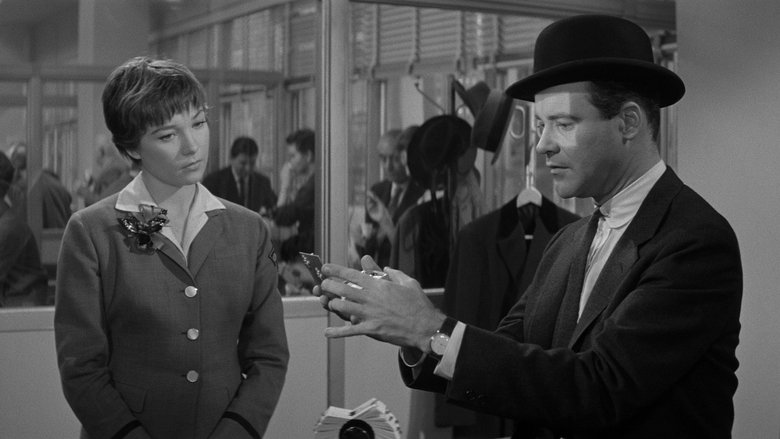
The broken compact is revealed during a conversation between Bud and Fran at the office Christmas party. Fran uses it to check her makeup, leading to the poignant exchange that reveals her inner sadness and vulnerability beneath a cheerful exterior.
Gin Rummy Game
The game of gin rummy represents the budding, authentic connection between Bud and Fran. It is an activity they share during her recovery, a quiet and simple form of companionship that stands in stark contrast to the deceitful relationships around them. The final line, "Shut up and deal," signifies an acceptance of their shared future, whatever hand they're dealt, and serves as an unconventional declaration of love.
Bud teaches Fran to play gin rummy while she is recuperating in his apartment after her suicide attempt. The game becomes their ritual. The film famously ends not with a kiss, but with them sitting down to play another hand, with Fran delivering the iconic final line.
Philosophical Questions
What is the true cost of ambition in a morally compromised system?
The film relentlessly explores this question through Bud Baxter's Faustian bargain. To get ahead, he sacrifices his privacy, his sleep, his health, and ultimately, his integrity. The promotions and perks he receives are contrasted with his increasing loneliness and moral unease. "The Apartment" argues that ambition within a corrupt system inevitably leads to the erosion of the self. The film suggests that true success is not measured by one's position on the corporate ladder but by one's ability to maintain their humanity and self-respect, even if it means walking away from the system altogether, as Bud eventually does.
What does it mean to be a decent human being ('a mensch')?
This question is explicitly posed by Bud's neighbor, Dr. Dreyfuss, who tells him to "be a mensch." Initially, Bud is the opposite: he facilitates deceit and avoids confrontation. The film's narrative tracks his transformation as he learns to take responsibility, act with empathy, and show courage. Being a "mensch," the film suggests, involves caring for others (as Bud does for Fran after her overdose), taking a moral stand even at great personal cost (quitting his job), and choosing human connection over material gain. It is a journey from passive complicity to active decency.
Can genuine connection blossom in an environment of alienation and deceit?
The central relationship between Bud and Fran serves as the answer to this question. Both characters are deeply isolated and trapped in webs of deceit—Bud's with the executives and Fran's with Sheldrake. Their connection forms not through grand romantic gestures, but through shared vulnerability and quiet moments of care, like playing gin rummy or making spaghetti. The film posits that even in the most cynical and impersonal of worlds, authenticity and empathy can create a sanctuary. Their bond, forged in the aftermath of trauma, becomes the one honest thing in their lives, proving that genuine connection is not only possible but essential for survival.
Core Meaning
At its heart, "The Apartment" is a powerful critique of corporate culture's dehumanizing effects and a poignant exploration of loneliness and the search for genuine human connection in a modern, impersonal world. Director Billy Wilder uses the central premise—a man trading his personal space for professional gain—as a metaphor for the loss of integrity and self-respect in the pursuit of success. The film ultimately champions the idea that true happiness and dignity are found not in career advancement or material success, but in empathy, moral courage, and authentic love. It poses the question of what it means to be a decent human being, a "mensch," in a system that often rewards cynicism and exploitation.