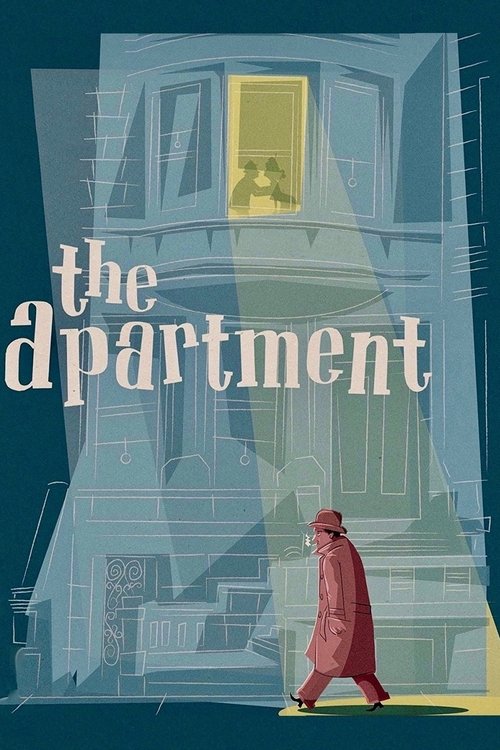
The Apartment
"Movie-wise, there has never been anything like it - laugh-wise, love-wise, or otherwise-wise!"
Overview
"The Apartment" tells the story of C.C. "Bud" Baxter (Jack Lemmon), a lonely and ambitious insurance clerk in a vast, impersonal New York City corporation. To curry favor with his superiors and climb the corporate ladder, Bud allows four executives to use his Upper West Side apartment for their extramarital affairs. He meticulously juggles their schedules, often finding himself locked out of his own home in the cold, a situation that leads his neighbors to believe he is a wild playboy.
Bud's carefully managed but lonely existence is complicated when he falls for the charming and witty elevator operator in his building, Fran Kubelik (Shirley MacLaine). He is devastated to discover that Fran is the mistress of the top personnel director, Jeff D. Sheldrake (Fred MacMurray), who has also started using Bud's apartment for his trysts in exchange for a major promotion. The film navigates a delicate balance of comedy and drama as Bud is forced to confront the moral implications of his choices and the true cost of his ambition, especially after a dramatic incident forces him and Fran together in the apartment under dire circumstances.
Core Meaning
At its heart, "The Apartment" is a powerful critique of corporate culture's dehumanizing effects and a poignant exploration of loneliness and the search for genuine human connection in a modern, impersonal world. Director Billy Wilder uses the central premise—a man trading his personal space for professional gain—as a metaphor for the loss of integrity and self-respect in the pursuit of success. The film ultimately champions the idea that true happiness and dignity are found not in career advancement or material success, but in empathy, moral courage, and authentic love. It poses the question of what it means to be a decent human being, a "mensch," in a system that often rewards cynicism and exploitation.
Thematic DNA
Corporate Dehumanization and Moral Compromise
The film portrays the corporate world as a soulless, hierarchical machine where individuals are reduced to numbers (Bud is one of 31,259 employees). To get ahead, Bud sacrifices his privacy and ethics, effectively prostituting his home. This theme is visualized through the vast, geometrically perfect office set, created with forced perspective to look endless, emphasizing Bud's status as a small, interchangeable cog. The executives, particularly Sheldrake, embody corporate ruthlessness, exploiting their subordinates for personal convenience without regard for their well-being.
Loneliness and Alienation
Despite being set in a bustling city and a crowded office, the main characters are profoundly lonely. Bud's apartment, constantly in use by others for their intimate moments, becomes a symbol of his own isolation; it's a home filled with the lives of others but empty of his own. Fran, trapped in a loveless affair, also feels emotionally stranded. The film captures the paradox of feeling alone in a crowd, particularly during the Christmas and New Year's holidays, which serve as a backdrop that heightens their feelings of solitude.
The Search for Integrity and Self-Respect
Bud's character arc is defined by his journey from a passive pushover to a man of integrity. Initially, he allows himself to be used, but his growing feelings for Fran, and witnessing the pain she endures, awakens his conscience. His ultimate act of defiance—refusing Sheldrake the key and quitting his job—is a powerful reclamation of his self-respect. Fran's journey mirrors his; she eventually finds the strength to leave the manipulative Sheldrake for a relationship built on genuine care and mutual respect.
Power Dynamics and Exploitation of Women
"The Apartment" was groundbreaking for its frank depiction of the sexual politics of the workplace. The male executives use their power and position to exploit female employees like Fran and Sheldrake's secretary, Miss Olsen. Fran is treated as a disposable object by Sheldrake, who makes false promises to maintain their affair. The film critiques this casual sexism and the emotional damage it inflicts, a theme that remains depressingly relevant.
Character Analysis
C.C. 'Bud' Baxter
Jack Lemmon
Motivation
Initially, Bud is motivated purely by ambition and the desire to climb the corporate ladder at Consolidated Life insurance company. He craves success to escape his anonymous, lonely existence. This motivation shifts as he falls for Fran, and his primary goal becomes protecting her and winning her affection, leading him to prioritize his personal values over his career.
Character Arc
Bud begins as a lonely, ambitious but morally flexible pushover, eager to please his superiors for a promotion. He is a passive participant in a corrupt system. His arc is a journey towards moral awakening, spurred by his love for Fran and the realization of the human cost of his complicity. By nursing Fran back to health, he discovers his own capacity for empathy and courage, culminating in his decision to quit his job and become a "mensch" (a good person), choosing integrity over success.
Fran Kubelik
Shirley MacLaine
Motivation
Fran is motivated by a deep-seated desire to be loved, which unfortunately leads her into a self-destructive affair with the married Sheldrake, who she hopes will leave his wife for her. She is a self-proclaimed person who "gets took." Her motivation evolves as she experiences Bud's kindness, shifting from a desperate need for Sheldrake's approval to a desire for the genuine connection Bud offers.
Character Arc
Fran is introduced as a quirky, charming, and seemingly cheerful elevator operator. However, beneath this exterior, she is deeply melancholic and vulnerable, repeatedly falling for the wrong men who take advantage of her. Her arc involves recognizing her own worth. After her suicide attempt and recovery under Bud's care, she realizes the difference between Sheldrake's manipulative affection and Bud's genuine love. Her final act of leaving Sheldrake to be with Bud signifies her choosing a healthier, more respectful relationship and taking control of her own happiness.
Jeff D. Sheldrake
Fred MacMurray
Motivation
Sheldrake is motivated by selfishness and a sense of entitlement. His primary drivers are satisfying his own desires—whether for extramarital affairs or maintaining his powerful corporate position—with minimal consequences to himself. He leverages his authority to exploit those beneath him, showing a sociopathic lack of empathy for the emotional damage he causes.
Character Arc
Sheldrake is a static character who experiences no positive growth. He is a suave, charming, and utterly ruthless personnel director who views people as disposable commodities to be used for his own gain. He manipulates Bud for his apartment and strings Fran along with false promises. Even when his actions lead to Fran's suicide attempt, he shows little remorse, his primary concern being his own convenience and reputation. He ends the film as he began: a powerful, cynical, and morally bankrupt man, though he has lost both his mistress and his most useful subordinate.
Symbols & Motifs
The Apartment Key
The key to Bud's apartment symbolizes both power and corruption. For the executives, possessing the key grants them power to indulge in their affairs. For Bud, giving away the key represents his moral compromise and ambition. His final act of refusing to hand over the key to Sheldrake is a symbolic reclamation of his integrity and his personal space.
The key is a central prop passed between characters throughout the film. Bud initially gives it to his superiors to gain favor. He receives a key to the executive washroom as a reward, symbolizing his ascent. The climax involves Bud taking back his apartment key from Sheldrake, signaling his moral transformation.
The Broken Compact Mirror
The broken mirror symbolizes Fran Kubelik's fractured self-image and emotional state. When Bud points out that her compact mirror is broken, she replies, "Yes, I know. I like it that way. Makes me look the way I feel." This reflects her feelings of being broken by her affair with Sheldrake and her general disillusionment with love.
The broken compact is revealed during a conversation between Bud and Fran at the office Christmas party. Fran uses it to check her makeup, leading to the poignant exchange that reveals her inner sadness and vulnerability beneath a cheerful exterior.
Gin Rummy Game
The game of gin rummy represents the budding, authentic connection between Bud and Fran. It is an activity they share during her recovery, a quiet and simple form of companionship that stands in stark contrast to the deceitful relationships around them. The final line, "Shut up and deal," signifies an acceptance of their shared future, whatever hand they're dealt, and serves as an unconventional declaration of love.
Bud teaches Fran to play gin rummy while she is recuperating in his apartment after her suicide attempt. The game becomes their ritual. The film famously ends not with a kiss, but with them sitting down to play another hand, with Fran delivering the iconic final line.
Memorable Quotes
When you're in love with a married man, you shouldn't wear mascara.
— Fran Kubelik
Context:
Fran says this to Bud Baxter at a bar on Christmas Eve, shortly after being let down by Sheldrake once again. She has just discovered that he has no intention of spending the holiday with her, and her mascara is running from crying.
Meaning:
This poignant line reveals Fran's deep-seated sadness and resignation about her affair with Sheldrake. It's a witty remark that masks profound heartbreak, acknowledging the constant cycle of crying and disappointment she endures while clinging to a hopeless romance. It perfectly encapsulates the film's blend of comedy and pathos.
The mirror... it's broken." "Yes, I know. I like it that way. Makes me look the way I feel.
— C.C. Baxter & Fran Kubelik
Context:
This conversation occurs during the office Christmas party. Bud finds Fran looking into her compact, and he points out that the mirror is broken. Her response is a quiet, devastating admission of her inner turmoil.
Meaning:
This exchange is a symbolic representation of Fran's internal state. The cracked mirror reflects her fractured self-esteem and emotional pain resulting from her toxic affair. Her acceptance of the broken reflection shows a deep level of self-awareness about her own unhappiness. For Bud, it's a moment of insight into the sadness she hides behind her cheerful demeanor.
I absolutely adore you, Miss Kubelik." "Shut up and deal.
— C.C. Baxter & Fran Kubelik
Context:
After leaving Sheldrake on New Year's Eve, Fran rushes to Bud's apartment. She finds him packing to leave. Relieved, they sit down to continue their long-running game of gin rummy. Bud confesses his love, and she responds with this classic line as she shuffles the cards, smiling.
Meaning:
This is the film's iconic final exchange. Bud's earnest, heartfelt confession is met with Fran's pragmatic, seemingly dismissive reply. However, her line is not a rejection; it's an acceptance. It signifies her choice to be with him and to face the future together, accepting whatever hand they are dealt. It's a perfect, unsentimental conclusion that encapsulates their quirky relationship, emphasizing companionship and mutual respect over grand romantic gestures.
That's the way it crumbles, cookie-wise.
— C.C. Baxter
Context:
Bud uses this phrase multiple times in the film, often in situations where he is being inconvenienced or let down, such as when he has to give up his apartment yet again or when things don't go his way.
Meaning:
This is one of Bud's signature quirky phrases, a folksy aphorism he uses to express resignation to life's disappointments. It reflects his initially passive and accepting nature, a man who takes what life throws at him without complaint. The repetition of the phrase highlights his personality before his moral transformation.
Philosophical Questions
What is the true cost of ambition in a morally compromised system?
The film relentlessly explores this question through Bud Baxter's Faustian bargain. To get ahead, he sacrifices his privacy, his sleep, his health, and ultimately, his integrity. The promotions and perks he receives are contrasted with his increasing loneliness and moral unease. "The Apartment" argues that ambition within a corrupt system inevitably leads to the erosion of the self. The film suggests that true success is not measured by one's position on the corporate ladder but by one's ability to maintain their humanity and self-respect, even if it means walking away from the system altogether, as Bud eventually does.
What does it mean to be a decent human being ('a mensch')?
This question is explicitly posed by Bud's neighbor, Dr. Dreyfuss, who tells him to "be a mensch." Initially, Bud is the opposite: he facilitates deceit and avoids confrontation. The film's narrative tracks his transformation as he learns to take responsibility, act with empathy, and show courage. Being a "mensch," the film suggests, involves caring for others (as Bud does for Fran after her overdose), taking a moral stand even at great personal cost (quitting his job), and choosing human connection over material gain. It is a journey from passive complicity to active decency.
Can genuine connection blossom in an environment of alienation and deceit?
The central relationship between Bud and Fran serves as the answer to this question. Both characters are deeply isolated and trapped in webs of deceit—Bud's with the executives and Fran's with Sheldrake. Their connection forms not through grand romantic gestures, but through shared vulnerability and quiet moments of care, like playing gin rummy or making spaghetti. The film posits that even in the most cynical and impersonal of worlds, authenticity and empathy can create a sanctuary. Their bond, forged in the aftermath of trauma, becomes the one honest thing in their lives, proving that genuine connection is not only possible but essential for survival.
Alternative Interpretations
A Critique of Capitalism
One prominent interpretation views "The Apartment" as a sharp allegory for capitalist exploitation. Bud Baxter's act of renting out his apartment is seen as a symbol of how workers must sell not only their labor but also their private lives and integrity to succeed in a corporate system. The apartment itself becomes an extension of the office—a space where the powerful exploit the powerless. Sheldrake represents the predatory nature of capital, while Bud and Fran are the proletariat who must ultimately form a bond of solidarity to rebel against their oppressor. Their final union is not just a romantic victory but a small act of defiance against a dehumanizing economic structure.
A Non-Romantic Ending?
While often categorized as a romance, some critics and viewers interpret the ending as more ambiguous and focused on companionship rather than traditional love. Fran's final line, "Shut up and deal," is not a passionate declaration but a pragmatic acceptance of a new partnership. Having been deeply hurt by a manipulative "romance," Fran may be choosing something safer and more honest: the simple, caring companionship she found with Bud while playing cards. The ending, in this view, celebrates the triumph of mutual respect and solidarity over the grand, often deceptive, promises of romantic love. It suggests that what these two lonely people need most is not a fairy-tale ending, but a friend to play cards with through the night.
A Feminist Reading
A feminist interpretation focuses on Fran Kubelik's journey toward agency. Initially, she is a passive victim of a patriarchal corporate system, defined by her relationship with a powerful man. Her suicide attempt can be seen as the tragic result of this power imbalance. However, her recovery in Bud's apartment, away from Sheldrake's influence, allows her to begin healing and reassessing her life. Her final decision to leave Sheldrake is a powerful act of self-liberation. She rejects the role of the mistress waiting to be saved and instead actively chooses her own path, opting for a partnership with Bud that is based on equality and care, not power and dependence.
Cultural Impact
Historical Context and Controversy
Released in 1960, "The Apartment" arrived at the tail end of the conservative Eisenhower era and pushed the boundaries of what was acceptable under the still-enforced Hays Production Code. Its candid depiction of adultery, corporate corruption, and a suicide attempt was controversial and daring for its time. The film was seen by some as a "dirty fairy tale," yet it resonated with a public transitioning into a more socially aware decade. It reflected the changing urban landscape of post-war America, capturing the anonymity and moral ambiguity of corporate life in a skyscraper-filled city.
Influence on Cinema
"The Apartment" had a profound influence on cinema, particularly in its masterful blending of genres. It is often cited as a benchmark for romantic comedy-dramas, proving that a film could be simultaneously hilarious, heartbreaking, and socially incisive. Its cynical take on corporate life paved the way for countless workplace comedies and dramas, from "Office Space" to TV's "The Office" and "Mad Men." Sam Mendes, director of "American Beauty," cited "The Apartment" as a key inspiration. The film's complex, flawed protagonists and its bittersweet, adult sensibility moved mainstream filmmaking towards greater realism and psychological depth.
Critical and Audience Reception
Despite the controversy, the film was a major commercial and critical success. It became the 8th highest-grossing film of 1960 and won five Academy Awards, including Best Picture, Best Director, and Best Original Screenplay. While some critics at the time found its subject matter sordid, many, like Bosley Crowther of The New York Times, praised it as "gleeful, tender, and even sentimental." Over time, its reputation has only grown, and it is now universally regarded as one of the greatest films ever made, appearing on numerous AFI and Sight & Sound lists.
Impact on Pop Culture
The film was adapted into the successful 1968 Broadway musical "Promises, Promises," with a book by Neil Simon and music by Burt Bacharach and Hal David. Its iconic final line, "Shut up and deal," has become a classic piece of movie dialogue, celebrated for its perfect, character-driven ambiguity. The film's aesthetic and themes have been referenced and homaged in numerous other works, cementing its status as a cornerstone of American cinema.
Audience Reception
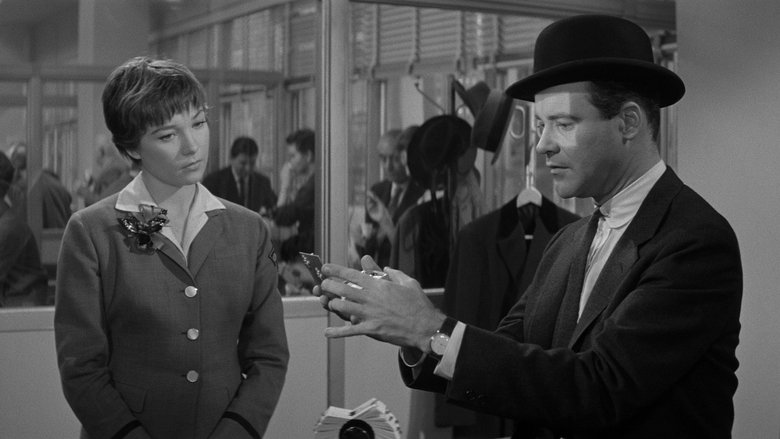
Audience reception for "The Apartment" has been overwhelmingly positive since its release, and it has solidified its place as a beloved classic. Viewers consistently praise the masterful screenplay by Billy Wilder and I.A.L. Diamond, celebrating its sharp, witty dialogue and its perfect balance of cynical humor and genuine heart. The performances of Jack Lemmon and Shirley MacLaine are almost universally adored, with audiences finding Lemmon's portrayal of the lovable, put-upon Bud Baxter deeply relatable and MacLaine's Fran Kubelik to be an unforgettable mix of charm and vulnerability. Many viewers are struck by how modern the film feels, with its themes of corporate disillusionment, loneliness, and workplace sexism remaining highly relevant. While a small minority of viewers, both then and now, find the subject matter too dark or cynical for a comedy, the vast majority see it as a sophisticated, mature, and ultimately life-affirming story about finding decency in a corrupt world. The bittersweet ending is frequently cited as a highlight—a perfectly pitched conclusion that avoids cliché in favor of something more authentic and hopeful.
Interesting Facts
- The inspiration for the film came to Billy Wilder after he saw David Lean's "Brief Encounter" (1945) and wondered about the unseen character who lends his apartment for the affair.
- The massive insurance office set was created using forced perspective. Full-sized desks and adult actors were in the foreground, followed by progressively smaller desks with children in suits, and finally tiny desks with cutouts in the far background to create the illusion of a vast space.
- Fred MacMurray, known for playing nice guys, was hesitant to play the villainous J.D. Sheldrake. After the film's release, he was reportedly accosted by women in public who were angry at his character's actions, and he vowed never to play a villain again.
- While director Billy Wilder was famously strict about actors sticking to the script, he allowed Jack Lemmon to improvise in two scenes: when Bud Baxter accidentally squirts nasal spray across the room, and when he sings while straining spaghetti with a tennis racket.
- The plot was also partly inspired by a real-life Hollywood scandal where agent Jennings Lang was shot by producer Walter Wanger for having an affair with Wanger's wife, actress Joan Bennett. Lang had been using a low-level employee's apartment for the trysts.
- The office Christmas party scene was filmed on December 23, 1959, to capture a genuine holiday atmosphere. Wilder used real alcohol and completed most of the filming on the first take.
- Shirley MacLaine was only given 40 pages of the script at a time because Wilder didn't want her to know how the story would end.
- "The Apartment" was the last entirely black-and-white film to win the Academy Award for Best Picture for over 30 years, until "Schindler's List" in 1993. (The Artist won in 2011).
- The name "Sheldrake" was a favorite of Billy Wilder's, also appearing in his films "Sunset Blvd.", "Ace in the Hole", and "Kiss Me, Stupid".
Easter Eggs
While watching TV, C.C. Baxter tries to see the movie "Grand Hotel" (1932).
This is a direct reference to a previous winner of the Academy Award for Best Picture. "The Apartment" was one of the first Best Picture winners to explicitly reference another. The scene also highlights Bud's loneliness, as he attempts to watch a classic film alone but is repeatedly interrupted.
Sheldrake makes a comment about Bud and Fran having "a lost weekend" together in the apartment.
This is an in-joke and a self-reference to director Billy Wilder's own 1945 film, "The Lost Weekend," which also won the Academy Award for Best Picture.
The prop master, Tom Plews, has his name on the door of the office next to Baxter's.
This is a subtle nod to a member of the film's crew. The name on the door reads "T.W. Plews."
⚠️ Spoiler Analysis
Click to reveal detailed analysis with spoilers
Frequently Asked Questions
Explore More About This Movie
Dive deeper into specific aspects of the movie with our detailed analysis pages
Comments (0)
No comments yet. Be the first to share your thoughts!