Full spoilers follow.
The setup. Bruno's father Ralf has been promoted to commandant of a concentration camp; the "farm" Bruno sees from his window is Auschwitz, which he calls "Out-With." The people in "striped pyjamas" are prisoners. Pavel, the elderly man peeling potatoes in the kitchen and tending Bruno's grazed knee, is a doctor stripped of his profession; he is later beaten, apparently fatally, by Lieutenant Kotler for a trivial offence at dinner — a scene Bruno witnesses and cannot process.
The house divides. Elsa, who believed her husband was a soldier, learns the truth when Kotler casually refers to what is being burned. Her horror curdles the marriage; the grandmother's contempt for the regime is already established, and she dies in an air raid. Gretel, meanwhile, is converted by the tutor Herr Liszt, papering her room with propaganda. Elsa forces Ralf to agree to send the children away — the departure date that will supply the film's ticking clock.
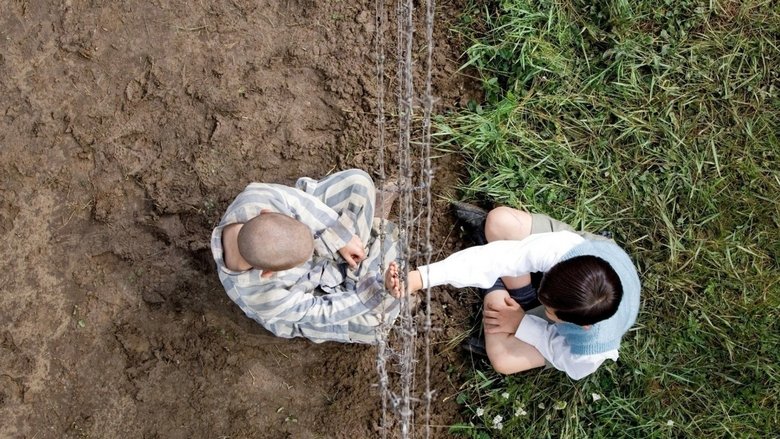
Bruno's betrayal. Bruno smuggles food to Shmuel at the fence. When Shmuel is brought into the house to polish glasses and Kotler finds him eating a cake Bruno gave him, Bruno panics and denies knowing him. Shmuel is beaten and disappears from the fence for days. When he returns, bruised, he forgives Bruno without conditions — the film's moral high point, and the engine of everything that follows.
The climax. To atone, and because Shmuel's father has gone missing, Bruno proposes an expedition: he will dig under the fence, put on a set of striped pyjamas Shmuel brings him, and help search the camp. He does exactly that on his last day, in heavy rain, hiding his own clothes in the mud. Inside, the two boys are swept up in a group of prisoners being marched from a hut. Told to undress "for a shower," they are herded into a dark chamber. Bruno, frightened, holds Shmuel's hand. The door seals; a canister of Zyklon B is emptied through the roof by a masked guard; the screen cuts to black on the sound of the chamber falling silent.
The parallel search. Simultaneously, Elsa realises Bruno is missing. The family and soldiers race into the storm and follow his tracks to the fence, where they find his discarded clothes. Ralf, understanding instantly, sprints into the camp shouting his son's name and arrives at the sealed chamber seconds too late. The final images are of Elsa collapsing at the wire, Gretel sobbing, Ralf broken against the door — and then a long, still shot of the empty changing room, the hooks along the wall hung with rows of abandoned striped uniforms.
What becomes clear afterwards. That closing shot is the film's real ending: the camera holds not on Bruno but on the clothes of everyone else who was murdered that day and every other day, refusing to let the one death stand in for the rest. Retroactively, the propaganda film Ralf screened acquires its full weight — he manufactured the very illusion that let his son believe the camp was harmless, and thus authored the misunderstanding that killed him. The striped uniform, the object that gives the film its title, works as the final proof of the film's thesis: the moment Bruno puts it on, the machine his father built cannot distinguish him from anyone else, because the distinction never existed outside the ideology that enforced it. Elsa's late awakening and Ralf's compartmentalised life both collapse in the same instant, and the fence — the boundary the household relied on to keep its comfort intact — turns out to have been permeable in the one direction they never considered.