The Boy in the Striped Pyjamas
A haunting wartime drama where childhood innocence clashes with the shadow of the Holocaust. Through a barbed-wire fence, a forbidden friendship blooms, eventually dissolving into the gray smoke of human cruelty.
The Boy in the Striped Pyjamas

The Boy in the Striped Pyjamas

"Lines may divide us, but hope will unite us."

07 May 2008 United Kingdom 94 min ⭐ 7.8 (7,467)
Director: Mark Herman
Cast: Asa Butterfield, Vera Farmiga, David Thewlis, Jack Scanlon, Amber Beattie
Drama War History
The Fragility of Innocence Boundaries and Barriers Indoctrination and Complicity The Nature of Humanity
Budget: $12,500,000
Box Office: $20,416,563

Overview

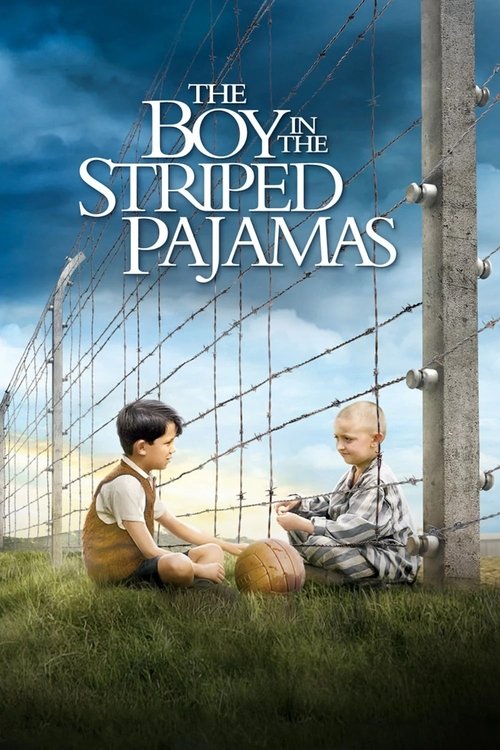
The Boy in the Striped Pyjamas (2008) is a historical drama that explores the horrors of the Holocaust through the eyes of eight-year-old Bruno. After his father, a high-ranking Nazi officer, is promoted to command a concentration camp in occupied Poland, the family moves from their comfortable life in Berlin to a desolate, isolated house. Bored and lonely, Bruno ignores his mother's warnings and explores the forbidden woods behind their home, eventually discovering a perimeter fence.

On the other side of the barbed wire, he meets Shmuel, a Jewish boy of the same age who lives in what Bruno perceives to be a 'farm' where everyone wears striped pajamas. Despite the literal and ideological barriers separating them, the two boys develop a secret friendship, exchanging food and stories. Bruno’s naive curiosity leads him to believe that their differences are merely superficial, even as the dark reality of his father’s work and the systemic violence of the camp begin to seep into his family's domestic life.

Core Meaning

The core meaning of the film lies in the devastating intersection of childhood innocence and adult inhumanity. Director Mark Herman uses the friendship between Bruno and Shmuel to argue that hatred and prejudice are learned behaviors, not innate traits. The film suggests that ideology can blind even 'ordinary' families to the suffering in their own backyards, and that the consequences of such systemic evil are ultimately undiscriminating, consuming the innocent along with the guilty.

Thematic DNA

The Fragility of Innocence 35%
Boundaries and Barriers 25%
Indoctrination and Complicity 20%
The Nature of Humanity 20%

The Fragility of Innocence

The film highlights how childhood naivety can be both a shield and a fatal flaw. Bruno’s inability to understand terms like "The Fury" (Führer) or "Out-With" (Auschwitz) protects his morality but leaves him vulnerable to the machinery of death he accidentally enters.

Boundaries and Barriers

Physical and psychological fences define the narrative. The literal barbed wire represents the racial and political divide, while the domestic boundaries within the house represent the compartmentalization of Nazi life, where a father can be a loving patriarch at breakfast and a mass murderer by noon.

Indoctrination and Complicity

Through Gretel’s transformation from a doll-loving girl to a Hitler Youth enthusiast, the film illustrates how propaganda systematically erodes empathy. It also explores the complicity of the German populace, showing how some actively participated while others, like Elsa, initially looked away.

The Nature of Humanity

By depicting the friendship between a German boy and a Jewish boy, the film asserts that human connection transcends political and ethnic lines. Shmuel is seen by the state as 'not really people,' but to Bruno, he is simply a friend, challenging the viewer's perception of dehumanization.

Character Analysis

Bruno

Asa Butterfield

Archetype: Innocent / Explorer
Key Trait: Empathetic naivety

Motivation

Driven by loneliness and curiosity. He wants to explore his new environment and find a friend to play with, leading him to the fence.

Character Arc

Bruno moves from a state of sheltered ignorance in Berlin to a tragic realization of the world's cruelty. His development is marked by his internal struggle to reconcile the 'good' father he loves with the horrific actions of the man running the camp.

Shmuel

Jack Scanlon

Archetype: Victim / Witness
Key Trait: Quiet resilience

Motivation

Survival and the longing for his family. He seeks comfort and food from Bruno while searching for his missing father.

Character Arc

Shmuel remains largely static due to his imprisonment, but his interactions with Bruno show a desperate clinging to humanity. He acts as the silent witness to the horrors Bruno cannot see.

Elsa (Mother)

Vera Farmiga

Archetype: The Disillusioned Citizen
Key Trait: Internalized conflict

Motivation

Protecting her children and maintaining a sense of domestic normalcy amidst the surrounding chaos.

Character Arc

She begins as a supportive Nazi wife but undergoes a psychological collapse as she realizes the true nature of the 'Final Solution.' Her arc represents the moral decay and eventual horror of the German middle class.

Ralf (Father)

David Thewlis

Archetype: The Dutiful Soldier / Antagonist
Key Trait: Cold professionalism

Motivation

Ambition and a rigid sense of duty to the Nazi state, believing his actions are for the greater good of his family and nation.

Character Arc

He remains steadfast in his Nazi duty, viewing his role as essential for the Reich. His arc ends in irony and total personal loss, as the machinery of death he built consumes his own legacy.

Symbols & Motifs

The Striped Pyjamas

Meaning:

Symbolizes dehumanization and the loss of individual identity. To the Nazis, the uniform marks the prisoners as sub-human; to Bruno, it is a costume for a game or a comfortable set of clothes, showing his lack of understanding of the prisoners' suffering.

Context:

The clothing worn by Shmuel and the other camp inmates. Bruno eventually dons a pair himself to sneak into the camp, which leads to his tragic end.

The Barbed Wire Fence

Meaning:

Represents the ideological barrier between the 'Aryans' and the Jews. It is the physical manifestation of the boundary between life and death, and between the 'protected' German world and the 'condemned' Jewish world.

Context:

The fence is where Bruno and Shmuel meet daily. It serves as the primary visual and narrative divider throughout the movie.

The Pile of Naked Dolls

Meaning:

A chilling visual metaphor for the mass graves of the Holocaust. It marks the death of Gretel's childhood and her replacement of empathy with Nazi ideology.

Context:

Bruno finds his sister’s discarded dolls in the basement, piled up and stripped of their clothes, mirroring the way prisoners' belongings and bodies were treated at the camp.

Memorable Quotes

Childhood is measured out by sounds and smells and sights, before the dark hour of reason grows.

— Opening Narration (quoting John Betjeman)

Context:

Displayed as a title card at the very beginning of the film.

Meaning:

Sets the stage for the film's exploration of sensory perception versus rational understanding, suggesting that children see the truth of the heart before the world forces 'logic' or 'ideology' upon them.

Those people... well, they're not really people at all, Bruno.

— Ralf (Father)

Context:

Ralf says this to Bruno when the boy asks who the people in the 'pajamas' are through his window.

Meaning:

Illustrates the dehumanization central to Nazi ideology, showing how the perpetrator justifies his actions by removing the 'human' status of the victims.

We're not supposed to be friends, you and me. We're meant to be enemies.

— Bruno

Context:

Bruno says this to Shmuel during one of their meetings at the fence after receiving lessons from his tutor.

Meaning:

Reflects the encroachment of propaganda into Bruno's mind, yet his subsequent actions prove that his inherent humanity still overrides the state-mandated hatred.

Philosophical Questions

Can innocence exist within a system of absolute evil?

The film explores whether Bruno's ignorance makes him 'innocent' or if his indirect participation in the lifestyle provided by the Holocaust makes him complicit. It asks if the 'shield' of childhood is valid when the surrounding reality is so monstrous.

Does the tragedy of the 'accidental victim' outweigh the tragedy of the 'intended' one?

By ending with Bruno’s death, the film forces the audience to confront their own empathy. Many critics argue the film manipulates the audience into grieving for the Nazi’s son more than the thousands of Jewish children, raising questions about how we value human life based on proximity and narrative framing.

Alternative Interpretations

One interpretation of the film is that it functions as a secular parable or 'fable' (as described by author John Boyne) rather than a historical document. In this reading, the physical impossibility of the fence meetings is irrelevant; the fence represents the psychological divide between empathy and apathy. Another interpretation focuses on Elsa’s descent, seeing her not as a hero, but as a representation of the 'Good German' who only objects to evil when it personally inconveniences or threatens her own family, rather than out of a universal moral stand.

Cultural Impact

The Boy in the Striped Pyjamas has a complex cultural legacy. It is widely used in schools globally as a 'gateway' to Holocaust education due to its emotional accessibility and child's perspective. However, it has been heavily criticized by organizations like the Auschwitz-Birkenau State Museum for historical inaccuracies (such as the impossibility of a child surviving the selection process to live in the camp). Critics argue that by focusing on the 'tragedy' of a Nazi child's death, the film risks creating a false moral equivalence between the perpetrators and the victims. Despite this, it remains one of the most commercially successful and recognized Holocaust films of the 21st century.

Audience Reception

The film received generally positive reviews from general audiences, who praised the powerful performances of Asa Butterfield and Vera Farmiga. It holds a 65% rating on Rotten Tomatoes but much higher 'Audience Scores.' While viewers often report being 'shattered' or 'devastated' by the ending, scholarly reception remains cold, frequently citing the film as 'historically dangerous' for its sanitization of the camp experience and its reliance on the implausible premise of the boys' friendship.

Interesting Facts

  • The parents are named Ralf and Elsa in the script but are credited only as 'Father' and 'Mother' to reflect Bruno's childlike perspective.
  • Director Mark Herman chose to have the actors speak in their natural English accents rather than fake German ones to make the characters feel more 'accessible' and less like historical caricatures.
  • The film was shot on location in Budapest, Hungary.
  • Pavel, the family's servant, was a doctor before the war, a detail that underscores the systematic waste of human life and talent during the Holocaust.
  • The ending differs slightly from the book; the film provides more visual focus on the family’s frantic search and their reaction to the tragedy.
  • To maintain the surprise of the ending, the young actors Asa Butterfield and Jack Scanlon were not told the full details of the gas chamber scene until shortly before filming.

Easter Eggs

The 'Airplane' Motif

In the opening scene, Bruno and his friends run through Berlin mimicking planes. This visualizes their innocent play, but it also references the bombing raids that would eventually destroy German cities, including the raid that kills Bruno's grandmother later in the film.

The Basement Dolls

The way the dolls are piled in the basement is a deliberate reference to the hair and belongings collected from victims at Auschwitz, a chilling detail for viewers familiar with Holocaust museum imagery.

⚠️ Spoiler Analysis

Click to reveal detailed analysis with spoilers

Frequently Asked Questions

Explore More About This Movie

Dive deeper into specific aspects of the movie with our detailed analysis pages

Comments (0)

Leave a comment

No comments yet. Be the first to share your thoughts!