
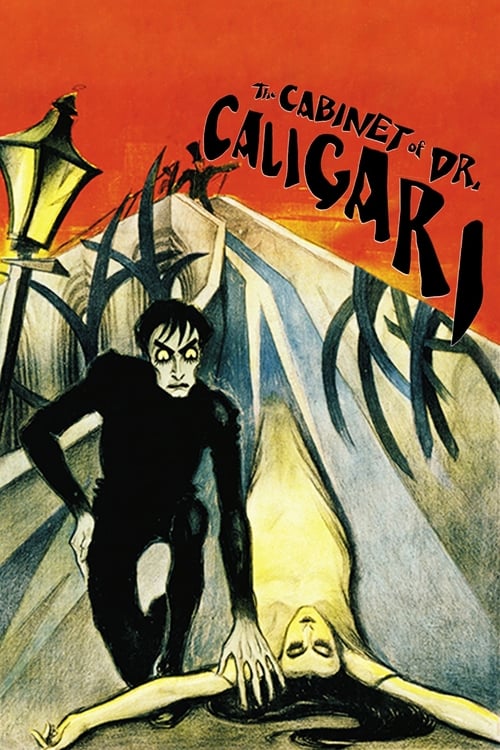
The Cabinet of Dr. Caligari
A German Expressionist nightmare of distorted reality, this silent horror film plunges the viewer into a madman's chilling tale, rendered in a world of painted shadows and jagged landscapes.
The Cabinet of Dr. Caligari

Das Cabinet des Dr. Caligari

"You must become Caligari!"

27 February 1920 Germany 77 min ⭐ 7.9 (1,690)
Director: Robert Wiene
Cast: Werner Krauss, Conrad Veidt, Friedrich Fehér, Lil Dagover, Hans Heinrich von Twardowski
Drama Crime Thriller Horror
Authority and Tyranny Sanity vs. Insanity Deception and Perception Fate and Free Will
Budget: $18,000
Box Office: $8,811

The Cabinet of Dr. Caligari - Ending Explained

⚠️ Spoiler Analysis

The groundbreaking spoiler of "The Cabinet of Dr. Caligari" is that the entire horrific tale recounted by the protagonist, Francis, is a delusion. The film's final act reveals that Francis is not a hero investigating a crime, but a patient in an insane asylum. The characters he has described are his fellow inmates: the beautiful Jane is a catatonic patient who believes she is a queen, and the menacing somnambulist Cesare is a quiet, harmless man. Most significantly, the villainous Dr. Caligari is, in reality, the benevolent director of the asylum.

This twist ending fundamentally reframes the film's unique visual style. The bizarre, distorted sets, sharp angles, and painted shadows are not just an artistic choice of German Expressionism but are a literal representation of Francis's fractured psyche. The audience is forced to understand that they have been viewing the world through the eyes of a madman. The exaggerated, theatrical performances also become clear as manifestations of his paranoid perceptions.

However, the film's true genius lies in its final moment of ambiguity. After Francis is subdued, the asylum director looks toward the camera and proclaims, "At last I understand his delusion... Now I know how to cure him." The expression on his face and the direct address to the audience can be interpreted as sinister. This leaves open the terrifying possibility that Francis was telling the truth and has been successfully silenced by the very authoritarian evil he sought to expose. This final twist ensures the film's anti-authoritarian message remains potent, questioning who holds the power to define reality and sanity.

Alternative Interpretations

The film's frame story and its final scene are the source of significant debate and alternative interpretations. While the most direct reading is that Francis is insane and his story is a delusion, many critics argue that this is a simplification that undermines the film's power.

A major alternative interpretation posits that the frame story, which was forced on the writers by the studio, is a betrayal of the original intent. In this view, Francis's core story is the truth, and the asylum ending is an allegorical representation of how authority crushes rebellion by branding it as madness. The director's final line, "Now I know how to cure him," becomes a sinister threat to silence a dissenter, making the supposedly benevolent doctor the true tyrannical Caligari. This reading preserves the film's anti-authoritarian message.

Another perspective suggests that it is not a story of sane vs. insane, but an exploration of the subjective nature of reality itself. Both the inner story and the frame story are presented with Expressionistic, distorted visuals, suggesting that neither perspective is objectively "real." The film, therefore, becomes a commentary on how individuals construct their own realities and the chaos that ensues when these subjective worlds collide. A further psychoanalytic reading suggests Francis may have invented the entire story as a complex alibi to cover his own guilt over murdering Alan, his rival for Jane's affection.