
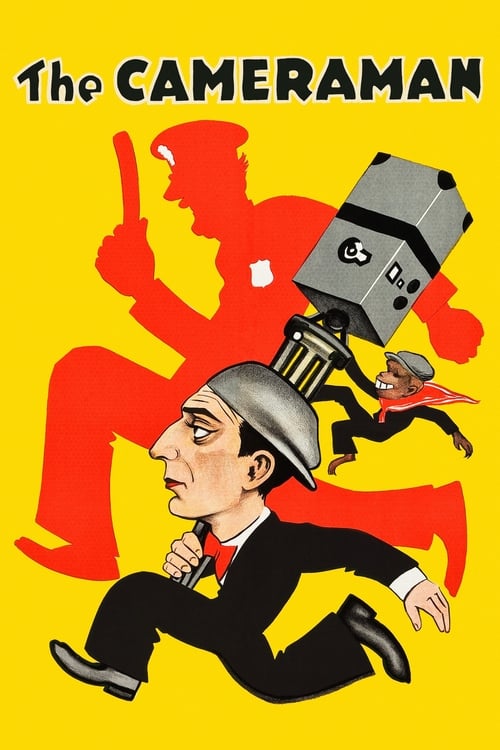
"You'll laugh yourself completely out of focus!"
The Cameraman - Symbolism & Philosophy
Symbols & Motifs
The Movie Camera
The movie camera symbolizes Buster's ambition, his link to the modern world, and his hope for a future with Sally. It represents a significant step up from his antiquated tintype equipment, embodying progress and the dynamic nature of 20th-century life. It is the tool through which he ultimately proves his worth, not by mastering it conventionally, but by allowing it to capture his unique, chaotic view of the world.
Buster purchases the camera after meeting Sally, draining his bank account to do so. His initial struggles with it provide many of the film's gags. His dogged protection of the camera during the Tong War and the final revelation of the footage it captured (both his and the monkey's) solidify its role as the key to his professional and romantic success.
The Monkey (Josephine)
The monkey represents chance, chaos, and unexpected fortune. In a world governed by rules and professional standards, the monkey is an agent of unpredictability. It is through the monkey's accidental filming that Buster's true heroism is revealed, symbolizing the idea that genius and truth can emerge from the most unlikely and chaotic of sources.
Buster acquires the monkey after a run-in with an organ grinder. The monkey accompanies him on his filming expeditions, most notably during the Tong War and the boat race. In the film's climax, the monkey picks up the camera and films Buster rescuing Sally after Harold cowardly abandons her, providing the evidence that vindicates Buster.
The Empty Yankee Stadium
The empty stadium symbolizes Buster's isolation and his desperate desire to prove himself in a world that isn't paying attention. His solitary pantomime of a baseball game is a masterful, comedic, and poignant performance for an audience of none. It highlights his creativity and resilience in the face of failure and obscurity.
After failing to find any news to film, Buster goes to Yankee Stadium, only to find it deserted because the team is playing out of town. Instead of giving up, he performs an entire baseball game by himself, playing all the positions in a brilliant display of physical comedy.
Philosophical Questions
What is the relationship between art and accident?
The film explores this question through Buster's footage. His initial, technically flawed reels are dismissed as incompetent, yet they contain surreal, avant-garde imagery created by mistake. The climax further complicates this idea: the most crucial, prize-winning footage is shot by a monkey. This suggests that art and truth can arise from pure chance, independent of the creator's skill or intent, questioning the very definition of a deliberate artist.
Does the camera capture objective reality or create its own?
"The Cameraman" constantly plays with the idea of cinematic reality. The newsreel company wants objective documentation of events. However, Buster's camera captures distorted, subjective, and sometimes more emotionally resonant images through its mistakes. The final reel, which combines footage of a Tong War with a dramatic rescue, is edited and presented in a way that creates a narrative of heroism. The film suggests that the act of filming and editing is never truly objective, but always an act of creating a specific version of reality.
Core Meaning
The core meaning of "The Cameraman" is a celebration of perseverance, authenticity, and the idea that true artistry comes from the heart, not just technical skill. The film posits that passion and a unique perspective can triumph over conventional competence. Director Edward Sedgwick and Keaton explore the theme that the camera, as a tool of the modern age, does not merely capture reality but can reveal deeper truths through accident and chance. Buster's journey from a bumbling amateur to a celebrated professional isn't a story of him learning to be like everyone else; it's a story of his unique, chaotic approach being recognized for the accidental genius it contains. The film ultimately champions the underdog and suggests that love is the most powerful motivator for self-improvement and success.