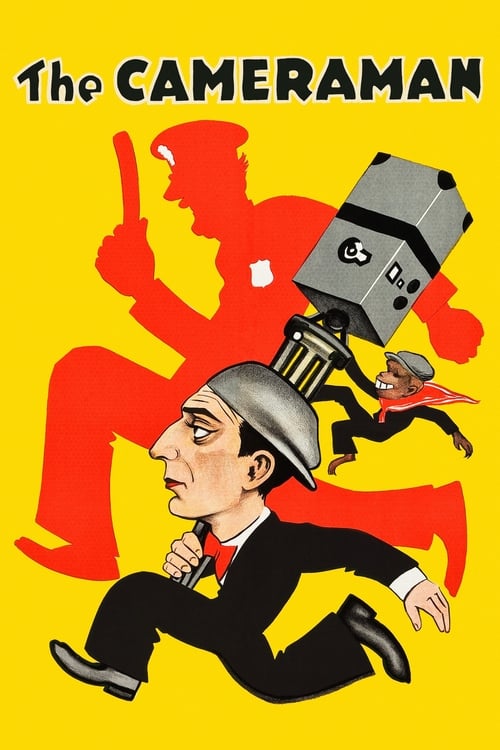
The Cameraman
A silent comedy's earnest heart pulses with a romantic fervor, painting a portrait of ambition and accidental genius through the chaotic lens of a clumsy cameraman's world.
The Cameraman

The Cameraman

"You'll laugh yourself completely out of focus!"

10 September 1928 United States of America 74 min ⭐ 7.8 (411)
Director: Edward Sedgwick Buster Keaton
Cast: Buster Keaton, Marceline Day, Harold Goodwin, Sidney Bracey, Harry Gribbon
Comedy Romance
Love as a Catalyst for Ambition The Nature of Filmmaking and Reality The Triumph of the Underdog Man vs. Machine

Overview

"The Cameraman" follows Buster (Buster Keaton), a humble and somewhat inept tintype photographer in New York City. His life takes an unexpected turn when he becomes instantly smitten with Sally (Marceline Day), a charming secretary for MGM Newsreels. Determined to win her affection and get closer to her, Buster trades his still camera for a rundown motion picture camera and attempts to become a newsreel cameraman himself. This decision pits him against the arrogant established cameraman, Harold Stagg (Harold Goodwin), who also has his eyes on Sally.

Sally encourages Buster's new ambition, advising him to go out and film anything he can. However, his initial efforts are a comical disaster, resulting in double-exposed, backward, and generally unusable footage that earns him only ridicule from the professionals at MGM. Despite his repeated failures and the constant mishaps that seem to follow him—from a chaotic trip to a public swimming pool to a drenching ride in a rumble seat—Buster's persistence is unwavering, fueled by his love for Sally and his own resilient spirit.
Core Meaning

The core meaning of "The Cameraman" is a celebration of perseverance, authenticity, and the idea that true artistry comes from the heart, not just technical skill. The film posits that passion and a unique perspective can triumph over conventional competence. Director Edward Sedgwick and Keaton explore the theme that the camera, as a tool of the modern age, does not merely capture reality but can reveal deeper truths through accident and chance. Buster's journey from a bumbling amateur to a celebrated professional isn't a story of him learning to be like everyone else; it's a story of his unique, chaotic approach being recognized for the accidental genius it contains. The film ultimately champions the underdog and suggests that love is the most powerful motivator for self-improvement and success.

Thematic DNA

Love as a Catalyst for Ambition 35%
The Nature of Filmmaking and Reality 30%
The Triumph of the Underdog 25%
Man vs. Machine 10%

Love as a Catalyst for Ambition

The entire plot is driven by Buster's love for Sally. His decision to abandon his modest career as a tintype photographer and plunge into the competitive, modern world of newsreel cinematography is solely to be near her and win her admiration. Every comical failure and every daring attempt is a testament to his devotion. Sally, in turn, provides the encouragement that fuels his persistence, seeing the genuine heart behind his clumsy exterior.

The Nature of Filmmaking and Reality

The film is a meta-commentary on the art of filmmaking itself. Buster's early, technically flawed footage—with its double exposures and reversed action—is laughed at by the newsreel professionals but celebrated by modern critics as accidentally avant-garde. This theme culminates in the climax, where the most crucial and heroic footage is captured not by a skilled professional, but by a monkey, suggesting that incredible moments can be recorded by chance and that the camera can capture truths the human eye might miss.

The Triumph of the Underdog

A quintessential Keaton theme, "The Cameraman" champions the earnest, seemingly incompetent individual against a world of arrogant professionals. Buster is consistently mocked by his rival Harold and the other MGM cameramen. He is physically smaller and professionally inept. Yet, his unwavering determination, kindness, and courage ultimately lead to his success, proving that innate character is more valuable than superficial skill or social standing.

Man vs. Machine

Buster's relationship with his movie camera is a central comedic element. The device is both his key to success and a constant source of frustration. He struggles to operate it, leading to disastrous results. However, his refusal to abandon it, even during a violent Tong War, shows his dedication. The camera becomes an extension of his ambition, a chaotic partner in his quest for love and recognition.

Character Analysis

Buster

Buster Keaton

Archetype: The Lovable Underdog / The Accidental Hero
Key Trait: Resilient Optimism

Motivation

His primary motivation is to win the love and respect of Sally. This desire drives him to change careers, face physical danger, and endure constant ridicule.

Character Arc

Buster begins as a humble, anachronistic tintype photographer who is clumsy and socially awkward. His infatuation with Sally propels him into the fast-paced world of newsreel filming, where he is initially a complete failure. Through sheer perseverance, courage, and a series of fortunate accidents, he not only captures incredible footage but also proves his heroic character, ultimately transforming into a respected professional and winning the girl's heart.

Sally Richards

Marceline Day

Archetype: The Supportive Love Interest
Key Trait: Encouraging

Motivation

Sally is motivated by a desire for genuine connection and decency. She is drawn to Buster's good heart and encourages his efforts, hoping to see him succeed.

Character Arc

Sally starts as the object of Buster's affection. Unlike others, she sees past his awkwardness and appreciates his kindness and determination. She consistently encourages him despite his failures. Her arc solidifies as she witnesses Buster's genuine heroism in rescuing her, choosing his authentic courage over Harold's superficial charm, and ultimately becoming his biggest advocate.

Harold Stagg

Harold Goodwin

Archetype: The Rival / The Bully
Key Trait: Arrogant

Motivation

Harold is motivated by ego and a desire to maintain his superior status, both professionally and in his pursuit of Sally. He seeks to belittle Buster to eliminate him as a rival.

Character Arc

Harold is an arrogant and condescending MGM cameraman who serves as a direct foil to Buster. He is professionally competent but morally bankrupt. His arc is one of exposure; he begins as the successful rival but his true cowardly and deceitful nature is revealed when he abandons Sally in danger and later tries to take credit for her rescue. He ends the film disgraced.

Symbols & Motifs

The Movie Camera

Meaning:

The movie camera symbolizes Buster's ambition, his link to the modern world, and his hope for a future with Sally. It represents a significant step up from his antiquated tintype equipment, embodying progress and the dynamic nature of 20th-century life. It is the tool through which he ultimately proves his worth, not by mastering it conventionally, but by allowing it to capture his unique, chaotic view of the world.

Context:

Buster purchases the camera after meeting Sally, draining his bank account to do so. His initial struggles with it provide many of the film's gags. His dogged protection of the camera during the Tong War and the final revelation of the footage it captured (both his and the monkey's) solidify its role as the key to his professional and romantic success.

The Monkey (Josephine)

Meaning:

The monkey represents chance, chaos, and unexpected fortune. In a world governed by rules and professional standards, the monkey is an agent of unpredictability. It is through the monkey's accidental filming that Buster's true heroism is revealed, symbolizing the idea that genius and truth can emerge from the most unlikely and chaotic of sources.

Context:

Buster acquires the monkey after a run-in with an organ grinder. The monkey accompanies him on his filming expeditions, most notably during the Tong War and the boat race. In the film's climax, the monkey picks up the camera and films Buster rescuing Sally after Harold cowardly abandons her, providing the evidence that vindicates Buster.

The Empty Yankee Stadium

Meaning:

The empty stadium symbolizes Buster's isolation and his desperate desire to prove himself in a world that isn't paying attention. His solitary pantomime of a baseball game is a masterful, comedic, and poignant performance for an audience of none. It highlights his creativity and resilience in the face of failure and obscurity.

Context:

After failing to find any news to film, Buster goes to Yankee Stadium, only to find it deserted because the team is playing out of town. Instead of giving up, he performs an entire baseball game by himself, playing all the positions in a brilliant display of physical comedy.

Memorable Quotes

Don't be discouraged. You just keep trying.

— Sally Richards (Intertitle)

Context:

This intertitle appears after Buster's first batch of film is screened at MGM and is met with laughter and derision. While everyone else dismisses him, Sally offers these words of comfort, inspiring him to not give up on his new dream.

Meaning:

This line encapsulates Sally's role as Buster's primary source of support. It's a simple but powerful message of encouragement that fuels his determination in the face of constant failure and ridicule. It establishes the film's romantic core and its theme of perseverance.

The new cameraman seems to have a fine artistic touch--He shot this battleship coming down Broadway.

— Newsreel Staff (Intertitle)

Context:

This line is shown as an intertitle representing the mockery from the MGM staff as they watch Buster's first reel. One of his mistakes was double-exposing footage of a battleship over a shot of a city street, leading to this comical observation.

Meaning:

This sarcastic comment highlights the technical incompetence of Buster's initial filmmaking attempts. The humor lies in the absurdity of his double-exposed footage, which accidentally creates a surreal, artistic image. The quote underscores the theme of accidental art versus commercial filmmaking.

Philosophical Questions

What is the relationship between art and accident?

The film explores this question through Buster's footage. His initial, technically flawed reels are dismissed as incompetent, yet they contain surreal, avant-garde imagery created by mistake. The climax further complicates this idea: the most crucial, prize-winning footage is shot by a monkey. This suggests that art and truth can arise from pure chance, independent of the creator's skill or intent, questioning the very definition of a deliberate artist.

Does the camera capture objective reality or create its own?

"The Cameraman" constantly plays with the idea of cinematic reality. The newsreel company wants objective documentation of events. However, Buster's camera captures distorted, subjective, and sometimes more emotionally resonant images through its mistakes. The final reel, which combines footage of a Tong War with a dramatic rescue, is edited and presented in a way that creates a narrative of heroism. The film suggests that the act of filming and editing is never truly objective, but always an act of creating a specific version of reality.

Alternative Interpretations

While on the surface a straightforward romantic comedy, "The Cameraman" can be interpreted as a poignant allegory for Buster Keaton's own professional anxieties. His move to MGM marked the end of his independent studio where he had total creative freedom. The film's plot, in which an individual artist (Buster) struggles against the rigid, formulaic expectations of a large media corporation (MGM Newsreels), directly mirrors Keaton's own battle with the studio system. Buster's ultimate success comes not from conforming, but from his unique, chaotic, and accidental footage—a potential argument from Keaton that true artistry can't be tamed by studio mandates.

Another interpretation focuses on the nature of cinema itself. The film constantly plays with the idea of what is real versus what is recorded. Buster's "failed" footage, with its surreal double exposures, is arguably more artistic than the straightforward newsreels. The climax, where a monkey becomes the 'cameraman' who captures the most truthful and heroic event, can be seen as a commentary on the unpredictable, almost magical ability of film to capture reality, suggesting that the intention of the person behind the camera is less important than the truth the lens happens to record.

Cultural Impact

"The Cameraman" was released in 1928, at the pinnacle of the silent film era and on the cusp of the sound revolution. It represents the last great, creatively independent work of Buster Keaton before his career was stifled by the rigid MGM studio system. The film itself is a meta-narrative on the changing media landscape, contrasting Buster's old-fashioned tintype photography with the fast-paced, modern world of the newsreel.

Critically and commercially, the film was a success upon its release, lauded for its ingenious gags and perfect comedic structure. For years, MGM held it up as the blueprint for a perfect comedy. However, its reputation has grown immensely over time, with modern critics and fans considering it one of Keaton's masterpieces, alongside classics like "The General" and "Sherlock Jr." Its influence can be seen in countless comedies about filmmaking and in the work of physical comedians who followed. The film's poignant struggle of an independent artist against a corporate machine prophetically mirrored Keaton's own career trajectory at MGM, adding a layer of tragic irony to its legacy. The film was added to the National Film Registry in 2005, cementing its status as a culturally significant American film.

Audience Reception

Upon its release in 1928, "The Cameraman" was a box office hit and was well-received by critics, who praised Buster Keaton's performance and the film's clever and original gags. It was widely regarded as a perfectly structured comedy. Decades later, its reputation has only grown, with contemporary audiences and critics almost universally hailing it as one of Keaton's finest masterpieces. Praise is often directed at the inventive set-pieces, such as the solo baseball game at Yankee Stadium and the chaotic dressing room scene. Viewers celebrate the film's blend of hilarious slapstick with a genuinely sweet and heartfelt romance, noting that it has more emotional depth than many of Keaton's other works. There is virtually no criticism of the film today; it is seen as the brilliant final flourish of Keaton's golden era of creative freedom.

Interesting Facts

  • "The Cameraman" was Buster Keaton's first film after signing a contract with Metro-Goldwyn-Mayer (MGM), a move he later called "the worst mistake of my career" because it led to the loss of his creative independence.
  • Although Edward Sedgwick is the credited director, Keaton had significant creative control and co-directed much of the film uncredited. It was the last film where he was able to maintain this level of artistic input.
  • MGM's production head, Irving Thalberg, loved the film and laughed heartily during the rushes, a rare display of emotion from him.
  • For decades, MGM used the film to train new writers and comedians, considering it a "perfectly constructed comedy" until their print wore out.
  • The film was considered lost for many years, believed to have been destroyed in the 1965 MGM vault fire. A nearly complete print was found in Paris in 1968, and a higher-quality (though incomplete) print was discovered in 1991, which were combined for modern releases.
  • The famous dressing room scene, where Buster and another man hilariously struggle to change in a tiny cubicle, was improvised on the spot in a single take with unit manager Edward Brophy.
  • The baseball scene in the empty Yankee Stadium was inspired by Keaton's real-life passion for the sport; he even organized charity baseball teams in Hollywood.
  • In 2005, "The Cameraman" was selected for preservation in the United States National Film Registry by the Library of Congress as being "culturally, historically, or aesthetically significant."

⚠️ Spoiler Analysis

Click to reveal detailed analysis with spoilers

Frequently Asked Questions

Explore More About This Movie

Dive deeper into specific aspects of the movie with our detailed analysis pages

Comments (0)

Leave a comment

No comments yet. Be the first to share your thoughts!