Il conformista
"A dazzling movie."
The Conformist - Symbolism & Philosophy
Symbols & Motifs
Plato's Cave / Light and Shadow
It symbolizes the illusions and false realities of fascist ideology, representing a society that prefers comfortable lies over the painful truth.
Marcello explicitly discusses Plato's Cave with Professor Quadri. Visually, it is constantly reinforced through chiaroscuro lighting and the final scene where Marcello sits near a fire looking out from the darkness.
Fascist Architecture
The crushing, oppressive weight of the totalitarian state over personal identity.
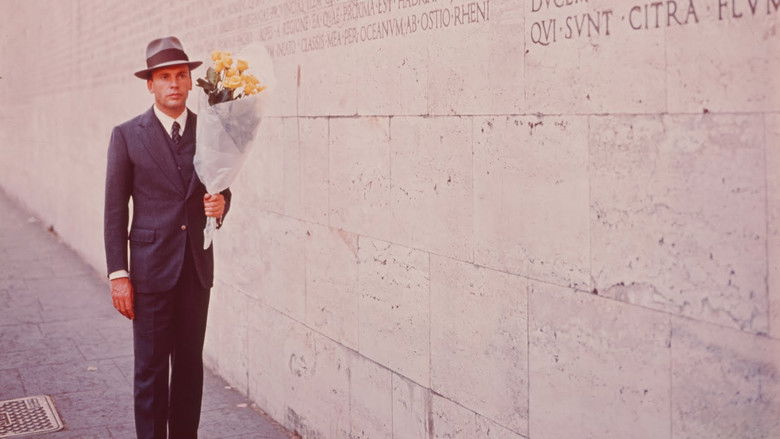
Marcello is frequently filmed from low angles against massive, imposing, stark white marble structures, making him look tiny, insignificant, and swallowed by the state.
The Blind Friend (Italo)
Willful ignorance, moral blindness, and the unthinking dissemination of propaganda.
Italo is a fascist radio broadcaster who literally cannot see, yet confidently preaches the regime's ideals to the masses.
The Snowy Woods of Savoy
The cold, stark, unfeeling reality of nature and death, contrasting with the artificial warmth of the city.
This is the setting for the film's brutal climax. The white snow provides a blank, merciless canvas for the horrific political assassination.
Venetian Blinds and Striped Shadows
Mental and societal entrapment; the feeling of living in a prison of one's own making.
Shadows are frequently cast across Marcello and Giulia's faces and bodies, visually locking them behind conceptual prison bars.
Philosophical Questions
Is evil driven by fanatical ideology, or by deep-seated personal insecurity?
The film suggests that horrific atrocities are often committed not out of a genuine belief in a cause, but out of a desperate, cowardly desire to fit into a broken society. Marcello facilitates murder simply to prove he is "normal."
What is the true moral price of conformity?
It challenges the societal pursuit of assimilation, asking if the sacrifice of one's soul, individuality, and basic human empathy is worth the perceived safety of social acceptance.
Core Meaning
Bernardo Bertolucci's masterpiece explores the deep psychological roots of authoritarianism, positing that fascism is not merely a political ideology, but a refuge for the insecure and the traumatized.
The director argues that totalitarian regimes thrive not just on fanatical zealots, but on the moral cowardice of ordinary people who are terrified of their own perceived deviance. Through Marcello, the film sends a chilling message: the desperate desire to be "normal" and fit into mainstream society can drive a person to commit the most unnatural and horrific acts.