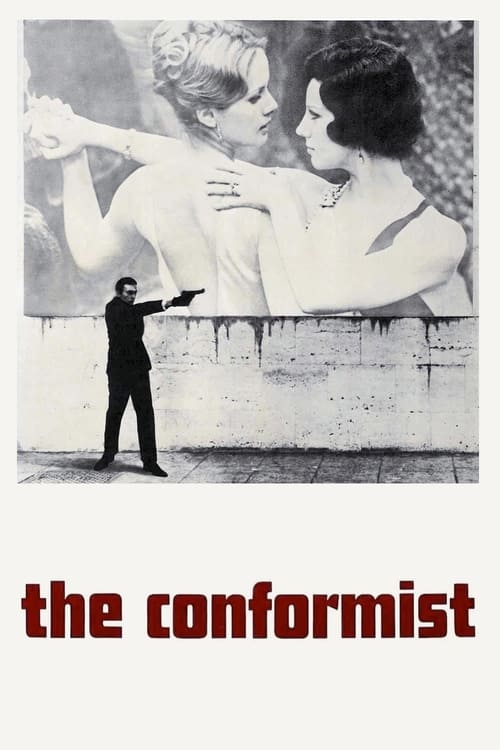
The Conformist
A suffocating, velvet-draped descent into moral bankruptcy. The cold architecture of Fascism mirrors a hollow soul, as a man trades his humanity for the illusion of normalcy, lost in a labyrinth of light and shadow.
The Conformist

The Conformist

Il conformista

"A dazzling movie."

29 January 1971 Germany 108 min ⭐ 7.7 (749)
Director: Bernardo Bertolucci
Cast: Jean-Louis Trintignant, Stefania Sandrelli, Gastone Moschin, Dominique Sanda, Enzo Tarascio
Drama
The Psychology of Conformity and Fascism Repression and Sexuality Illusion vs. Reality (Blindness) Bourgeois Decadence and Mediocrity
Budget: $750,000
Box Office: $233,493

Overview

Set primarily in 1938, the film follows Marcello Clerici, an Italian aristocrat who willingly joins Benito Mussolini's secret police. Driven by a traumatic childhood event that left him feeling deeply abnormal and guilty, Marcello is desperate to assimilate into the prevailing political and social order. To perfect his facade of ordinary life, he marries Giulia, a shallow, middle-class woman who embodies the mediocre conformity he craves.

Marcello is assigned a grim task to prove his loyalty to the fascist state: he must travel to Paris and orchestrate the assassination of his former college mentor, Professor Quadri, who is now an outspoken anti-fascist exile. Using his honeymoon as a convenient cover, Marcello navigates a dangerous web of political intrigue and personal desire.

Upon arriving in Paris, the mission is complicated when Marcello becomes infatuated with Quadri's enigmatic and sexually liberated wife, Anna. As the assassination date looms closer, Marcello's carefully constructed world begins to fracture, forcing a collision between his repressed psychological demons and his desperate quest to belong.
Core Meaning

Bernardo Bertolucci's masterpiece explores the deep psychological roots of authoritarianism, positing that fascism is not merely a political ideology, but a refuge for the insecure and the traumatized.

The director argues that totalitarian regimes thrive not just on fanatical zealots, but on the moral cowardice of ordinary people who are terrified of their own perceived deviance. Through Marcello, the film sends a chilling message: the desperate desire to be "normal" and fit into mainstream society can drive a person to commit the most unnatural and horrific acts.

Thematic DNA

The Psychology of Conformity and Fascism 35%
Repression and Sexuality 25%
Illusion vs. Reality (Blindness) 25%
Bourgeois Decadence and Mediocrity 15%

The Psychology of Conformity and Fascism

The film treats fascism as a psychological disease rather than just a political stance. Marcello does not join the secret police out of patriotic fervor, but out of a pathetic desire to blend in. The theme illustrates how the fear of standing out allows totalitarianism to flourish.

Repression and Sexuality

Marcello's latent homosexuality and deep-seated childhood trauma act as the engine for his overcompensation. In contrast, Anna's fluid sexuality and uninhibited nature represent the freedom and truth that Marcello is violently trying to suppress within himself.

Illusion vs. Reality (Blindness)

Explicitly tied to Plato's Allegory of the Cave, the film constantly plays with the idea of blindness to the truth. The citizens of Fascist Italy—represented literally by Marcello's blind friend Italo—are trapped watching the "shadows" of propaganda, unable or unwilling to see reality.

Bourgeois Decadence and Mediocrity

The emptiness of the middle-class values that Marcello idolizes is heavily critiqued. Giulia's petty ambitions, her obsession with domesticity, and Marcello's dysfunctional aristocratic family highlight the moral rot hiding behind polite society.

Character Analysis

Marcello Clerici

Jean-Louis Trintignant

Archetype: Antihero / The Conformist
Key Trait: Moral Cowardice

Motivation

To completely bury his perceived deviance and childhood trauma by becoming entirely, invisibly "normal" within a fascist society.

Character Arc

Marcello transitions from a man actively building a facade of brutal normalcy to a shattered shell. When his regime falls and his foundational trauma is proven false, he completely unravels, left with nothing but his own emptiness.

Anna Quadri

Dominique Sanda

Archetype: Rebel / Temptress
Key Trait: Uninhibited

Motivation

Political and personal liberty, driven by passion, intuition, and a desire to disrupt conformity.

Character Arc

Anna begins as a playful, seductive force of resistance who sees right through Marcello's facade, but ultimately becomes a tragic victim of the regime she defied.

Giulia

Stefania Sandrelli

Archetype: The Ordinary Citizen
Key Trait: Mediocre

Motivation

Social stability, marital conventionality, and willful ignorance of the darker political reality.

Character Arc

Giulia remains largely static, comfortably oblivious and compliant, surviving through her unwavering commitment to bourgeois domesticity.

Professor Quadri

Enzo Tarascio

Archetype: Mentor / Martyr
Key Trait: Idealistic

Motivation

To oppose totalitarianism through intellectual freedom and ideological resistance.

Character Arc

Acts as Marcello's moral and intellectual foil. He mistakenly places his faith in Marcello's intellect over his intuition, leading to his brutal downfall.

Symbols & Motifs

Plato's Cave / Light and Shadow

Meaning:

It symbolizes the illusions and false realities of fascist ideology, representing a society that prefers comfortable lies over the painful truth.

Context:

Marcello explicitly discusses Plato's Cave with Professor Quadri. Visually, it is constantly reinforced through chiaroscuro lighting and the final scene where Marcello sits near a fire looking out from the darkness.

Fascist Architecture

Meaning:

The crushing, oppressive weight of the totalitarian state over personal identity.

Context:

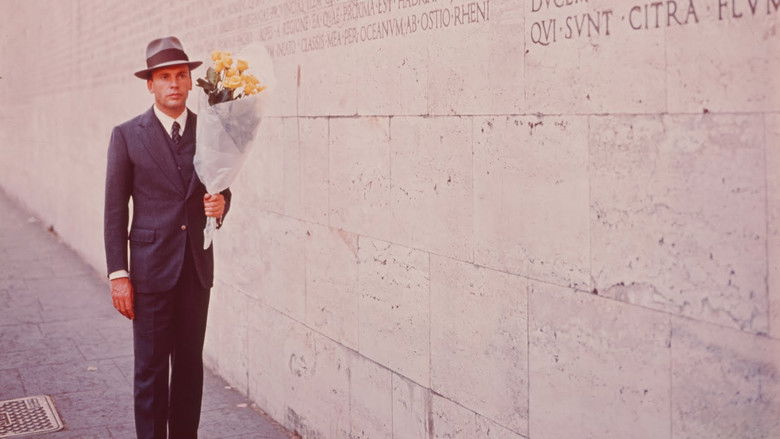
Marcello is frequently filmed from low angles against massive, imposing, stark white marble structures, making him look tiny, insignificant, and swallowed by the state.

The Blind Friend (Italo)

Meaning:

Willful ignorance, moral blindness, and the unthinking dissemination of propaganda.

Context:

Italo is a fascist radio broadcaster who literally cannot see, yet confidently preaches the regime's ideals to the masses.

The Snowy Woods of Savoy

Meaning:

The cold, stark, unfeeling reality of nature and death, contrasting with the artificial warmth of the city.

Context:

This is the setting for the film's brutal climax. The white snow provides a blank, merciless canvas for the horrific political assassination.

Venetian Blinds and Striped Shadows

Meaning:

Mental and societal entrapment; the feeling of living in a prison of one's own making.

Context:

Shadows are frequently cast across Marcello and Giulia's faces and bodies, visually locking them behind conceptual prison bars.

Memorable Quotes

I'm going to build a life that's normal. I'm marrying a petty bourgeoise.

— Marcello Clerici

Context:

Marcello is speaking during his confession to a priest, rationalizing his impending marriage to Giulia.

Meaning:

This exposes his hollow motivation for marriage. He does not seek a romantic partner, but rather a societal prop to validate his disguise.

Really serious people are never serious.

— Professor Quadri

Context:

Said in Paris when discussing Marcello's demeanor as a student.

Meaning:

Highlights the absurdity of fascist rigidity compared to true intellectual freedom and philosophical curiosity.

Cowards, homosexuals, Jews – they're all the same thing! If it were up to me, I'd stand them all against a wall!

— Manganiello

Context:

The fascist agent Manganiello expresses his disgust while waiting in the car during the mission.

Meaning:

Showcases the brutal, unvarnished bigotry of the fascist regime, serving as a dark mirror to Marcello's own internal conflicts and repressed fears.

They're all very moral maladies.

— Marcello Clerici

Context:

Marcello says this to Giulia's mother after she lists the mundane childhood illnesses Giulia has survived.

Meaning:

Demonstrates his pathological obsession with aligning everything—even biological facts and childhood illnesses—with a rigid, acceptable moral order.

Philosophical Questions

Is evil driven by fanatical ideology, or by deep-seated personal insecurity?

The film suggests that horrific atrocities are often committed not out of a genuine belief in a cause, but out of a desperate, cowardly desire to fit into a broken society. Marcello facilitates murder simply to prove he is "normal."

What is the true moral price of conformity?

It challenges the societal pursuit of assimilation, asking if the sacrifice of one's soul, individuality, and basic human empathy is worth the perceived safety of social acceptance.

Alternative Interpretations

The Freudian Psychoanalytic Reading: Many critics interpret the entire film through a strictly psychoanalytic lens, viewing Marcello's journey as a desperate attempt to overcome his Oedipal complex and severe childhood trauma. In this view, fascism is merely an external manifestation of his psychological defense mechanisms. Conforming to the state is his way of overcompensating for his latent homosexuality, and his assassination of Professor Quadri is a symbolic patricide.

The Subjective Reality/Fever Dream Theory: Given the film's highly stylized, disjointed, and surreal visual grammar, some viewers suggest the narrative unfolds entirely within Marcello's subjective, fractured memory. The fluid transitions between past and present, the theatrical lighting, and the almost dreamlike logic of scenes (like the dancers freezing in the Parisian ballroom) emphasize that we are witnessing the distorted perceptions of a guilty, unreliable mind rather than objective historical events.

Cultural Impact

The Conformist is widely regarded as a cinematic masterpiece that fundamentally altered the visual language of modern film. Released during a politically volatile period, its deep dive into the psychology of fascism struck a nerve with audiences and critics alike, shifting the historical focus from the battlefield to the internal rot of the complicit citizen.

Its greatest cultural impact lies in its profound influence on the "New Hollywood" directors of the 1970s. Filmmakers like Francis Ford Coppola, Martin Scorsese, and Steven Spielberg studied Bertolucci's use of fluid camera movements, non-linear storytelling, and psychological architecture. Coppola proudly integrated its visual motifs into The Godfather series.

Furthermore, Vittorio Storaro's cinematography set a new global benchmark. His masterful integration of Art Deco aesthetics, aggressive chiaroscuro lighting, and bold color palettes went on to influence not just cinema, but fashion photography, advertising, and music videos for decades to come.

Audience Reception

Upon release, The Conformist was met with widespread critical acclaim, immediately establishing Bernardo Bertolucci as an international auteur. Critics and audiences uniformly praised its breathtaking cinematography, intricate production design, and Jean-Louis Trintignant's chillingly restrained performance as the hollow protagonist.

While arthouse audiences lauded the film's complex, non-linear structure and heavy political symbolism, some mainstream viewers found the disjointed timeline and cold, unlikable characters challenging to engage with emotionally. The brutal climax in the snowy woods of Savoy was frequently cited as a point of visceral shock, praised for its masterful execution but noted for its devastating bleakness.

Today, the overall verdict is unanimous among cinephiles: it is a flawless exercise in style meeting substance, maintaining a 100% rating on review aggregators and regularly appearing on lists of the greatest films ever made.

Interesting Facts

  • Director Bernardo Bertolucci was only 29 years old when he made the film.
  • The movie was shot on a relatively modest budget of just $750,000, yet it features some of the most lavish and acclaimed production design in film history.
  • Francis Ford Coppola was so heavily influenced by the film's visual style that he hired its cinematographer, Vittorio Storaro, to shoot 'Apocalypse Now'.
  • The iconic shot of autumn leaves blowing around Marcello directly inspired a very similar scene in Coppola's 'The Godfather Part II'.
  • Marlon Brando reportedly agreed to star in Bertolucci's next film, 'Last Tango in Paris', largely because he was so impressed by 'The Conformist'.

Easter Eggs

Professor Quadri's Address and Phone Number

Bertolucci gave Professor Quadri the actual Paris address and phone number of his real-life former mentor, the legendary French New Wave director Jean-Luc Godard. The assassination plot symbolically mirrored Bertolucci "killing" his cinematic father to forge his own distinct artistic path.

The Sopranos 'Pine Barrens' Homage

The brutal, snowy, wooded assassination scene directly inspired the visual style, lighting, and haunting mood of the famous "Pine Barrens" episode of The Sopranos, directed by Steve Buscemi.

⚠️ Spoiler Analysis

Click to reveal detailed analysis with spoilers

Frequently Asked Questions

Explore More About This Movie

Dive deeper into specific aspects of the movie with our detailed analysis pages

Comments (0)

Leave a comment

No comments yet. Be the first to share your thoughts!