El ángel exterminador
"The degeneration of high society!"
The Exterminating Angel - Ending Explained
⚠️ Spoiler Analysis
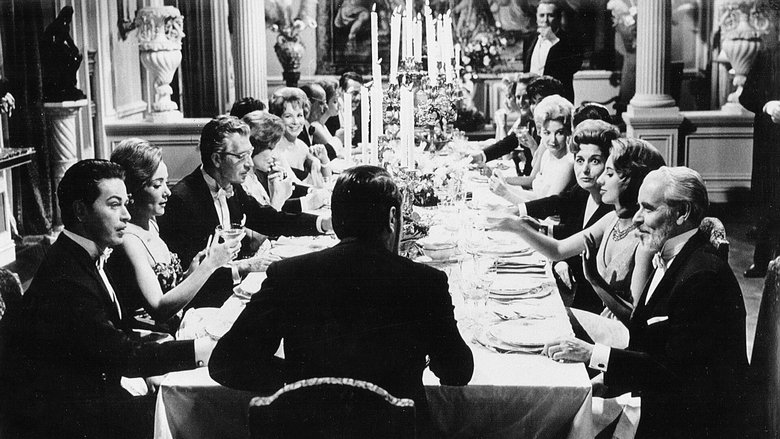
The entire plot of "The Exterminating Angel" hinges on an inexplicable phenomenon: after a dinner party, none of the wealthy guests can bring themselves to leave the host's music room. There is no physical barrier, only a psychological one. As days pass, their refined manners dissolve completely. They smash a water pipe in the wall to drink, burn furniture and a cello for warmth, and capture and roast sheep that have mysteriously wandered into the house. One elderly guest, Sergio, dies of natural causes and his body is hidden in a closet. A young engaged couple, Eduardo and Beatriz, commit suicide together in another closet.
The group's paranoia escalates, and a faction, led by Raúl, decides that the host, Edmundo Nóbile, is the cause of their curse and must be sacrificed. Just as they are about to kill him, a guest named Leticia has a moment of clarity. She realizes that everyone is in the exact same position they were in on the first night, just after the piano recital. She convinces the group to meticulously re-enact their conversations and actions from that moment. After they complete this bizarre ritual of repetition, the spell is broken, and they are suddenly able to walk out of the room and leave the mansion.
The final, devastating twist comes in the last scene. The survivors attend a Te Deum mass at a cathedral to give thanks for their deliverance. As the service concludes, it becomes clear that they—along with the entire congregation and the clergy—are now trapped inside the church. Outside, riot police are seen suppressing a demonstration. The film ends with a flock of sheep entering the cathedral, implying that the cycle of mindless ritual and inexplicable confinement is beginning all over again, this time on a larger, societal scale. The hidden meaning is that their 'escape' was temporary and illusory; humanity is perpetually trapped by its social and religious structures, doomed to repeat its folly.
Alternative Interpretations
While the most common interpretation sees the film as a political allegory for Franco's Spain and a critique of the bourgeoisie, several other readings exist:
- Psychoanalytic Interpretation: From this perspective, the room represents the human psyche, and the inability to leave symbolizes a collective psychological repression. The guests are trapped by their own unconscious desires, fears, and social taboos. Their eventual escape through the ritual of repetition could be seen as a form of psychotherapy, where confronting and re-enacting a trauma allows for release.
- Religious/Metaphysical Allegory: The title itself invites a religious reading, with the 'Exterminating Angel' being a divine or demonic force punishing the guests for their sins and moral vacuity. The house on 'Providence Street' becomes a version of Hell, a state of being where souls are condemned to eternally confront each other's true natures. The cyclical ending, trapping them in a church, suggests that humanity is perpetually trapped by its own systems of belief and ritual, unable to achieve true freedom.
- Existentialist Reading: The film can be viewed through the lens of existentialism, particularly Jean-Paul Sartre's play "No Exit," where "hell is other people." The guests are condemned to an absurd, meaningless situation without explanation. Their confinement forces them to confront the void at the center of their existence, which was previously masked by social rituals. The psychological barrier is a manifestation of their own lack of free will or their inability to act decisively in a meaningless universe.
- A Purely Surrealist Work: Buñuel himself often resisted allegorical interpretations, encouraging a more direct, intuitive experience of his films. In this view, the film is not meant to be a puzzle with a single solution. It is an exercise in surrealism, designed to provoke, disturb, and explore the logic of dreams. The bizarre events are not symbols for something else; they are simply a depiction of a reality where the irrational has taken over.