The Exterminating Angel
A surrealist black comedy descending into a terrifying allegory as high-society guests find themselves psychologically trapped at a dinner party, their polished veneers cracking under pressure.
The Exterminating Angel

The Exterminating Angel

El ángel exterminador

"The degeneration of high society!"

16 May 1962 Mexico 93 min ⭐ 7.9 (698)
Director: Luis Buñuel
Cast: Silvia Pinal, Enrique Rambal, Jacqueline Andere, José Baviera, Augusto Benedico
Drama Fantasy Comedy
Critique of the Bourgeoisie Breakdown of Social Order The Irrational and Unexplained Religion and Ritual

Overview

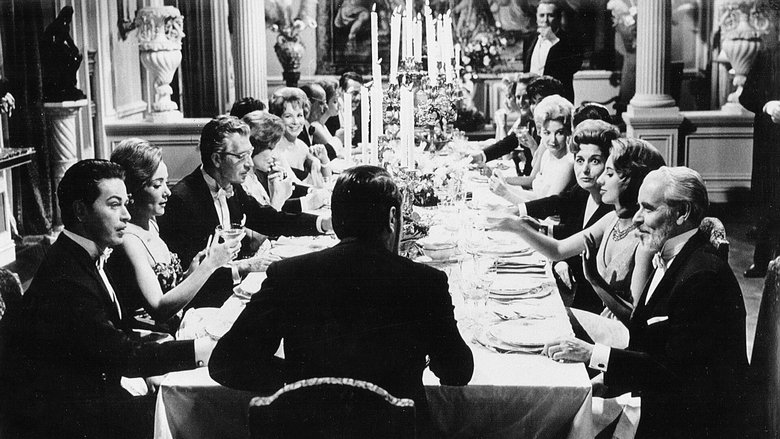
"The Exterminating Angel" (El ángel exterminador) is a 1962 surrealist film by Luis Buñuel. After a lavish dinner party, a group of wealthy guests discovers they are inexplicably unable to leave the music room. There is no physical barrier, yet a powerful psychological inertia prevents anyone from crossing the threshold. The servants had mysteriously fled earlier in the evening, leaving the aristocrats to fend for themselves.

As days turn into weeks, the veneer of civility disintegrates. The elegant guests devolve into barbarism, hoarding resources, succumbing to paranoia, and abandoning all social etiquette. They break open a water pipe for sustenance and roast sheep that have wandered into the mansion over a fire made from broken furniture and a cello. The situation outside the mansion is equally bizarre; police and onlookers find themselves just as unable to enter the house as the guests are to leave. The film is a sharp, satirical, and allegorical critique of the bourgeoisie, religion, and the fragility of social order.

Core Meaning

Luis Buñuel intended "The Exterminating Angel" as a devastating critique of the bourgeoisie, exposing their moral hollowness and the superficiality of their social rituals. The film suggests that beneath their refined exteriors, the ruling class harbors savage instincts that emerge when the structures of society collapse. The inexplicable entrapment serves as a metaphor for the self-imposed prisons of convention, ritual, and class structure. Buñuel himself resisted a single explanation, stating, "The best explanation of this film is that, from the standpoint of pure reason, there is no explanation." This highlights the film's surrealist nature, aiming to explore the irrational and unconscious forces that govern human behavior, suggesting that societal norms are arbitrary and can easily crumble, revealing a more primal human nature underneath.

Thematic DNA

Critique of the Bourgeoisie 40%
Breakdown of Social Order 30%
The Irrational and Unexplained 20%
Religion and Ritual 10%

Critique of the Bourgeoisie

The film is a ferocious satire of the upper class. Initially presented as elegant and cultured, the guests quickly shed their civility when faced with hardship. Their descent into savagery—marked by gossip, violence, selfishness, and the complete breakdown of etiquette—reveals the emptiness of their social rituals. Buñuel portrays them as a class utterly dependent on the labor of others (the servants who flee) and incapable of survival without the societal structures that grant them privilege. Their inability to perform a simple action like walking through a door symbolizes their paralysis and entrapment within their own social codes.

Breakdown of Social Order

The film meticulously documents the collapse of civilization on a micro scale. What begins with a minor breach of etiquette escalates into chaos, illness, suicide, and plots of murder. The drawing room becomes a microcosm of society where laws, morals, and hygiene are abandoned. The guests' reliance on superstition, Masonic rituals, and prayer proves useless, highlighting the fragility of the systems people create to maintain order. This theme is underscored by the final scene, where a similar entrapment occurs in a church, suggesting that no institution is immune to this irrational collapse.

The Irrational and Unexplained

A core element of the film is its surrealist refusal to provide a logical reason for the characters' confinement. The force trapping them is psychological, not physical. This highlights Buñuel's interest in the unconscious, the absurd, and the aspects of human existence that defy rational explanation. The repeated scenes, the presence of a bear and sheep in the mansion, and the dream sequences all contribute to an atmosphere where logic is suspended, forcing the audience to confront the arbitrary and mysterious nature of reality.

Religion and Ritual

Buñuel consistently satirizes religion and empty rituals. The guests' prayers and recourse to religious objects fail to save them. The film's title itself has biblical connotations of an avenging angel. The ordeal concludes with the guests attending a Te Deum mass to give thanks, only to find themselves trapped once again inside the church, with a flock of sheep entering behind them. This cyclical ending suggests that religious institutions are just another form of social trap, based on mindless ritual and repetition, ultimately offering no true salvation or escape.

Character Analysis

Edmundo Nóbile

Enrique Rambal

Archetype: The Ineffectual Host
Key Trait: Propriety

Motivation

His primary motivation is to maintain the decorum and etiquette of a high-society host. Even as things fall apart, he attempts to uphold the appearances of civility. Later, his motivation shifts to sheer survival and a desperate desire to end the ordeal, even at the cost of his own life.

Character Arc

Edmundo begins as the confident, urbane host, the embodiment of bourgeois hospitality. As the crisis deepens, his authority crumbles. He is blamed by his guests for their predicament and proves incapable of finding a solution. His arc is one of complete emasculation and loss of control, culminating in his desperate offer to sacrifice himself to break the curse, an offer which is ultimately rendered unnecessary. He represents the impotence of the ruling class when its rituals fail.

Leticia 'La Valkiria'

Silvia Pinal

Archetype: The Catalyst / The Outsider
Key Trait: Perceptive

Motivation

Her motivation is survival and escape. Unlike the others who are paralyzed by irrational fear or social convention, she is actively looking for a logical, albeit bizarre, solution to their illogical problem.

Character Arc

Leticia, a guest referred to as 'The Valkyrie,' is initially portrayed as somewhat savage and apart from the group. While others descend into chaos, she maintains a degree of composure and insight. Her arc is one of rising to become the savior of the group. It is her keen observation and intelligence that lead to the discovery of the escape method: consciously repeating the events of the first night. She represents a form of perceptive intelligence that transcends the group's rigid mindset.

Dr. Carlos Conde

Augusto Benedico

Archetype: The Voice of Reason
Key Trait: Rational

Motivation

His motivation is to preserve life and maintain a scientific, logical perspective. He is driven by his professional ethics and a genuine concern for the others, acting as a moral compass for the group even when they ignore him.

Character Arc

Dr. Conde is consistently the most rational and humane member of the trapped party. He tries to maintain order, tends to the sick, and resists the descent into superstition and violence. His arc is a tragic one; despite his efforts, his rationality is largely powerless against the tide of collective hysteria. He represents the failure of logic and science in the face of the profoundly irrational. Even as others plot to murder the host, he remains a pillar of sanity.

Raúl

Tito Junco

Archetype: The Agitator
Key Trait: Aggressive

Motivation

Driven by fear and a need to assign blame, Raúl's motivation is to find a simple, violent solution to a complex problem. He seeks a scapegoat to channel the group's collective anxiety and terror.

Character Arc

Raúl represents the darker, more aggressive side of the bourgeois facade. He is quick to anger and blame, directing his frustration at the host, Edmundo. His arc shows the rapid progression from discontent to murderous intent. He becomes the leader of the faction that decides Edmundo must be sacrificed, embodying the savage scapegoating mentality that emerges under pressure.

Symbols & Motifs

The Open Doorway

Meaning:

The open but impassable doorway symbolizes the invisible, psychological barriers that confine people. It represents the self-imposed limitations of social convention, class norms, and mental inertia. The barrier is not physical but entirely in the minds of the guests, suggesting that freedom is often a state of mind and that people can be prisoners of their own etiquette and lack of will.

Context:

The central premise of the film revolves around the guests' inability to cross the threshold of the music room to leave the party. They approach the exit but always find a reason to turn back. This is mirrored by the crowd outside, who cannot bring themselves to enter the mansion gates.

Sheep

Meaning:

The sheep are a multivalent symbol. On one level, they represent innocence and passivity, contrasting with the devolving savagery of the human guests. They can also be interpreted as religious symbols, representing the Lamb of God or a sacrificial offering, especially since they are slaughtered and eaten in a desperate, almost ritualistic manner. In the final scene, a flock of sheep entering the church reinforces the idea of the congregation as a mindless flock, blindly following ritual.

Context:

A bear and three sheep are part of a planned surprise for the guests. The sheep later wander into the salon where the trapped guests are starving. They are captured and roasted over a makeshift fire. In the film's final shot, a flock of sheep is seen entering the cathedral where the characters have become trapped again.

Repetition

Meaning:

Buñuel uses repetition to disorient the viewer and to critique the ritualistic, cyclical nature of bourgeois life. The repeated entrance of the guests suggests that their lives are a series of meaningless, repeated actions. The eventual escape is achieved only through a conscious, meticulous re-enactment of the moments before they were trapped, suggesting that breaking a cycle requires awareness of the repetition itself. However, the ending implies humanity is doomed to repeat its mistakes.

Context:

Several scenes are repeated with slight variations. Most notably, the guests' arrival at the mansion is shown twice at the beginning of the film. The hostess's toast is also repeated. The key to their escape is Leticia's realization that they must repeat the exact words and actions from the first night.

The Severed Hand

Meaning:

A classic Buñuelian and surrealist image, the severed hand represents themes of irrationality, desire, and the grotesque breaking through into reality. It echoes similar imagery from his first film, "Un Chien Andalou," and is often linked to Freudian concepts of castration and repressed fears. It serves as a purely jarring, dream-like element that defies logical interpretation within the narrative.

Context:

The severed hand appears in a dream or hallucination. One of the female guests dreams of it, and it crawls across the floor. Another character has a nightmare where they are tormented by a disembodied hand.

Memorable Quotes

Me parece que la gente de clase humilde siente menos el dolor. ¿No ha visto usted nunca un toro herido? Ni un átomo de dolor.

— Female Guest

Context:

Spoken during a casual conversation among the female guests early in the party, before the crisis begins. The comment is made with complete sincerity, exposing the ingrained prejudices of the upper class.

Meaning:

Translated as: "It seems to me that the lower class don't feel pain the way we do. Haven't you ever seen a wounded bull? Not a trace of pain." This line perfectly encapsulates the dehumanizing and condescending attitude of the aristocracy. It reveals their profound lack of empathy and their belief in their own exceptionalism, a core tenet of the class structure Buñuel is dismantling.

¿Y por qué no habría de gustarme? Hace mucho tiempo que no estoy en ninguna parte.

— Cristian Ugalde

Context:

This is said by one of the guests as they mingle in the music room after dinner, just before they realize they are trapped. The line carries an unintentional prophetic weight.

Meaning:

Translated as: "And why shouldn't I like it? It's been a long time since I've been anywhere." This quote, said in response to being asked if he likes the salon, is deeply ironic and foreshadows the impending, indefinite confinement. It speaks to the existential emptiness and ennui of the bourgeois characters, for whom even a lavish party is just another location in a life of placelessness.

Wouldn't it be a good joke if I sneaked up and pushed you out? Try it, and I'll kill you.

— Two Guests

Context:

Two male guests are standing at the threshold of the salon, looking out into the hallway they cannot bring themselves to enter. The exchange highlights their psychological paralysis.

Meaning:

This exchange reveals the underlying tension and aggression simmering just beneath the surface of their polite interactions. The suggestion of a playful "joke" is met with a deadly serious threat, demonstrating how quickly their social pretenses can give way to primal fear and violence. It shows that they are aware of the invisible barrier and are terrified of what crossing it might entail.

Philosophical Questions

What is the true nature of civilization and social order?

The film posits that civilization is a thin veneer, a collection of arbitrary rituals and etiquette that masks a more primal, savage human nature. By removing the ability for the guests to leave, Buñuel strips away the external structures of their lives, forcing them to confront their own inner emptiness and brutality. The rapid descent into chaos questions whether social order is an inherent human trait or merely a fragile construct, easily shattered by unexplained circumstances.

Are we prisoners of our own routines and social conventions?

The psychological, rather than physical, nature of the guests' imprisonment suggests that the most powerful cages are the ones we build for ourselves. Their inability to simply walk through a door reflects a profound inertia and an enslavement to social norms and unspoken rules. The film asks whether our daily routines, social hierarchies, and accepted behaviors are forms of freedom or subtle forms of confinement that prevent authentic action and thought.

Can reason and logic prevail against the irrational?

Through the character of Dr. Conde, the film explores the limits of rationality. Despite his calm, logical approach, he is powerless to stop the group's slide into hysteria, superstition, and violence. Buñuel, a true surrealist, challenges the primacy of reason, suggesting that human existence is fundamentally governed by unconscious, absurd, and irrational forces that science and logic cannot explain or control.

Alternative Interpretations

While the most common interpretation sees the film as a political allegory for Franco's Spain and a critique of the bourgeoisie, several other readings exist:

  • Psychoanalytic Interpretation: From this perspective, the room represents the human psyche, and the inability to leave symbolizes a collective psychological repression. The guests are trapped by their own unconscious desires, fears, and social taboos. Their eventual escape through the ritual of repetition could be seen as a form of psychotherapy, where confronting and re-enacting a trauma allows for release.
  • Religious/Metaphysical Allegory: The title itself invites a religious reading, with the 'Exterminating Angel' being a divine or demonic force punishing the guests for their sins and moral vacuity. The house on 'Providence Street' becomes a version of Hell, a state of being where souls are condemned to eternally confront each other's true natures. The cyclical ending, trapping them in a church, suggests that humanity is perpetually trapped by its own systems of belief and ritual, unable to achieve true freedom.
  • Existentialist Reading: The film can be viewed through the lens of existentialism, particularly Jean-Paul Sartre's play "No Exit," where "hell is other people." The guests are condemned to an absurd, meaningless situation without explanation. Their confinement forces them to confront the void at the center of their existence, which was previously masked by social rituals. The psychological barrier is a manifestation of their own lack of free will or their inability to act decisively in a meaningless universe.
  • A Purely Surrealist Work: Buñuel himself often resisted allegorical interpretations, encouraging a more direct, intuitive experience of his films. In this view, the film is not meant to be a puzzle with a single solution. It is an exercise in surrealism, designed to provoke, disturb, and explore the logic of dreams. The bizarre events are not symbols for something else; they are simply a depiction of a reality where the irrational has taken over.

Cultural Impact

"The Exterminating Angel" was made in Mexico following the international scandal of "Viridiana" (1961), which was condemned by the Vatican and banned in Spain. This context is crucial, as the film can be read as a powerful allegory for the intellectual and social paralysis of Spain under Francisco Franco's fascist regime, a society from which Buñuel was exiled. Critics like Roger Ebert have strongly supported this political interpretation, seeing the trapped guests as the ruling class in Spain, isolated and decaying in their own cul-de-sac.

The film is considered a masterpiece of surrealist cinema and had a significant influence on future filmmakers. Its premise of psychological entrapment and social breakdown has been echoed in numerous horror and satirical films that explore claustrophobia and the fragility of the human psyche. It is often cited as a precursor to the modern contained-room thriller and films that critique the elite, such as "Triangle of Sadness" (2022). The film was also adapted into a successful opera by Thomas Adès in 2016, demonstrating its enduring power and relevance.

Upon its release, the film was acclaimed by critics, winning an award at the Cannes Film Festival. Its ambiguous, challenging nature has fueled decades of academic analysis and debate, solidifying its place as one of the most provocative and enduring works in film history. Jean-Luc Godard, a key figure in the French New Wave, explicitly cited the film as an influence on his own satirical work "Weekend" (1967), which also depicts the collapse of Western civilization.

Audience Reception

Audience reception for "The Exterminating Angel" is largely positive among cinephiles, though it is often described as unsettling and perplexing. On review aggregator Rotten Tomatoes, the film holds a 93% approval rating. Viewers praise its originality, its dark, satirical humor, and its provocative, thought-provoking premise. Many consider it a masterpiece of surrealist filmmaking and a brilliant social commentary. The main points of praise focus on Buñuel's masterful direction in building a sense of dread and claustrophobia, and the film's enduring relevance as a critique of class and society.

Criticism often stems from its deliberately confusing and non-linear elements. Some viewers find the lack of a clear explanation for the events frustrating, and the surrealist imagery can be alienating for those accustomed to conventional narratives. The repeated scenes, in particular, are sometimes mistaken for errors by first-time viewers. However, even those who find it baffling often acknowledge its power and unforgettable, dream-like (or nightmare-like) quality. It is widely regarded not as an easy or comfortable watch, but as a challenging and essential piece of cinema.

Interesting Facts

  • The film's original working title was "The Castaways of Providence Street" ("Los Náufragos de la Calle Providencia"), which emphasizes the theme of being stranded and isolated.
  • Director Luis Buñuel gave his cast and crew minimal explanation for the bizarre events in the script, leaving them as confused as their characters. Some crew members believed the repeated scenes were editing mistakes.
  • Buñuel claimed the idea of having a bear and sheep at a dinner party was inspired by a real party he attended in New York.
  • According to Buñuel, there are around twenty instances of repetition in the film, some more subtle than others.
  • Marilyn Monroe visited the set during filming. Cinematographer Gabriel Figueroa explained the strange plot to her.
  • The film was made during Buñuel's period of exile in Mexico and was one of the few films from that time over which he had complete artistic freedom.
  • Buñuel later expressed regret that he didn't push the guests' savagery further, even to the point of cannibalism, and wished he could have made the film in Europe with more authentic bourgeois settings.
  • The film won the FIPRESCI Prize at the 1962 Cannes Film Festival.

Easter Eggs

Woody Allen's 2011 film "Midnight in Paris" features a scene where the time-traveling protagonist suggests the plot of "The Exterminating Angel" to a young Luis Buñuel, who is perplexed by the idea and says it makes no sense.

This is a direct and playful homage to Buñuel and one of his most famously inexplicable films. It winks at the audience's own potential confusion and celebrates the surrealist nature of the plot, which even its creator (in the fictional context) can't comprehend.

The image of a severed, crawling hand recalls identical imagery in Buñuel's first film, "Un Chien Andalou" (1929), which he co-directed with Salvador Dalí.

This is a self-reference to Buñuel's surrealist origins. The hand is a recurring motif in his work, often symbolizing repressed desires, guilt, or the purely irrational. Its inclusion connects "The Exterminating Angel" to the broader surrealist movement and Buñuel's lifelong artistic obsessions.

⚠️ Spoiler Analysis

Click to reveal detailed analysis with spoilers

Frequently Asked Questions

Explore More About This Movie

Dive deeper into specific aspects of the movie with our detailed analysis pages

Comments (0)

Leave a comment

No comments yet. Be the first to share your thoughts!