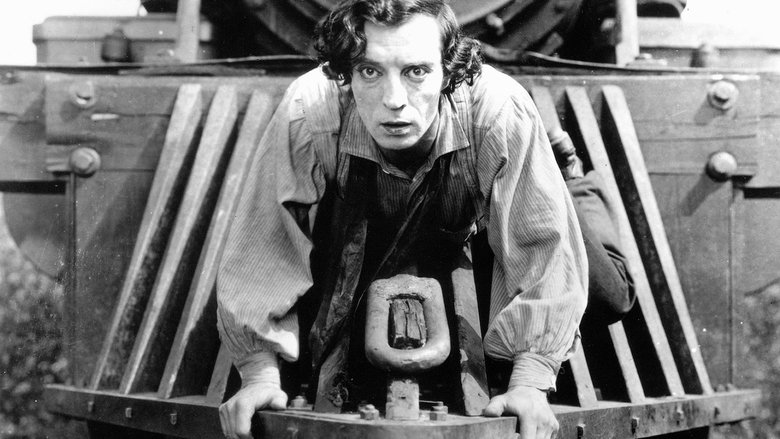
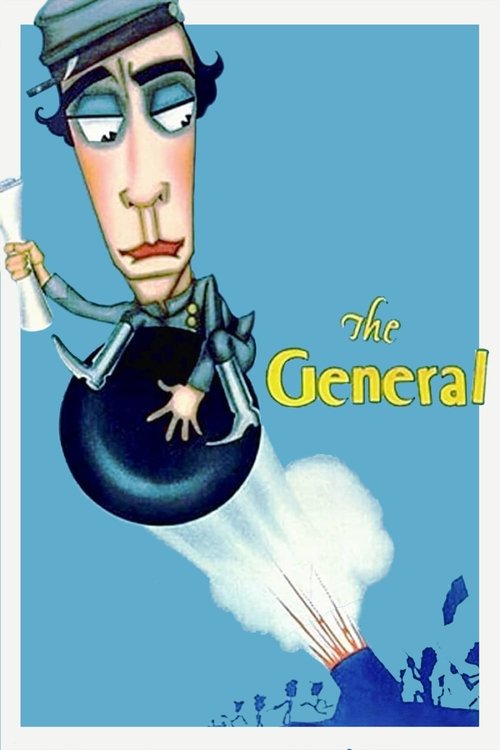
"Buster drives "The General" to trainload of laughter."
The General - Symbolism & Philosophy
Symbols & Motifs
The General (The Locomotive)
The locomotive, named "The General," symbolizes more than just a mode of transportation. It represents one of Johnnie Gray's two great loves, embodying his identity, purpose, and passion. It is an extension of himself, and its theft is a deep personal violation that drives the entire plot. The engine is a character in its own right, a majestic and powerful force that Johnnie understands intimately and fights desperately to reclaim.
The locomotive is the central object of the film. It is stolen by Union spies, leading to the epic chase. Johnnie's quest is not just to rescue his fiancée, but equally to recover his beloved engine. The final battle sequences and his ultimate triumph are inextricably linked to his reunion with and masterful operation of "The General."
The Uniform
The military uniform symbolizes societal expectations of honor and bravery. Annabelle initially rejects Johnnie because he is not in uniform, equating it with cowardice. The irony is that Johnnie performs his most heroic acts as a civilian. When he finally dons a uniform, it is first that of the enemy for disguise, and only at the very end does he receive his own Confederate officer's uniform, a reward for the bravery he demonstrated without one. It symbolizes the difference between the appearance of heroism and the reality of it.
Annabelle's ultimatum, "I don't want you to speak to me again until you are in uniform," sets up this symbolic thread. Johnnie is repeatedly shown failing to enlist, yet his actions prove him braver than many who wear the uniform. The film concludes with him awkwardly trying to salute passing soldiers while embracing Annabelle, humorously attempting to reconcile his new official status with his personal life.
Philosophical Questions
What is the true nature of heroism?
The film delves into this question by contrasting societal definitions of a hero with actual heroic deeds. Johnnie Gray is rejected by the army and scorned by his fiancée because he lacks a uniform, the conventional symbol of a hero. However, the film demonstrates that his courage, resourcefulness, and unwavering perseverance in the face of immense danger are the true markers of a hero. The film posits that heroism is not about titles or appearances but about action, ingenuity, and the willingness to risk everything for what one loves, challenging the audience to reconsider their own definitions of bravery.
What is the relationship between humanity and technology?
"The General" explores the deep connection between an individual and a machine. For Johnnie Gray, the locomotive is not merely a tool but a beloved entity, almost a living creature he understands intimately. The film showcases humanity's capacity to master complex technology, using it as an extension of one's own will and skill. Keaton's character doesn't fight against the machine, as in Chaplin's "Modern Times," but rather works in perfect symbiosis with it. This raises questions about whether technology is a dehumanizing force or a powerful partner that can amplify human potential and determination.
Core Meaning
At its heart, "The General" is an exploration of heroism in the face of adversity, demonstrating that courage can manifest in unexpected ways outside the conventional battlefield. Director Buster Keaton aimed to tell a story of an ordinary man's extraordinary perseverance, driven by love and personal conviction. Johnnie Gray is not a soldier, but his unwavering dedication to rescuing his two loves—his engine and his sweetheart—propels him to perform feats of incredible bravery. The film suggests that heroism is not defined by a uniform or title, but by one's actions and the willingness to risk everything for what one holds dear. It's a testament to the resilience of the individual against overwhelming forces, blending comedy with a sincere appreciation for ingenuity and determination.