The General
A thrilling silent-era epic where a lovelorn engineer's devotion to his locomotive hurtles him through the chaos of the Civil War, painting a breathtaking portrait of one man's absurd, death-defying pursuit of his two mechanical and human loves.
The General

The General

"Buster drives "The General" to trainload of laughter."

25 December 1926 United States of America 79 min ⭐ 7.9 (1,340)
Director: Clyde Bruckman Buster Keaton
Cast: Buster Keaton, Marion Mack, Glen Cavender, Jim Farley, Frederick Vroom
War Action Comedy Romance Adventure
Heroism and Courage Man vs. Machine Love and Perseverance The Absurdity of War
Budget: $750,000
Box Office: $1,000,000

Overview

Set during the American Civil War, "The General" follows Johnnie Gray, a Southern railroad engineer whose two great loves are his locomotive, "The General," and his fiancée, Annabelle Lee. When the war breaks out, Johnnie is eager to enlist to impress Annabelle, but is rejected because his skills as an engineer are deemed too valuable to the Confederate war effort, a reason that is not explained to him. Annabelle, believing him a coward, shuns him.

A year later, Union spies steal "The General" with Annabelle inadvertently on board. This act of theft launches Johnnie into a relentless and daring pursuit behind enemy lines. Commandeering another locomotive, he single-handedly chases after the hijackers, facing numerous obstacles and performing incredible stunts along the way. His mission is twofold: to reclaim his beloved engine and to rescue the woman who has misjudged him.

Johnnie's journey takes him deep into Union territory, where he must rely on his wits and incredible physical prowess to survive. He not only rescues Annabelle but also overhears crucial intelligence about a planned Union attack. Together, they steal back "The General" and embark on a perilous race back to Confederate lines, all while being pursued by the Union army, culminating in a spectacular battle sequence.
Core Meaning

At its heart, "The General" is an exploration of heroism in the face of adversity, demonstrating that courage can manifest in unexpected ways outside the conventional battlefield. Director Buster Keaton aimed to tell a story of an ordinary man's extraordinary perseverance, driven by love and personal conviction. Johnnie Gray is not a soldier, but his unwavering dedication to rescuing his two loves—his engine and his sweetheart—propels him to perform feats of incredible bravery. The film suggests that heroism is not defined by a uniform or title, but by one's actions and the willingness to risk everything for what one holds dear. It's a testament to the resilience of the individual against overwhelming forces, blending comedy with a sincere appreciation for ingenuity and determination.

Thematic DNA

Heroism and Courage 35%
Man vs. Machine 30%
Love and Perseverance 25%
The Absurdity of War 10%

Heroism and Courage

The film centers on the theme of heroism, challenging conventional notions of bravery. Johnnie Gray is initially seen as a coward for not enlisting, but he proves his valor through his relentless, single-handed pursuit of his stolen train and his beloved. His heroism is not that of a soldier in battle, but of an ordinary individual driven by love and duty to perform extraordinary and dangerous feats. He ultimately saves the day, not as part of an army, but through his personal ingenuity and courage.

Man vs. Machine

A recurring theme in Buster Keaton's work, the relationship between man and machine is central to "The General." Johnnie Gray's locomotive is not just a machine; it's one of the two great loves of his life. The film showcases a mastery of technology, as Johnnie uses his deep understanding of trains to both pursue and escape his enemies. The train becomes an extension of his own determination and resourcefulness, a character in its own right, highlighting Keaton's fascination with the mechanical world and humanity's ability to master it.

Love and Perseverance

Johnnie's entire adventure is motivated by his dual love for Annabelle Lee and his engine, "The General". His perseverance is fueled by the desire to reclaim both. He endures rejection from his love, the dangers of war, and the mockery of his peers, yet he never gives up. This unwavering determination in the face of seemingly insurmountable odds is a testament to the power of love and personal conviction as driving forces.

The Absurdity of War

While set against the backdrop of the Civil War, the film often treats the conflict with a darkly comedic and absurd tone. Keaton uses the war as a stage for his incredible gags and stunts, sometimes using soldiers' deaths as punchlines. Johnnie, an individual, comically outwits and single-handedly battles entire armies. This blend of high-stakes drama and slapstick comedy underscores the chaos and often illogical nature of warfare, a perspective that was controversial to some audiences at the time.

Character Analysis

Johnnie Gray

Buster Keaton

Archetype: The Everyman Hero
Key Trait: Resourceful

Motivation

Johnnie's primary motivation is his profound love for two things: his fiancée, Annabelle Lee, and his locomotive, "The General." When both are taken from him by Union spies, his singular focus becomes their rescue and recovery. This personal quest drives him to perform incredible, death-defying stunts and to single-handedly take on the Union army.

Character Arc

Johnnie begins as a skilled but unassuming train engineer, ostracized and deemed a coward by his love and community for failing to enlist in the army. His arc is one of vindication. Through his perilous journey to rescue his two loves, Annabelle and his locomotive, he transforms from a social outcast into an undeniable hero. He proves that courage is not determined by a uniform but by action and ingenuity, ultimately earning the respect of his peers and the love of Annabelle, as well as a commission as an officer.

Annabelle Lee

Marion Mack

Archetype: The Damsel in Distress / The Catalyst
Key Trait: Judgmental (initially), Admiring (later)

Motivation

Initially, her motivation is to see Johnnie conform to the societal expectation of enlisting in the Confederate army. After being kidnapped, her motivation shifts to survival and escape. She becomes an active, if sometimes comically inept, participant in the escape with Johnnie, motivated by a newfound respect and love for him.

Character Arc

Annabelle starts as a fairly conventional Southern belle who initially rejects Johnnie based on societal pressure and a misunderstanding of his failure to enlist. Her character arc involves realizing the true nature of heroism. After being kidnapped and witnessing Johnnie's incredible bravery and resourcefulness firsthand, her perception of him completely changes. She moves from disdain to admiration and deep affection, recognizing that his courage far exceeds that of the uniformed men she once admired.

Captain Anderson

Glen Cavender

Archetype: The Antagonist
Key Trait: Cunning

Motivation

As a Union Captain, his motivation is purely military. He aims to execute a strategic raid by stealing the train and burning bridges to cripple the Confederate army's infrastructure and aid the Union war effort. His actions are dictated by duty to his side of the conflict.

Character Arc

Captain Anderson is the leader of the Union spies who steal "The General." He serves as the primary antagonist driving the conflict. His character does not have a significant arc; he remains a determined and capable enemy agent throughout the film, focused on his mission to disrupt Confederate supply lines. He represents the formidable, faceless opposition that Johnnie must overcome.

Symbols & Motifs

The General (The Locomotive)

Meaning:

The locomotive, named "The General," symbolizes more than just a mode of transportation. It represents one of Johnnie Gray's two great loves, embodying his identity, purpose, and passion. It is an extension of himself, and its theft is a deep personal violation that drives the entire plot. The engine is a character in its own right, a majestic and powerful force that Johnnie understands intimately and fights desperately to reclaim.

Context:

The locomotive is the central object of the film. It is stolen by Union spies, leading to the epic chase. Johnnie's quest is not just to rescue his fiancée, but equally to recover his beloved engine. The final battle sequences and his ultimate triumph are inextricably linked to his reunion with and masterful operation of "The General."

The Uniform

Meaning:

The military uniform symbolizes societal expectations of honor and bravery. Annabelle initially rejects Johnnie because he is not in uniform, equating it with cowardice. The irony is that Johnnie performs his most heroic acts as a civilian. When he finally dons a uniform, it is first that of the enemy for disguise, and only at the very end does he receive his own Confederate officer's uniform, a reward for the bravery he demonstrated without one. It symbolizes the difference between the appearance of heroism and the reality of it.

Context:

Annabelle's ultimatum, "I don't want you to speak to me again until you are in uniform," sets up this symbolic thread. Johnnie is repeatedly shown failing to enlist, yet his actions prove him braver than many who wear the uniform. The film concludes with him awkwardly trying to salute passing soldiers while embracing Annabelle, humorously attempting to reconcile his new official status with his personal life.

Memorable Quotes

If you lose this war don't blame me.

— Johnnie Gray

Context:

Spoken to the Confederate recruiting officer who refuses to enlist him because his job as an engineer is considered too vital. Unaware of this reason, Johnnie is simply indignant at the rejection.

Meaning:

This intertitle line is delivered by Johnnie out of frustration after being rejected for enlistment. It's a moment of comic irony, as he is dismissed as unimportant to the war effort. The quote becomes deeply significant as the film progresses, because Johnnie, the rejected civilian, ends up playing a pivotal role in a crucial battle, effectively proving that the army's loss would indeed have been his to prevent.

I don't want you to speak to me again until you are in uniform.

— Annabelle Lee

Context:

Annabelle says this to Johnnie after she learns he did not enlist in the Confederate Army. She mistakenly believes his rejection was due to cowardice, leading her to break off their relationship until he meets her condition.

Meaning:

This quote establishes the central romantic conflict and Johnnie's initial motivation. Annabelle voices the societal pressure and her own belief that honor and bravery are synonymous with being a soldier. It sets the stage for the film's exploration of heroism, as Johnnie must prove his worth outside the confines of a military uniform, a feat he accomplishes spectacularly.

Philosophical Questions

What is the true nature of heroism?

The film delves into this question by contrasting societal definitions of a hero with actual heroic deeds. Johnnie Gray is rejected by the army and scorned by his fiancée because he lacks a uniform, the conventional symbol of a hero. However, the film demonstrates that his courage, resourcefulness, and unwavering perseverance in the face of immense danger are the true markers of a hero. The film posits that heroism is not about titles or appearances but about action, ingenuity, and the willingness to risk everything for what one loves, challenging the audience to reconsider their own definitions of bravery.

What is the relationship between humanity and technology?

"The General" explores the deep connection between an individual and a machine. For Johnnie Gray, the locomotive is not merely a tool but a beloved entity, almost a living creature he understands intimately. The film showcases humanity's capacity to master complex technology, using it as an extension of one's own will and skill. Keaton's character doesn't fight against the machine, as in Chaplin's "Modern Times," but rather works in perfect symbiosis with it. This raises questions about whether technology is a dehumanizing force or a powerful partner that can amplify human potential and determination.

Alternative Interpretations

While on the surface "The General" is a straightforward action-comedy, its historical context invites alternative readings. One interpretation views the film through the lens of the "Lost Cause" mythology, a revisionist history that romanticized the Confederacy. By framing the Confederate protagonist as a heroic underdog and the Union as the villainous aggressors, the film aligns with a sympathetic, and historically sanitized, view of the South prevalent in the 1920s. Some analyses suggest Keaton's choice was less a political statement and more a narrative one, believing an underdog story was more compelling. However, this choice makes the film a complex cultural artifact, reflecting the racial and historical attitudes of its time.

Another interpretation focuses on the film's symmetrical structure as a metaphor for control and chaos. As noted by critic Noël Carroll, the film is divided into two mirrored halves: the first chase, where Johnnie is reactive and things constantly go wrong, and the second chase (back to the South), where he is in control, setting the traps himself. This reading suggests the film is less about the Civil War and more about Keaton's recurring theme of an individual learning to master a chaotic, mechanical world, moving from being a victim of circumstance to an agent of his own destiny.

Cultural Impact

Initially a box-office bomb that severely damaged Buster Keaton's career, "The General" has since been re-evaluated and is now considered one of the greatest films ever made. Its initial failure was attributed to its mixing of genres—it was as much an action-adventure film as a comedy—and its controversial choice to tell a Civil War story from the Confederate perspective, which some critics found distasteful. Robert Sherwood famously wrote, "someone should have told Buster Keaton that it is difficult to derive laughter from the sight of men being killed in battle."

Over the decades, however, critics and audiences have come to appreciate the film's incredible technical achievements, its breathtaking and authentic stunt work, and its sophisticated narrative structure. It was selected for preservation in the United States National Film Registry by the Library of Congress in its inaugural class in 1989. Orson Welles called it "the greatest comedy ever made, the greatest Civil War film ever made, and perhaps the greatest film ever made." The film's influence can be seen in countless action films that feature elaborate chase sequences, particularly those involving trains, and its masterful blend of comedy and high-stakes action set a new standard for the genre. Despite the problematic nature of its Confederate sympathies in a modern context, its artistic and technical brilliance remain undeniable, cementing its place as a landmark of silent cinema.

Audience Reception

Upon its initial release in 1926-27, "The General" was met with a lukewarm to hostile reception from both critics and audiences, resulting in a box office failure. Many viewers and reviewers found the film's comedic tone inappropriate for its Civil War setting, criticizing it for attempting to derive humor from battle and death. It was frequently described as "tedious" and less funny than Keaton's previous, more farcical works. The film's enormous budget, coupled with its poor box office returns, led to Buster Keaton losing his creative independence.

However, in the decades since, the film has undergone a significant critical re-evaluation. Modern audiences and critics almost universally praise it as a masterpiece of the silent era. It is now celebrated for its spectacular stunt work, masterful direction, epic scale, and seamless blend of action, comedy, and drama. It consistently ranks among the greatest films ever made in polls by critics and directors. While contemporary viewers may find its sympathetic portrayal of the Confederacy problematic, its technical and artistic merits are largely undisputed, securing its legacy as a cinematic classic.

Interesting Facts

  • The film was inspired by a real Civil War event known as the Great Locomotive Chase of 1862, detailed in William Pittenger's memoir. Keaton, however, told the story from the Confederate perspective, believing the audience would find them more sympathetic as underdogs.
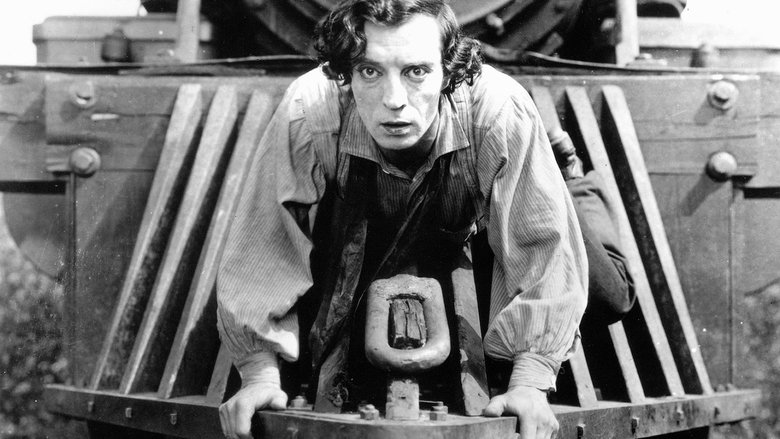
  • Buster Keaton performed all of his own dangerous stunts, including sitting on the coupling rod of the moving locomotive and running along the roofs of the train cars.
  • The film features what was reportedly the most expensive single shot in silent film history: a real train crashing from a burning trestle bridge into a river below. The wreckage remained a local tourist attraction in Oregon until it was salvaged for scrap metal during World War II.
  • Despite its current status as a masterpiece, "The General" was a critical and commercial failure upon its release. Critics found it tedious and not as funny as Keaton's previous work. The financial loss was so significant that Keaton lost his independent film studio and was forced to sign a restrictive contract with MGM, which he later called the biggest mistake of his career.
  • To create the armies, Keaton hired 500 members of the Oregon National Guard, having them wear Confederate uniforms for shots marching in one direction, then switch to Union uniforms for shots marching the other way.
  • Buster Keaton's father, Joe Keaton, has a cameo as a Union General.
  • During a scene where Annabelle and Johnnie are refilling the train's water reservoir, actress Marion Mack was genuinely shocked when a torrent of water drenched her; Keaton had not warned her about it beforehand.

⚠️ Spoiler Analysis

Click to reveal detailed analysis with spoilers

Frequently Asked Questions

Explore More About This Movie

Dive deeper into specific aspects of the movie with our detailed analysis pages

Comments (0)

Leave a comment

No comments yet. Be the first to share your thoughts!