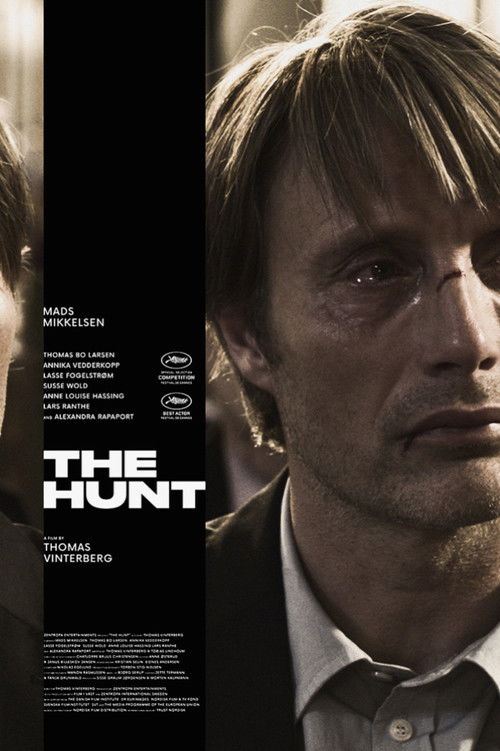
The Hunt
A chilling Danish drama that masterfully orchestrates a symphony of mounting dread, visually capturing the silent scream of innocence trapped in a web of lies.
The Hunt
The Hunt

Jagten

"The lie is spreading."

13 June 2012 Denmark 116 min ⭐ 8.1 (4,487)
Director: Thomas Vinterberg
Cast: Mads Mikkelsen, Thomas Bo Larsen, Annika Wedderkopp, Lasse Fogelstrøm, Susse Wold
Drama
Mass Hysteria and Mob Mentality Innocence and the Corruption of Truth The Fragility of Reputation and Trust Masculinity and Community
Budget: $3,800,000
Box Office: $18,300,000

The Hunt - Ending Explained

⚠️ Spoiler Analysis

The central twist of "The Hunt" is that there is no twist; Lucas is unequivocally innocent from the very beginning. The horror of the film lies in watching the inevitable and unjust destruction of his life based on a complete fabrication. The lie originates from Klara, the young daughter of Lucas's best friend, Theo. After Lucas gently rejects a small gift from her, a hurt and confused Klara—whose mind has been polluted by seeing a pornographic image on her brother's phone—tells the kindergarten headmistress, Grethe, that Lucas exposed himself to her.

Grethe, operating under the dangerous belief that children never lie about such things, escalates the situation immediately. She brings in a specialist who uses leading questions, coaxing a confirmation from the confused Klara. The accusation spreads through the small town like a contagion. Lucas is suspended from his job, his new relationship with Nadja crumbles under the strain, and he is violently ostracized. His dog, Fanny, is killed, and he is physically assaulted in the local supermarket. The climax of his public humiliation takes place in church on Christmas Eve, where he confronts Theo, begging him to see his innocence.

Eventually, Klara admits to her father that she made it up, but the hysteria has taken on a life of its own. Lucas is ultimately cleared when the police investigation falls apart; it is revealed that other children have been coached into telling identical stories with false details, such as mentioning a basement in Lucas's house, which he does not have. A year later, life seems to have returned to normal. Lucas is back with his friends and family, and his son Marcus is being inducted into the hunting group. However, in the film's final, chilling moments, while hunting in the woods, a shot is fired at Lucas from a distance. He sees a figure who then runs away. The identity of the shooter is never revealed. This ending makes it devastatingly clear that despite his legal innocence, someone in the community still sees him as a target. The accusation will follow him forever, and he will never be truly safe or free from the shadow of the lie.

Alternative Interpretations

While the film's narrative is largely straightforward in its assertion of Lucas's innocence, the ambiguous ending has generated significant discussion and multiple interpretations. The final scene, where an unseen figure fires a rifle at Lucas a year after his acquittal, is the primary source of debate.

  • The Lingering Suspicion Interpretation: This is the most common reading. The shot symbolizes that despite his legal exoneration and apparent reintegration into the community, Lucas will never be truly free. The seed of doubt remains in someone's mind, and he will forever be 'hunted' by the accusation. The shooter is an anonymous member of the community who still believes he is guilty, representing the indelible stain on his reputation.
  • The Guilt and Shame Interpretation: An alternative view suggests the shooter is not someone who still believes Lucas is guilty, but someone who is consumed by their own guilt and shame for having wronged him. In this reading, Lucas's continued presence is an unbearable reminder of the community's ugly behavior. The shot is an act of aggression born from the shooter's inability to face their own moral failure, an attempt to erase the living evidence of their mistake.
  • The Metaphorical Interpretation: Some viewers see the final shot not as a literal event, but as a visual metaphor for Lucas's internal state. It represents his own paranoia and the psychological trauma he has endured. He will now live the rest of his life looking over his shoulder, forever feeling like a target. The 'hunt' has moved from an external persecution to an internal, psychological prison.