The Hunt
Jagten
"The lie is spreading."
Overview
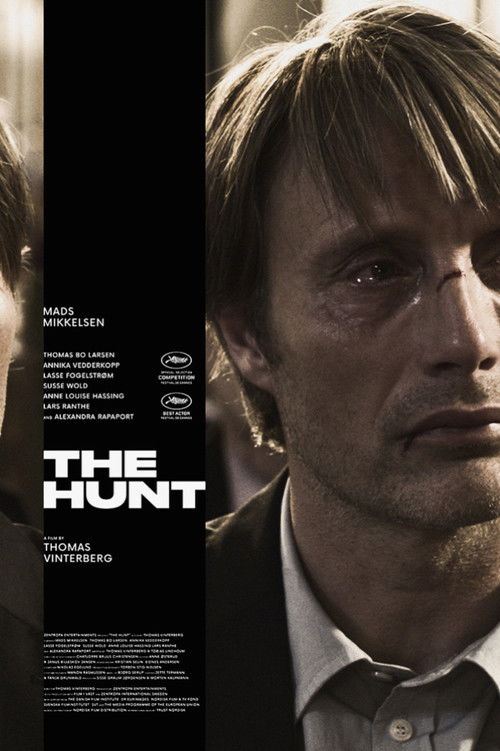
"The Hunt" (original title: "Jagten") is a 2012 Danish psychological drama directed by Thomas Vinterberg. The film stars Mads Mikkelsen as Lucas, a kind and gentle kindergarten teacher in a small, close-knit Danish village. Following a difficult divorce, Lucas is beginning to piece his life back together, rebuilding his relationship with his teenage son, Marcus (Lasse Fogelstrøm), and finding a new romance.
His newfound stability is shattered when Klara (Annika Wedderkopp), the young daughter of his best friend Theo (Thomas Bo Larsen), makes an innocent but ambiguous remark that is misinterpreted by the school's staff. This single, misconstrued statement plants a seed of suspicion that quickly blossoms into a full-blown witch hunt. As the lie spreads like a virus, Lucas finds himself ostracized and persecuted by the community he once called home, his life unraveling with terrifying speed.
Forced to endure the wrath and paranoia of his friends and neighbors, Lucas must fight a lonely and desperate battle to prove his innocence and reclaim his dignity. The film is a harrowing exploration of mass hysteria, the fragility of reputation, and the devastating consequences of a lie allowed to fester in a climate of fear.
Core Meaning
The core meaning of "The Hunt" revolves around the terrifying ease with which a lie can become truth and how fragile trust and social bonds are in the face of collective hysteria. Director Thomas Vinterberg explores the destructive power of suspicion and how quickly a community, driven by fear and a misguided sense of righteousness, can turn on one of its own. The film serves as a powerful and unsettling commentary on the dangers of rushing to judgment and the lasting scars left by false accusations, even after innocence is proven. It questions the nature of justice, the fallibility of human perception, and the terrifying reality that in the court of public opinion, accusation can be tantamount to conviction. Vinterberg presents a world where good intentions, fueled by irrational emotion, can lead to monstrous outcomes.
Thematic DNA
Mass Hysteria and Mob Mentality
The film is a stark depiction of how a single, unsubstantiated accusation can ignite collective paranoia within a small community. Once the rumor about Lucas begins, it spreads uncontrollably, and the townspeople, many of whom are his lifelong friends, quickly abandon reason and due process. They unite in their condemnation, their shared outrage feeding a mob mentality that leads to ostracism, vandalism, and violence. Vinterberg masterfully illustrates how groupthink can overwhelm individual critical thinking, transforming well-meaning citizens into a vengeful mob.
Innocence and the Corruption of Truth
At its heart, "The Hunt" is a story about the persecution of an innocent man. Lucas's innocence is clear to the audience from the beginning, making his suffering all the more harrowing to witness. The film explores how Klara's childish and innocent lie, influenced by things she doesn't fully understand, is twisted and magnified by the adult world. The adults' refusal to believe that a child could be mistaken or lie about such a matter leads to the complete distortion of truth, showing how deeply ingrained societal beliefs can lead to devastating injustice.
The Fragility of Reputation and Trust
Lucas's ordeal demonstrates how quickly a lifetime of trust and a good reputation can be utterly destroyed. The bonds of friendship and community, which seem so strong at the film's outset, prove to be incredibly fragile. His best friend, Theo, is torn between loyalty and paternal fear, ultimately choosing to believe the accusation. The film powerfully argues that once suspicion is cast, it can be nearly impossible to erase, leaving a permanent stain on a person's life, as symbolized by the ambiguous final scene.
Masculinity and Community
The film is set within a distinctly masculine community, centered around traditions like hunting. This environment, with its emphasis on camaraderie and strength, ironically becomes the breeding ground for the vicious campaign against Lucas. The hunt, a ritual of communal male bonding, becomes a dark metaphor for the town's persecution of Lucas. The film subtly critiques how this masculine world, in its attempt to protect its children, can manifest its own form of predatory violence.
Character Analysis
Lucas
Mads Mikkelsen
Motivation
Lucas's primary motivation is to prove his innocence and reclaim his life, dignity, and his relationship with his son. He is driven by a fundamental need for the truth to be recognized and for his friends and community to see him for who he truly is, not the monster they have imagined. His refusal to simply leave town is a testament to his fight for justice and his right to exist in his own home.
Character Arc
Lucas begins as a gentle, well-liked, and resilient man trying to rebuild his life. After the false accusation, he is thrust into a Kafkaesque nightmare, transforming from a respected community member into a pariah. His arc is one of endurance through profound suffering and isolation. Initially, he reacts with disbelief and a civilized faith that the truth will prevail. As the hostility escalates, he is pushed to his breaking point, culminating in a raw, public confrontation in the church. Though he is eventually exonerated, the final scene shows he is permanently scarred, forever living with the knowledge of how easily his world can be destroyed.
Theo
Thomas Bo Larsen
Motivation
Theo is motivated by a powerful, albeit misguided, love for his daughter, Klara. His fear for her well-being overrides his rational judgment and his long-standing trust in Lucas. Every action he takes against Lucas stems from this primal need to protect his child, making his betrayal both infuriating and tragically understandable.
Character Arc
Theo starts as Lucas's boisterous and loyal best friend. His world is shattered by his daughter's accusation. His arc is a tragic journey from unwavering friendship to suspicion and betrayal. Torn between his love for his friend and his protective instincts as a father, he succumbs to the community's hysteria. The weight of his decision visibly torments him, and even after Klara admits her lie, the damage to his friendship with Lucas is immense. He eventually seeks reconciliation, but his character represents the devastating emotional collateral of the witch hunt.
Klara
Annika Wedderkopp
Motivation
Klara's initial motivation is a simple, childish desire for attention and a feeling of being slighted after Lucas gently turns down her handmade gift. She doesn't intend to cause harm; her lie is a confused lashing out. Later, her motivation shifts to fear and confusion as she is pressured by the adults around her, demonstrating the vulnerability of children in such situations.
Character Arc
Klara is a young, imaginative child seeking attention and affection. She is not malicious, but her innocent crush on Lucas, his gentle rejection of her gift, and exposure to inappropriate imagery from her older brother lead her to tell a lie she doesn't comprehend. As the adults pressure her and put words in her mouth, she becomes confused and trapped in her own story. Her arc is one of lost innocence, as she witnesses the horrifying consequences of her words. Her eventual attempts to recant are dismissed by adults who believe they know better, highlighting the film's critique of how adults can fail children by not truly listening.
Marcus
Lasse Fogelstrøm
Motivation
Marcus is driven by an unwavering love and belief in his father's innocence. He is motivated to protect and support Lucas against the entire community. His actions are a direct and visceral response to the injustice he witnesses, showcasing a fierce loyalty that contrasts sharply with the betrayal of Lucas's adult friends.
Character Arc
Marcus is Lucas's teenage son who is caught in the crossfire of the accusation. He starts the film wanting to live with his father, representing Lucas's hope for a better future. When the witch hunt begins, Marcus's loyalty to his father never wavers. He becomes Lucas's fiercest defender, physically fighting for his father's honor and providing a crucial pillar of support. His arc is about being forced to grow up too quickly, confronting the ugliness of the adult world and standing steadfastly by his father's side, even when it means facing the community's wrath himself.
Symbols & Motifs
The Hunt
The act of hunting serves as the film's central and most powerful metaphor. It represents both the communal male tradition that binds the characters and the brutal, predatory witch-hunt that Lucas becomes the victim of. He is the innocent deer, relentlessly pursued by the very friends who once hunted alongside him. The title itself has a dual meaning, referring to the literal deer hunt and the metaphorical hunt for a scapegoat.
The film opens and closes with hunting scenes. The opening establishes the camaraderie of the men in the community. The final, tense scene, a year after Lucas's name has been cleared, shows him being targeted by an unseen shooter during a hunt. This signifies that despite his exoneration, he will forever be 'hunted' by the shadow of the accusation.
Fanny the Dog
Lucas's dog, Fanny, symbolizes innocence, loyalty, and unconditional love – everything that Lucas loses from his human companions. She is his last source of solace and companionship when the entire town has turned against him.
When Lucas is at his lowest point of isolation, he finds comfort in Fanny. Her brutal killing by an unknown member of the community is a pivotal moment, representing the ultimate violation of his private sanctuary and the depth of the town's hatred. It is a cruel act designed to completely break his spirit.
The Church
The church traditionally symbolizes sanctuary, community, truth, and moral judgment. In "The Hunt," it becomes a stage for public condemnation and, ultimately, a desperate plea for recognition and justice.
The climax of Lucas's public shaming occurs during the Christmas Eve service. Surrounded by the entire community in a place of supposed peace and forgiveness, he is met with whispers and hostile glares. It is here that he finally confronts Theo, forcing him to look into his eyes and see the truth. The scene powerfully inverts the church's purpose from a place of spiritual comfort to one of intense psychological torment and confrontation.
Philosophical Questions
What is the nature of truth in a community governed by emotion?
The film relentlessly explores how objective truth becomes irrelevant in the face of collective fear and emotional conviction. Klara's lie, a fabrication born of childish confusion, is adopted as an unshakeable truth by the adults because it aligns with their deepest fears about protecting children. Lucas's protests and the lack of evidence are dismissed. The film posits a frightening philosophical question: if an entire community believes a lie, does that lie become a functional reality, with all the destructive power of the truth? It demonstrates that 'truth' within a social group can be a matter of consensus rather than fact, a consensus dangerously shaped by hysteria.
Where is the line between righteous protection and vengeful persecution?
"The Hunt" examines the moral grey area where the noble intention of protecting children curdles into vigilantism. Every antagonist in the film, from the kindergarten principal to Theo, believes they are doing the right thing. They are acting out of a perceived love and duty to protect the innocent. The film forces the audience to question at what point this protective instinct becomes a destructive force. It challenges the viewer to consider how easily good people, driven by powerful emotions, can cross the line into perpetrating profound injustice, becoming the very monsters they fear.
Can forgiveness and social reintegration ever be absolute after a profound betrayal?
The film's final act questions the possibility of true reconciliation. A year after the events, the community appears to have welcomed Lucas back. They greet him, and his son is initiated into the hunting tradition, a symbol of acceptance. However, the final gunshot shatters this illusion of harmony. It raises the philosophical question of whether trust, once so thoroughly broken, can ever be fully restored. Can a community truly forgive and forget its own monstrous behavior, and can the victim ever feel truly safe among those who once condemned him? The ending suggests a pessimistic answer: that some wounds are too deep to heal, and the shadow of betrayal lingers indefinitely.
Alternative Interpretations
While the film's narrative is largely straightforward in its assertion of Lucas's innocence, the ambiguous ending has generated significant discussion and multiple interpretations. The final scene, where an unseen figure fires a rifle at Lucas a year after his acquittal, is the primary source of debate.
- The Lingering Suspicion Interpretation: This is the most common reading. The shot symbolizes that despite his legal exoneration and apparent reintegration into the community, Lucas will never be truly free. The seed of doubt remains in someone's mind, and he will forever be 'hunted' by the accusation. The shooter is an anonymous member of the community who still believes he is guilty, representing the indelible stain on his reputation.
- The Guilt and Shame Interpretation: An alternative view suggests the shooter is not someone who still believes Lucas is guilty, but someone who is consumed by their own guilt and shame for having wronged him. In this reading, Lucas's continued presence is an unbearable reminder of the community's ugly behavior. The shot is an act of aggression born from the shooter's inability to face their own moral failure, an attempt to erase the living evidence of their mistake.
- The Metaphorical Interpretation: Some viewers see the final shot not as a literal event, but as a visual metaphor for Lucas's internal state. It represents his own paranoia and the psychological trauma he has endured. He will now live the rest of his life looking over his shoulder, forever feeling like a target. The 'hunt' has moved from an external persecution to an internal, psychological prison.
Cultural Impact
"The Hunt" was released to universal critical acclaim and had a significant cultural impact for its unflinching and timely examination of sensitive social issues. Coming out in an era of increasing awareness about child abuse, the film dared to explore the other side of the coin: the catastrophic consequences of false accusations and the dangers of societal witch hunts. It resonated deeply with audiences and critics for its nuanced and humane portrayal of a community's descent into irrationality, drawing comparisons to classic works about mob mentality like Arthur Miller's "The Crucible".
The film sparked widespread discussion about due process, the concept of 'innocent until proven guilty', and the power of suggestion in child interviews. It arrived before the height of the #MeToo movement and has since been viewed as prescient in its exploration of how public opinion, amplified by social dynamics, can instantly destroy lives and careers. While not a critique of legitimate victims, it serves as a powerful cautionary tale about the importance of evidence over hysteria. Mads Mikkelsen's performance is widely regarded as one of the best of his career, further cementing his status as a major international star. "The Hunt" remains a vital and deeply unsettling piece of cinema, a timeless warning about the darkness that can emerge from a community's collective fear.
Audience Reception
Audience reception for "The Hunt" was overwhelmingly positive, with many viewers finding it to be a powerful, gripping, and emotionally devastating experience. The film is frequently described as intense, thought-provoking, and deeply unsettling, leaving a lasting impact on viewers. The central performance by Mads Mikkelsen is almost universally praised as a masterclass in acting, conveying a profound sense of anguish and resilience that anchors the film.
The main points of praise from audiences center on the film's realistic depiction of mass hysteria and its harrowing exploration of injustice. Many viewers express a sense of deep frustration and anger on behalf of the protagonist, a testament to the film's effectiveness in immersing the audience in his plight. The primary point of criticism or discomfort for some viewers is the film's sheer bleakness and the emotional toll it takes; it is often described as a difficult and uncomfortable watch. The ambiguous ending is a major point of discussion, with audiences debating its meaning and whether it provides a sense of closure. Overall, the audience verdict is that "The Hunt" is a brilliant but challenging film that raises important and uncomfortable questions about human nature and society.
Interesting Facts
- Director Thomas Vinterberg has described the film as the "anti-thesis to Festen", his 1998 breakthrough film. While 'Festen' was about uncovering a truth of child abuse, 'The Hunt' is about the devastating impact of a lie.
- Mads Mikkelsen won the Best Actor Award at the 2012 Cannes Film Festival for his powerful portrayal of Lucas.
- The film was Denmark's official entry for the Best Foreign Language Film at the 86th Academy Awards and was one of the final five nominees.
- The screenplay, co-written by Vinterberg and Tobias Lindholm, won the 2012 European Film Award for Best Screenwriter.
- Vinterberg was inspired to make the film after being approached by a Danish child psychologist in the late 1990s with files on cases of mass hysteria and false accusations.
- Initially, the character of Lucas was written as a more tough, man-of-few-words type, but Vinterberg and Mikkelsen collaborated to reshape him into a gentler, more humbled Scandinavian man to make his plight more impactful.
- The film was a financial success, earning over $16 million worldwide on an estimated budget of $3.8 million.
⚠️ Spoiler Analysis
Click to reveal detailed analysis with spoilers
Frequently Asked Questions
Explore More About This Movie
Dive deeper into specific aspects of the movie with our detailed analysis pages
Comments (0)
No comments yet. Be the first to share your thoughts!