
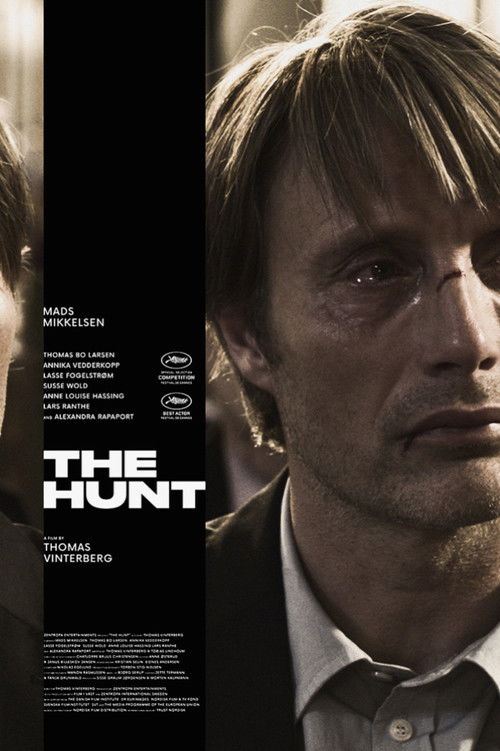
Jagten
"The lie is spreading."
The Hunt - Symbolism & Philosophy
Symbols & Motifs
The Hunt
The act of hunting serves as the film's central and most powerful metaphor. It represents both the communal male tradition that binds the characters and the brutal, predatory witch-hunt that Lucas becomes the victim of. He is the innocent deer, relentlessly pursued by the very friends who once hunted alongside him. The title itself has a dual meaning, referring to the literal deer hunt and the metaphorical hunt for a scapegoat.
The film opens and closes with hunting scenes. The opening establishes the camaraderie of the men in the community. The final, tense scene, a year after Lucas's name has been cleared, shows him being targeted by an unseen shooter during a hunt. This signifies that despite his exoneration, he will forever be 'hunted' by the shadow of the accusation.
Fanny the Dog
Lucas's dog, Fanny, symbolizes innocence, loyalty, and unconditional love – everything that Lucas loses from his human companions. She is his last source of solace and companionship when the entire town has turned against him.
When Lucas is at his lowest point of isolation, he finds comfort in Fanny. Her brutal killing by an unknown member of the community is a pivotal moment, representing the ultimate violation of his private sanctuary and the depth of the town's hatred. It is a cruel act designed to completely break his spirit.
The Church
The church traditionally symbolizes sanctuary, community, truth, and moral judgment. In "The Hunt," it becomes a stage for public condemnation and, ultimately, a desperate plea for recognition and justice.
The climax of Lucas's public shaming occurs during the Christmas Eve service. Surrounded by the entire community in a place of supposed peace and forgiveness, he is met with whispers and hostile glares. It is here that he finally confronts Theo, forcing him to look into his eyes and see the truth. The scene powerfully inverts the church's purpose from a place of spiritual comfort to one of intense psychological torment and confrontation.
Philosophical Questions
What is the nature of truth in a community governed by emotion?
The film relentlessly explores how objective truth becomes irrelevant in the face of collective fear and emotional conviction. Klara's lie, a fabrication born of childish confusion, is adopted as an unshakeable truth by the adults because it aligns with their deepest fears about protecting children. Lucas's protests and the lack of evidence are dismissed. The film posits a frightening philosophical question: if an entire community believes a lie, does that lie become a functional reality, with all the destructive power of the truth? It demonstrates that 'truth' within a social group can be a matter of consensus rather than fact, a consensus dangerously shaped by hysteria.
Where is the line between righteous protection and vengeful persecution?
"The Hunt" examines the moral grey area where the noble intention of protecting children curdles into vigilantism. Every antagonist in the film, from the kindergarten principal to Theo, believes they are doing the right thing. They are acting out of a perceived love and duty to protect the innocent. The film forces the audience to question at what point this protective instinct becomes a destructive force. It challenges the viewer to consider how easily good people, driven by powerful emotions, can cross the line into perpetrating profound injustice, becoming the very monsters they fear.
Can forgiveness and social reintegration ever be absolute after a profound betrayal?
The film's final act questions the possibility of true reconciliation. A year after the events, the community appears to have welcomed Lucas back. They greet him, and his son is initiated into the hunting tradition, a symbol of acceptance. However, the final gunshot shatters this illusion of harmony. It raises the philosophical question of whether trust, once so thoroughly broken, can ever be fully restored. Can a community truly forgive and forget its own monstrous behavior, and can the victim ever feel truly safe among those who once condemned him? The ending suggests a pessimistic answer: that some wounds are too deep to heal, and the shadow of betrayal lingers indefinitely.
Core Meaning
The core meaning of "The Hunt" revolves around the terrifying ease with which a lie can become truth and how fragile trust and social bonds are in the face of collective hysteria. Director Thomas Vinterberg explores the destructive power of suspicion and how quickly a community, driven by fear and a misguided sense of righteousness, can turn on one of its own. The film serves as a powerful and unsettling commentary on the dangers of rushing to judgment and the lasting scars left by false accusations, even after innocence is proven. It questions the nature of justice, the fallibility of human perception, and the terrifying reality that in the court of public opinion, accusation can be tantamount to conviction. Vinterberg presents a world where good intentions, fueled by irrational emotion, can lead to monstrous outcomes.