"It's no laughing matter."
The King of Comedy - Symbolism & Philosophy
Symbols & Motifs
Cardboard Cutouts
Symbolizes the one-dimensional nature of celebrity and the artificiality of Rupert's social world. He interacts with these flat images as if they are real people, highlighting his disconnect from human reality.
Rupert sets up a talk-show set in his basement with life-size cutouts of Liza Minnelli and Jerry Langford, conducting imaginary interviews with them.
The Red Suit
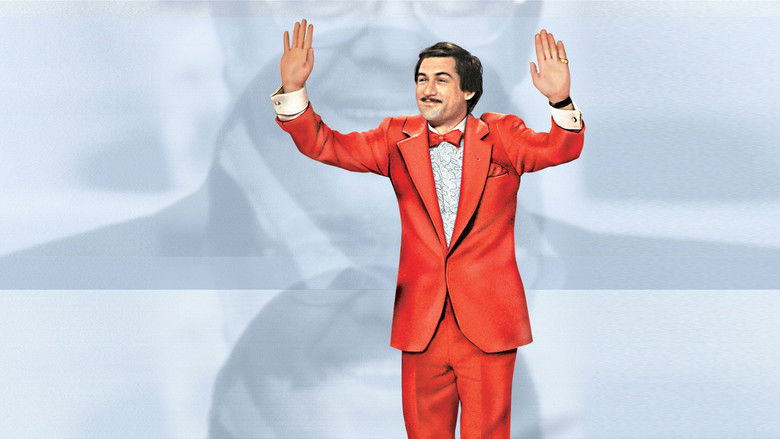
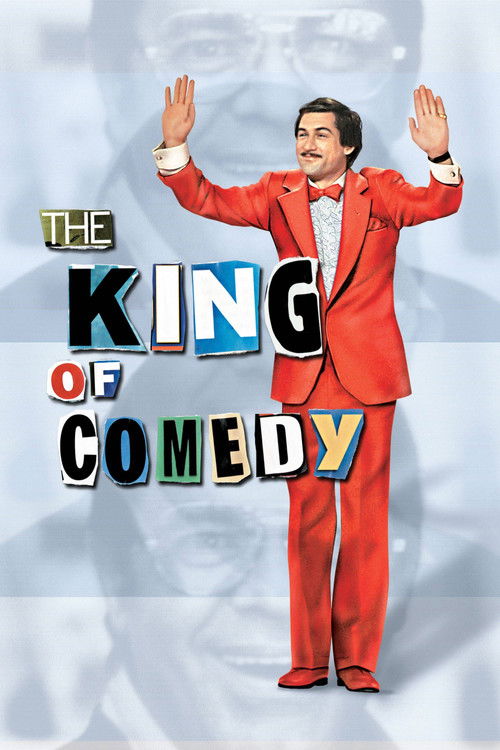
Represents Rupert's idealized self-image and his eventual "coronation" in the comedy world. It stands out against the drab, realistic colors of the rest of the film, signaling his entry into his own fantasy.
Rupert wears the flashy red suit during his actual (or imagined) performance on the Jerry Langford Show and in the film's final moments.
The Autograph Book
A symbol of validation and transactional fame. To Rupert, an autograph isn't just a souvenir; it's proof of an encounter that moves him closer to the "inner circle."
Rupert is seen obsessively collecting autographs and later signs his own book, symbolizing his self-appointment as a celebrity.
Duct Tape
Symbolizes the violent imposition of the fan's will onto the star. It is the literal tool used to force the "gatekeeper" to finally listen.
Used by Rupert and Masha to bind Jerry Langford during the kidnapping sequence.
Philosophical Questions
Is visibility a prerequisite for existence in a media-centric world?
The film explores the existential dread of being a 'nobody.' Rupert's actions suggest that he would rather be a criminal celebrity than a virtuous ghost, implying that modern identity is tied strictly to public recognition.
Does the audience bear responsibility for the monsters it creates?
By laughing at Rupert's routine—which contains a literal confession—the studio audience validates his pathology. The film asks if our hunger for entertainment makes us complicit in the breakdown of those who provide it.
Core Meaning
The core meaning of the film lies in its prophetic critique of a culture that values visibility over substance. Scorsese explores the idea that in a media-saturated society, existence is only validated by being "seen" on a screen. The film suggests that the boundary between fan and stalker—and between ambition and psychosis—is dangerously thin. It argues that the American dream has morphed into a nightmare of entitlement, where individuals feel they are "owed" fame simply for existing, regardless of talent or effort.