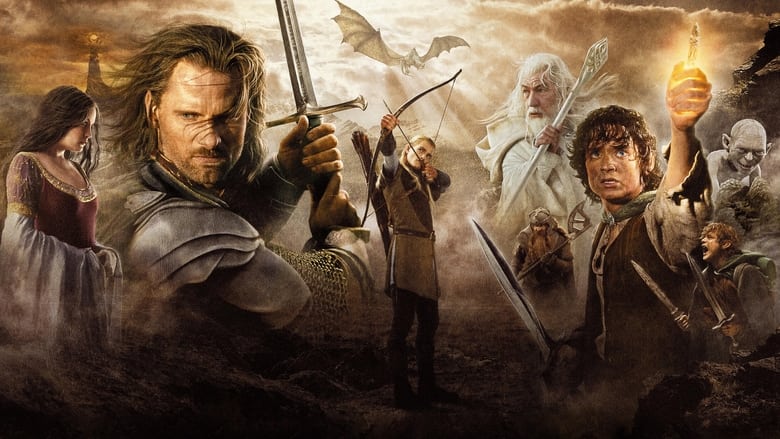
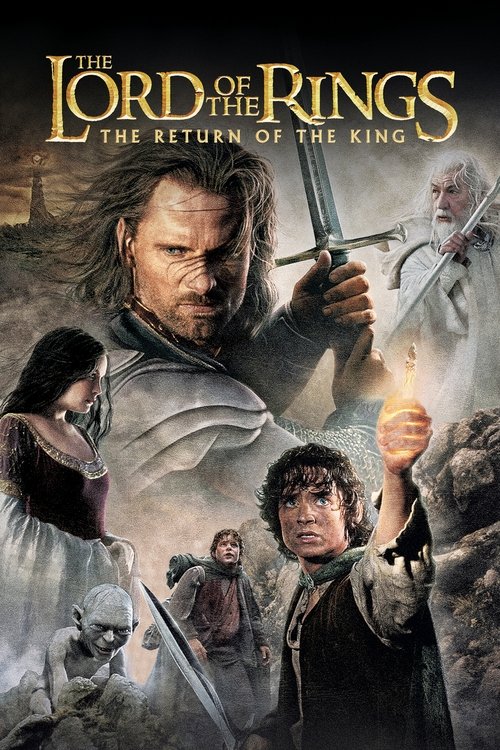
The climax of The Lord of the Rings: The Return of the King sees Frodo and Sam finally reach the Crack of Doom. However, at the final moment, Frodo succumbs to the Ring's power and claims it for himself. At that instant, Gollum, who has been secretly following them, attacks Frodo and bites off his finger to reclaim the Ring. In his moment of triumph, Gollum slips and falls into the lava, destroying both himself and the One Ring. The destruction of the Ring causes the downfall of Sauron, the collapse of his fortress Barad-dûr, and the defeat of his armies. Frodo and Sam are rescued from the erupting Mount Doom by Gandalf and the Great Eagles. Aragorn is crowned King of Gondor and marries Arwen. The hobbits return to the Shire, where Sam marries Rosie Cotton. However, Frodo is unable to find peace, as he is permanently scarred by his ordeal. The film concludes with Frodo, along with Bilbo, Gandalf, and the Elves, sailing away from the Grey Havens to the Undying Lands, a place of healing. He leaves the Red Book of Westmarch, containing the story of their adventures, to Sam, who returns to his family in the Shire.
"There can be no triumph without loss. No victory without suffering. No freedom without sacrifice."
Director: Peter Jackson
Cast: Elijah Wood, Ian McKellen, Viggo Mortensen, Sean Astin, Andy Serkis
The Lord of the Rings: The Return of the King — Ending Explained
⚠️ Spoiler Analysis
Alternative Interpretations
While the film presents a largely straightforward narrative of good versus evil, some alternative interpretations have been discussed by critics and audiences. One perspective is that the story can be read as an allegory for the dangers of industrialization and its destructive impact on the natural world, a theme dear to Tolkien himself. Mordor, with its fire, smoke, and machinery, stands in stark contrast to the idyllic, agrarian society of the Shire. Another interpretation views the quest to destroy the Ring through a psychological lens, with the Ring representing a kind of addiction or internal struggle that Frodo must overcome. Some have also interpreted the story through a religious framework, seeing it as a Christian allegory with Frodo as a Christ-like figure who bears the sins of the world, and Gandalf's return as a form of resurrection. Tolkien himself, while a devout Catholic, was not fond of allegory, but acknowledged his work was fundamentally religious and Catholic.
Explore More About This Movie
Dive deeper into specific aspects of the movie with our detailed analysis pages