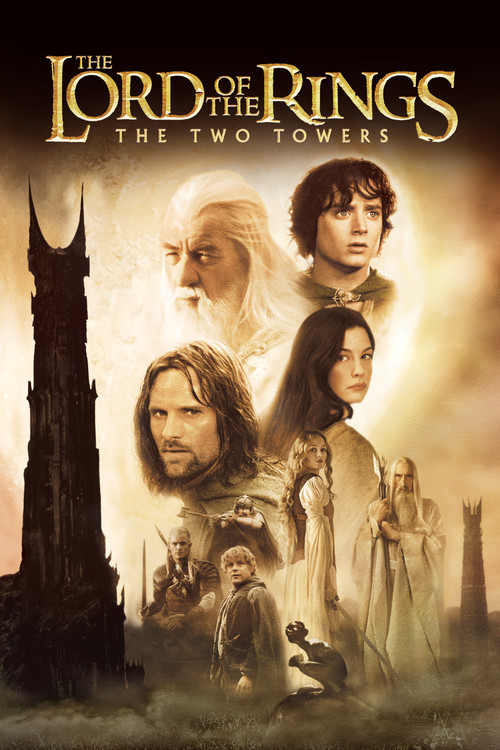
"The journey continues."
The Lord of the Rings: The Two Towers - Symbolism & Philosophy
Symbols & Motifs
The Two Towers (Orthanc and Barad-dûr)
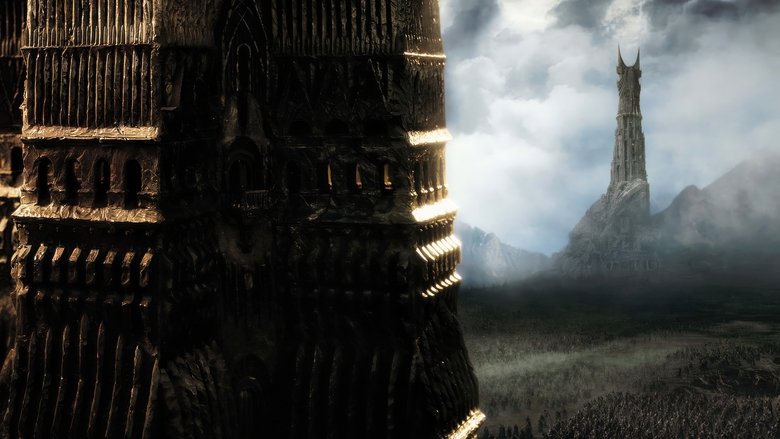
The titular towers symbolize two forms of evil. Saruman's tower, Orthanc, was once a place of wisdom but was corrupted from within, representing evil that arises from the perversion of good. Sauron's tower, Barad-dûr, was built by evil for evil purposes, representing an external, primordial darkness. Together, they embody the internal and external threats facing Middle-earth.
Orthanc is the center of Saruman's industrial war machine in Isengard, from where he commands his Uruk-hai army. Barad-dûr is shown in visions and represents the ultimate destination and source of the evil Frodo must confront. The film's title directly references the alliance between these two powers.
Gandalf the White
Gandalf's return as Gandalf the White symbolizes resurrection, hope, and renewed power. His transformation from the grey pilgrim to a radiant white figure signifies a purification and an elevation in his authority and strength, sent back to aid Middle-earth in its darkest hour. He is hope made manifest.
Aragorn, Legolas, and Gimli encounter him in Fangorn Forest, initially mistaking him for Saruman. He arrives at Edoras to free King Théoden from Saruman's influence and later leads the decisive charge that breaks the siege at Helm's Deep.
The Dead Marshes
The spectral faces of Elves, Men, and Orcs submerged in the swamp's waters symbolize the haunting, inescapable nature of the past and the grim unity of death. The marshes are a physical manifestation of the grief and horror of a long-ago battle, a reminder that the current war is built upon layers of past conflict and that the dead are never truly gone.
Frodo, Sam, and Gollum must traverse this treacherous landscape to approach Mordor. Frodo is entranced by the ghostly lights and nearly falls into the water, a moment that highlights the psychological and spiritual dangers of their path, not just the physical ones.
The One Ring
The Ring continues to be the ultimate symbol of power's corrupting influence. It represents the temptation to use evil means for good ends, a choice that inevitably leads to ruin. Its physical weight on Frodo mirrors the immense spiritual and psychological burden he carries, slowly eroding his will and identity.
Its power grows as it nears Mordor. It tempts Faramir, who shows his quality by resisting it. It causes Frodo to falter, nearly being captured by a Nazgûl, and creates an ever-present tension in his relationship with Sam and his reliance on Gollum.
Philosophical Questions
Can true good be achieved through evil means?
The film explores this question primarily through the temptation of the One Ring. Characters like Boromir (in flashback) and his brother Faramir are tempted to use the Ring—the enemy's greatest weapon—against him. Faramir's decision to reject this temptation and let Frodo go is presented as a moment of immense moral strength. He understands that wielding such a power, even for a noble cause, would inevitably corrupt the user. The film argues that the means are as important as the ends, and that certain tools of evil are inherently corrupting and cannot be used for good.
What is the role of hope in the face of certain defeat?
The Two Towers constantly places its heroes in situations where despair seems the only logical response. The defense of Helm's Deep is framed as a hopeless last stand. Frodo and Sam's journey is a slow, draining trek towards almost certain doom. The film posits that hope is not the denial of a grim reality, but an act of defiance against it. Sam's speech in Osgiliath is the clearest expression of this: he acknowledges the darkness and danger but chooses to hold on to the belief in goodness as a reason to keep going. Hope is portrayed as a conscious choice and a source of incredible resilience.
Does fate control our actions, or do we have free will?
The narrative weaves together themes of destiny and individual choice. Aragorn is destined to be king, and Frodo seems fated to be the Ring-bearer. However, the story emphasizes that destiny is fulfilled through countless individual choices. Aragorn must choose to accept his leadership role. Frodo must choose, every day, to resist the Ring and continue his journey. Faramir chooses to defy his father's law and his brother's weakness by letting Frodo go. The film suggests that while a larger fate may be at play, it is the small, personal choices of courage and honor that ultimately shape the future.
Core Meaning
The Lord of the Rings: The Two Towers is a meditation on the nature of hope in the face of overwhelming despair. It posits that even when evil seems insurmountable and fellowship is broken, courage, loyalty, and the resilience of the natural world can turn the tide. The film explores the idea that true strength is not found in solitary power, which corrupts figures like Saruman, but in unity and the willingness to fight for the good that remains in the world, a sentiment powerfully articulated by Samwise Gamgee. It contrasts the destructive, industrial war machine of Saruman with the enduring power of nature, suggesting that the industrial defilement of the world is a profound evil that the natural order will ultimately rise to combat.