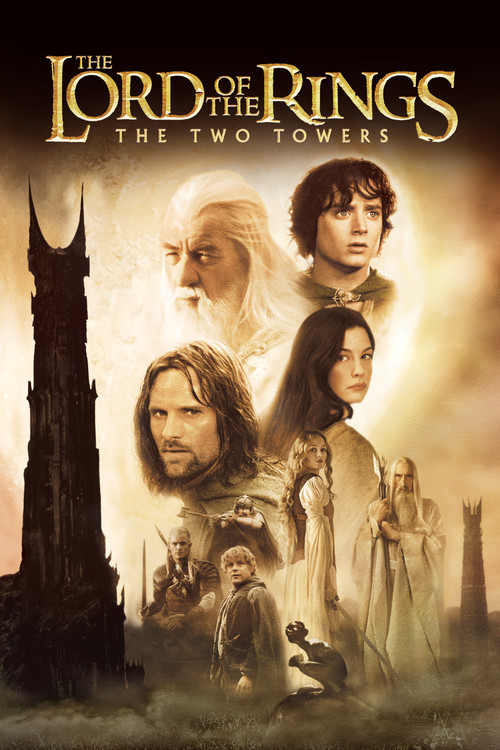
The Lord of the Rings: The Two Towers
"The journey continues."
Overview
Following the breaking of the Fellowship, the second installment of Peter Jackson's epic trilogy follows three separate but interconnected storylines. Frodo Baggins and his loyal companion Samwise Gamgee continue their perilous journey towards Mordor to destroy the One Ring. They are tracked and eventually guided by the treacherous Gollum, a creature twisted by his former possession of the Ring, whose inner conflict between his two personalities, Sméagol and Gollum, adds a layer of psychological complexity.
Meanwhile, Aragorn, the elf Legolas, and the dwarf Gimli pursue the Uruk-hai who have captured their hobbit friends, Merry and Pippin. Their quest leads them into the kingdom of Rohan, a land besieged by the armies of the corrupt wizard Saruman. Here they are reunited with a miraculously returned Gandalf, now more powerful as Gandalf the White, and must help King Théoden defend his people at the fortress of Helm's Deep. The captured hobbits, Merry and Pippin, escape into the ancient Fangorn Forest and befriend Treebeard, an Ent, a treelike being who they must convince to join the fight against Saruman's destructive forces.
Core Meaning
The Lord of the Rings: The Two Towers is a meditation on the nature of hope in the face of overwhelming despair. It posits that even when evil seems insurmountable and fellowship is broken, courage, loyalty, and the resilience of the natural world can turn the tide. The film explores the idea that true strength is not found in solitary power, which corrupts figures like Saruman, but in unity and the willingness to fight for the good that remains in the world, a sentiment powerfully articulated by Samwise Gamgee. It contrasts the destructive, industrial war machine of Saruman with the enduring power of nature, suggesting that the industrial defilement of the world is a profound evil that the natural order will ultimately rise to combat.
Thematic DNA
Hope vs. Despair
This is the central emotional conflict of the film. Characters are repeatedly pushed to their limits, facing seemingly impossible odds. King Théoden is lost in despair under Saruman's influence, the defenders of Helm's Deep are catastrophically outnumbered, and Frodo grows weaker under the Ring's oppressive weight. Yet, hope persists through the actions of individuals: Aragorn's resolve, Gandalf's return, and most poignantly, Sam's unwavering belief that there is "some good in this world, and it's worth fighting for."
The Corruption of Power
The film delves into how power corrupts. Saruman, once the wise leader of the wizards, has succumbed to a lust for power, aligning himself with Sauron and transforming Isengard into a destructive industrial wasteland. This is mirrored by the One Ring's growing influence over Frodo, which physically and mentally drains him, symbolizing the heavy burden and corrupting nature of absolute power. Gollum serves as a living cautionary tale of what the Ring's power can do to a person over time.
Nature vs. Industrialization
A strong environmental theme pervades the film, a direct reflection of Tolkien's own views. Saruman's war effort is depicted as a violent industrial machine, fueled by the destruction of forests to power his forges. This is set in stark opposition to the Ents, the ancient shepherds of the forest, who represent the slow, powerful, and ultimately vengeful force of nature itself. Their decision to march on Isengard is portrayed as nature's reclamation against its defilement.
Duty and Heroism
The film explores different facets of heroism. Aragorn steps further into his destined role as a leader, not for glory, but out of a sense of duty to protect the people of Rohan. Faramir, Boromir's brother, faces the same temptation of the Ring but chooses honor and duty over personal gain, showing a different, more resilient kind of strength. Samwise's heroism is not that of a warrior, but of a loyal friend, whose simple courage and emotional support are what keep the quest alive.
Character Analysis
Aragorn
Viggo Mortensen
Motivation
His primary motivation is his duty to protect the free peoples of Middle-earth and his love for Arwen. He fights for a future where they can be together, which requires him to accept the burdens of leadership and confront the forces of Sauron directly.
Character Arc
In The Two Towers, Aragorn fully embraces his role as a leader of Men. Having accepted his path at the end of the first film, he now acts with authority and resolve, guiding Legolas and Gimli, advising Théoden, and fighting to protect the people of Rohan. His declaration at Helm's Deep, "Then I shall die as one of them!", encapsulates his commitment to his adopted people and his transformation from a solitary ranger to a future king.
Frodo Baggins
Elijah Wood
Motivation
His motivation is pure duty: to carry the Ring to Mordor and destroy it. Unlike other characters fighting for victory in battle, Frodo's quest is a slow, sacrificial walk into the heart of enemy territory, driven by the knowledge that it is the only way to save the world.
Character Arc
Frodo's journey becomes darker and more internalized. The Ring's influence weighs heavily on him, making him more suspicious, desperate, and physically weakened. His arc is one of descent, as he struggles to maintain his identity against the Ring's corrupting power. He shows a growing, and perhaps dangerous, empathy for Gollum, recognizing a shared fate as a Ring-bearer, which isolates him further from Sam.
Samwise Gamgee
Sean Astin
Motivation
His motivation is his unwavering love for and loyalty to Frodo. He is not driven by a grand sense of destiny but by a simple, powerful promise to protect his master and friend, no matter the cost.
Character Arc
Sam's role evolves from a simple gardener and friend to Frodo's unwavering protector and moral compass. As Frodo weakens, Sam's strength and resolve grow. He is suspicious of Gollum, protective of Frodo, and ultimately provides the emotional anchor for the quest. His monologue at Osgiliath about the great stories is the thematic heart of the film, defining his simple, profound understanding of good, evil, and hope.
Gollum / Sméagol
Andy Serkis
Motivation
His sole motivation is to reclaim his "Precious," the One Ring. This desire overrides everything, forcing him to serve Frodo while constantly plotting to betray him. The inner conflict is between his method of getting the Ring (Sméagol's servitude vs. Gollum's murder).
Character Arc
Introduced fully in this film, Gollum's arc is a tragic internal war. The film masterfully portrays his split personality: the piteous, childlike Sméagol who is capable of loyalty to Frodo, and the malevolent, Ring-obsessed Gollum. For a time, it seems Sméagol might be redeemed through Frodo's kindness, but the cruelty of Faramir's men and Gollum's own deep-seated corruption push him back into treachery, setting up his plan to lead the hobbits to Shelob.
Symbols & Motifs
The Two Towers (Orthanc and Barad-dûr)
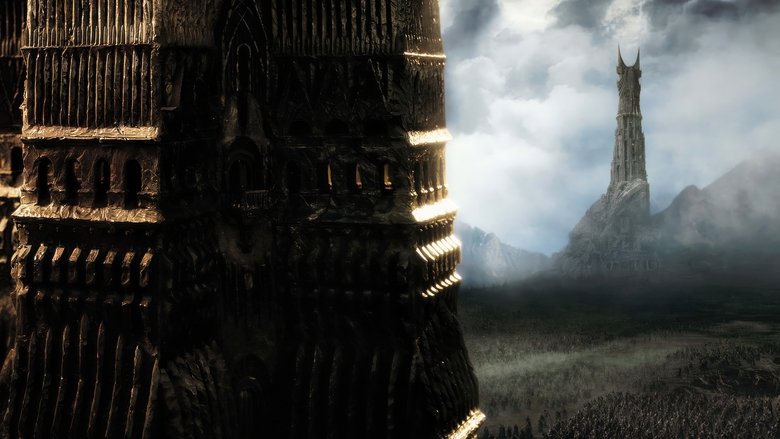
The titular towers symbolize two forms of evil. Saruman's tower, Orthanc, was once a place of wisdom but was corrupted from within, representing evil that arises from the perversion of good. Sauron's tower, Barad-dûr, was built by evil for evil purposes, representing an external, primordial darkness. Together, they embody the internal and external threats facing Middle-earth.
Orthanc is the center of Saruman's industrial war machine in Isengard, from where he commands his Uruk-hai army. Barad-dûr is shown in visions and represents the ultimate destination and source of the evil Frodo must confront. The film's title directly references the alliance between these two powers.
Gandalf the White
Gandalf's return as Gandalf the White symbolizes resurrection, hope, and renewed power. His transformation from the grey pilgrim to a radiant white figure signifies a purification and an elevation in his authority and strength, sent back to aid Middle-earth in its darkest hour. He is hope made manifest.
Aragorn, Legolas, and Gimli encounter him in Fangorn Forest, initially mistaking him for Saruman. He arrives at Edoras to free King Théoden from Saruman's influence and later leads the decisive charge that breaks the siege at Helm's Deep.
The Dead Marshes
The spectral faces of Elves, Men, and Orcs submerged in the swamp's waters symbolize the haunting, inescapable nature of the past and the grim unity of death. The marshes are a physical manifestation of the grief and horror of a long-ago battle, a reminder that the current war is built upon layers of past conflict and that the dead are never truly gone.
Frodo, Sam, and Gollum must traverse this treacherous landscape to approach Mordor. Frodo is entranced by the ghostly lights and nearly falls into the water, a moment that highlights the psychological and spiritual dangers of their path, not just the physical ones.
The One Ring
The Ring continues to be the ultimate symbol of power's corrupting influence. It represents the temptation to use evil means for good ends, a choice that inevitably leads to ruin. Its physical weight on Frodo mirrors the immense spiritual and psychological burden he carries, slowly eroding his will and identity.
Its power grows as it nears Mordor. It tempts Faramir, who shows his quality by resisting it. It causes Frodo to falter, nearly being captured by a Nazgûl, and creates an ever-present tension in his relationship with Sam and his reliance on Gollum.
Memorable Quotes
There's some good in this world, Mr. Frodo... and it's worth fighting for.
— Samwise Gamgee
Context:
After a terrifying encounter with a Nazgûl in the ruined city of Osgiliath, a despondent Frodo questions their mission. Sam, recalling the tales of heroes, delivers this powerful speech, renewing Frodo's strength and reminding them both what is at stake.
Meaning:
This quote is the philosophical core of the entire trilogy. Delivered when all hope seems lost, it affirms that the struggle against evil is not just about defeating an enemy, but about preserving the good, the beautiful, and the simple things in life. It is an affirmation of hope against despair.
The Battle for Helm's Deep is over. The Battle for Middle-earth is about to begin.
— Gandalf
Context:
Spoken at the end of the film, as Gandalf and Aragorn look out from Helm's Deep towards Mordor. They have won a reprieve, but the sight of Sauron's growing power in the East makes it clear that their struggle is far from over.
Meaning:
This line provides a crucial sense of perspective. While the victory at Helm's Deep is momentous, Gandalf understands it is only one battle in a much larger war. It serves as a powerful bridge to the final film, reminding the audience that the true threat, Sauron, has yet to be confronted directly and the stakes are about to get even higher.
What can men do against such reckless hate?
— Théoden
Context:
As he observes Saruman's massive Uruk-hai army approaching Helm's Deep, Théoden is overwhelmed by the sheer scale and ferocity of the enemy. Aragorn's response, "Ride out with me... Ride out and meet them," is the heroic counterpoint to Théoden's despair.
Meaning:
Théoden's question captures the feeling of hopelessness when facing an enemy that is not just powerful, but seemingly inhuman and devoid of reason or mercy. It speaks to the despair of fighting a war of attrition against a relentless, faceless foe.
They're taking the Hobbits to Isengard!
— Legolas
Context:
After a long pursuit, Legolas uses his keen elven eyesight to determine the destination of the Uruk-hai who have captured Merry and Pippin, shouting this line to Aragorn and Gimli as they race across the plains of Rohan.
Meaning:
While a straightforward line of dialogue, its rhythmic, urgent delivery by Orlando Bloom has made it one of the most iconic and frequently memed quotes from the trilogy. It perfectly encapsulates the driving purpose of the 'Three Hunters' in the first part of the film.
Philosophical Questions
Can true good be achieved through evil means?
The film explores this question primarily through the temptation of the One Ring. Characters like Boromir (in flashback) and his brother Faramir are tempted to use the Ring—the enemy's greatest weapon—against him. Faramir's decision to reject this temptation and let Frodo go is presented as a moment of immense moral strength. He understands that wielding such a power, even for a noble cause, would inevitably corrupt the user. The film argues that the means are as important as the ends, and that certain tools of evil are inherently corrupting and cannot be used for good.
What is the role of hope in the face of certain defeat?
The Two Towers constantly places its heroes in situations where despair seems the only logical response. The defense of Helm's Deep is framed as a hopeless last stand. Frodo and Sam's journey is a slow, draining trek towards almost certain doom. The film posits that hope is not the denial of a grim reality, but an act of defiance against it. Sam's speech in Osgiliath is the clearest expression of this: he acknowledges the darkness and danger but chooses to hold on to the belief in goodness as a reason to keep going. Hope is portrayed as a conscious choice and a source of incredible resilience.
Does fate control our actions, or do we have free will?
The narrative weaves together themes of destiny and individual choice. Aragorn is destined to be king, and Frodo seems fated to be the Ring-bearer. However, the story emphasizes that destiny is fulfilled through countless individual choices. Aragorn must choose to accept his leadership role. Frodo must choose, every day, to resist the Ring and continue his journey. Faramir chooses to defy his father's law and his brother's weakness by letting Frodo go. The film suggests that while a larger fate may be at play, it is the small, personal choices of courage and honor that ultimately shape the future.
Alternative Interpretations
While the primary reading of The Two Towers is a heroic fantasy about good versus evil, several alternative interpretations exist. One of the most prominent, drawn from Tolkien's own experiences, is an anti-war reading. The film doesn't glorify battle; instead, it emphasizes its cost: the fear in the eyes of boy soldiers, the grief of the king, and the destruction of the land. The Battle of Helm's Deep is portrayed not as a glorious adventure but as a desperate, terrifying struggle for survival.
Another interpretation views the film as a powerful environmentalist allegory. Saruman's destruction of Fangorn Forest to fuel his war machine is a stark metaphor for industrialization's ravaging of the natural world. The Ents' subsequent attack on Isengard can be seen as a form of ecological revenge, a literal representation of nature fighting back against its destruction. This theme resonated strongly with contemporary concerns about environmental degradation and corporate greed.
Finally, some critics have interpreted the story through a psychological lens, focusing on Frodo's journey as an exploration of addiction and trauma. The Ring is akin to an addictive substance that isolates him, alters his personality, and destroys his relationships. His connection with Gollum is not just about a shared burden, but a terrifying glimpse into the addict's future, a potential version of himself he must resist becoming.
Cultural Impact
The Lord of the Rings: The Two Towers was a monumental success, critically and commercially, cementing the trilogy as a cultural phenomenon. Released in 2002, it built upon the foundation of the first film, proving that epic fantasy could be a dominant force in mainstream cinema. The film's most significant technological impact was the character of Gollum. The seamless integration of Andy Serkis's motion-capture performance with digital animation was a watershed moment for visual effects, creating a fully realized, emotionally complex CGI character that was hailed as a revolutionary achievement. This technology paved the way for characters in films like Avatar and the Planet of the Apes reboot series.
The Battle of Helm's Deep became an instant benchmark for cinematic battle sequences, praised for its scale, clarity, and emotional weight. Its influence can be seen in numerous subsequent films and television shows attempting large-scale fantasy warfare. The film, along with the trilogy as a whole, revitalized interest in the fantasy genre and in J.R.R. Tolkien's literature for a new generation. It also had a significant impact on tourism in New Zealand, where the films were shot, with fans flocking to see the real-life landscapes of Middle-earth. Critically acclaimed, it was praised for its darker tone, emotional depth, and spectacular action, securing its place as one of the greatest sequels ever made.
Audience Reception
Audience reception for The Lord of the Rings: The Two Towers was overwhelmingly positive, with many viewers considering it equal to or even better than its predecessor. On aggregate sites, it holds exceptionally high ratings, indicating widespread acclaim. Audiences particularly praised the groundbreaking visual effects, singling out the creation of Gollum as a revolutionary achievement in character animation and performance. The epic scale and execution of the Battle of Helm's Deep were also major points of praise, often cited as one of the greatest battle sequences in film history.
Points of criticism were minor and infrequent. Some viewers found the constant cross-cutting between the three separate storylines to be occasionally jarring, disrupting the narrative flow of each individual plot. A small number of Tolkien purists took issue with certain changes from the source material, such as the arrival of the Elves at Helm's Deep or the alteration of Faramir's character arc (where he initially decides to take the Ring to Gondor before relenting). However, most audiences accepted these changes as necessary for the cinematic adaptation. Overall, the film was celebrated as a thrilling, emotionally resonant, and technically masterful middle chapter that left audiences eagerly anticipating the conclusion.
Interesting Facts
- During the scene where Aragorn, Legolas, and Gimli find a pile of burning Orc bodies, Aragorn kicks an Orc helmet and lets out a cry of anguish. The cry was real, as actor Viggo Mortensen broke two of his toes in that take.
- Andy Serkis, who performed the motion capture and voice for Gollum, originally thought the job would be a simple three-week voice-over role. His performance was so compelling that the team expanded the character's presence and relied on his physical acting to create the final CGI character.
- The massive Uruk-hai army chanting at Helm's Deep was not created by a small group in a studio. Director Peter Jackson led a stadium of 25,000 cricket fans in chanting the harsh, guttural sounds, which were then recorded and used in the film's sound design.
- The epic Battle of Helm's Deep took four months to film, with most of the shooting done at night in grueling, rainy conditions. The cast and crew were given T-shirts that read "I Survived Helm's Deep."
- Viggo Mortensen formed a strong bond with the horse who played Brego. After filming concluded, he purchased the horse from its owners.
- John Rhys-Davies, who plays the dwarf Gimli, also provides the voice for the Ent, Treebeard.
- Orlando Bloom originally auditioned for the role of Faramir. Peter Jackson, however, thought he would be a perfect Legolas and asked him to audition for that role instead.
- The set for Helm's Deep was so large and detailed that it took seven months to build into the side of a real quarry.
Easter Eggs
Director Peter Jackson has a cameo appearance during the Battle of Helm's Deep.
As the Rohirrim prepare to defend the fortress, Jackson, dressed as a Rohan soldier, stands on the battlements and hurls a spear at the attacking Uruk-hai. This continues his tradition of making brief appearances in his films.
Aragorn wears Boromir's vambraces (arm guards).
After Boromir's death at the end of The Fellowship of the Ring, Aragorn takes his fallen companion's vambraces and wears them for the rest of the trilogy. It is a subtle but constant visual tribute to Boromir's sacrifice and a symbol of the bond of the Fellowship.
On the Extended Edition DVD, there is a hidden MTV Movie Awards clip.
By navigating to a hidden icon in the scene selection menu of Disc 1, viewers can access a humorous clip from the 2003 MTV Movie Awards where Andy Serkis accepts an award, only to be interrupted by a comically abusive Gollum who delivers his own profanity-laced speech.
⚠️ Spoiler Analysis
Click to reveal detailed analysis with spoilers
Frequently Asked Questions
Explore More About This Movie
Dive deeper into specific aspects of the movie with our detailed analysis pages
Comments (0)
No comments yet. Be the first to share your thoughts!