"An emotional earthquake!"
The Miracle Worker - Symbolism & Philosophy
Symbols & Motifs
Water Pump
The water pump is the most powerful symbol in the film, representing Helen's miraculous breakthrough and rebirth. Water itself symbolizes knowledge, communication, and life. It is at the pump that the connection between a physical object (water) and a word spelled into her hand finally clicks, unlocking the world of language for Helen.
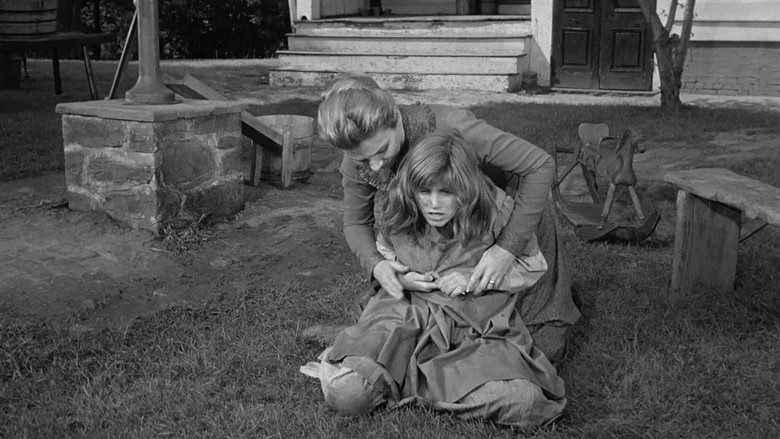
The climactic scene of the movie takes place at the water pump. After a struggle, Anne holds Helen's hand under the flowing water while repeatedly spelling "w-a-t-e-r" into her other palm. Helen's sudden comprehension marks the turning point of the entire story.
Keys and Locked Doors
Keys and locks symbolize both Helen's confinement and the means of her liberation. Helen is metaphorically "locked" inside herself, unable to communicate. The key represents the tool—language and education—that can unlock her mind and potential.
Early in the film, Helen locks Annie in her room and hides the key, a literal representation of her resistance and control. Annie's struggle to get out mirrors her larger struggle to "unlock" Helen's understanding. The eventual discovery of the key parallels the eventual breakthrough in communication.
Dolls
The dolls are symbolic of Helen's limited understanding of the world and serve as a primary tool for Annie's teaching. Initially, Helen treats the doll as an object without identity. The doll with no eyes represents Helen's own blindness. Annie uses a doll to introduce the concept of language by spelling "d-o-l-l" into Helen's hand.
Annie gives Helen a doll upon her arrival and immediately tries to teach her the corresponding word. Helen's violent reaction, wanting the doll but not the "word," demonstrates her initial resistance to language.
Smoked Glasses
Annie's smoked glasses are a constant visual reminder of her own partial blindness and her unique qualification to teach Helen. They symbolize that she can see the world differently, both literally and metaphorically. Her impairment gives her an empathy and understanding that the fully sighted Kellers lack, allowing her to see Helen's potential beyond the disability.
Annie wears the glasses throughout the film. They are a gift from the children at the Perkins school, connecting her to her past and her own journey of overcoming visual impairment.
Philosophical Questions
What is the relationship between language and consciousness?
The film explores this question by presenting Helen as a being with intelligence and will but without the framework to structure her thoughts or connect with the world conceptually. Annie's statement, "Language is to the mind more than light is to the eye," suggests that without words, the mind itself is blind. Helen's transformation from a feral child to a conscious, inquisitive student the moment she understands the concept of a word demonstrates the film's belief that language is the fundamental building block of human consciousness and identity.
Does true compassion require discipline over pity?
"The Miracle Worker" presents a compelling argument that pity is a destructive force that infantilizes and disables. The Kellers' love, expressed through pity, keeps Helen trapped in a state of dependency and rage. Annie's approach, which appears harsh, is framed as the truest form of compassion because it is rooted in respect for Helen's potential. The film forces the audience to question the nature of kindness, suggesting that allowing someone to exist without expectations is a form of cruelty, while demanding growth and discipline is an act of profound love.
Core Meaning
The core meaning of "The Miracle Worker" is the profound message that language is the key to unlocking the human mind and spirit. The film posits that without communication, an individual is trapped, unable to learn, grow, or connect with others in a meaningful way. Director Arthur Penn wanted to convey that perseverance, discipline, and a refusal to give in to pity are essential in overcoming seemingly insurmountable barriers. The "miracle" of the title is not a supernatural event, but the hard-won, transformative power of education and the profound connection between a teacher and a student who, together, achieve the impossible.