"It’s a hard world for little things."
The Night of the Hunter - Ending Explained
⚠️ Spoiler Analysis
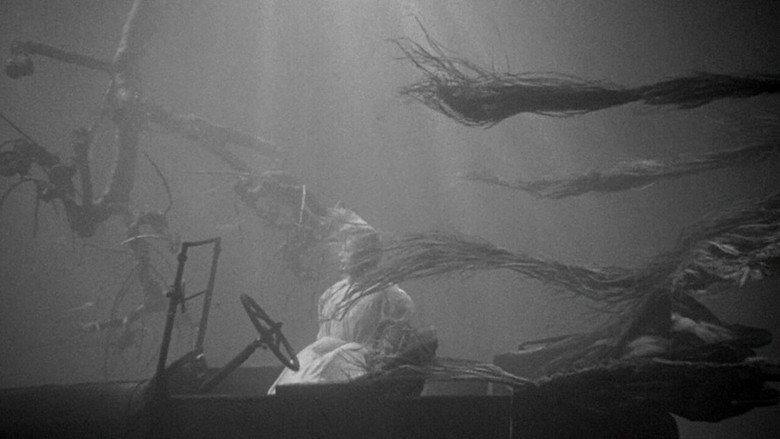
The plot's central tension revolves around the secret of the $10,000 hidden inside Pearl's doll. After marrying Willa, Harry Powell's frustration grows as he fails to extract the secret. During a chillingly stylized bedroom scene that resembles a chapel, Willa, having realized Powell's true nature and lack of interest in her, tells him she understands he married her for the money, not for love. Powell then murders her with his switchblade. The subsequent underwater sequence, showing Willa's body sitting in a car at the bottom of the river, her hair waving like seaweed, is one of the most indelible images in cinema history.
Powell convinces the townspeople that Willa left him for a life of sin. After he finally learns the money is in the doll, the children make a desperate escape, fleeing down the Ohio River. Their journey leads them to the farmhouse of Rachel Cooper, a tough, devout woman who cares for stray children. Powell eventually tracks them there, leading to a tense, psychological standoff. The climax is not a physical brawl but a battle of wills and faith, with Rachel standing guard all night with her shotgun while Powell waits outside, singing his haunting hymn. He eventually breaks in but is shot and wounded by Rachel, retreating to the barn where he is apprehended by police the next morning. The townspeople who once revered him quickly form a lynch mob, but Rachel protects Powell from them, understanding the cycle of hate. In the end, John and Pearl are safe, having found a true protector, and John is finally able to let go of the burden of the money.
Alternative Interpretations
While the central theme of good versus evil is clear, "The Night of the Hunter" invites several interpretive lenses:
- A Dark Fairy Tale: Many critics interpret the film not as a realistic thriller, but as a live-action fairy tale. Harry Powell is the archetypal 'Big Bad Wolf' stalking the 'little pigs' (the children), who must flee to a safe house. Rachel Cooper serves as the protective 'fairy godmother' figure. The film's stylized, dream-like visuals and clear moral archetypes support this reading.
- Southern Gothic Horror: The film is a prime example of the Southern Gothic genre, using its Depression-era West Virginia setting to explore themes of religious fanaticism, decay, and grotesque characters hidden beneath a veneer of piety. The oppressive atmosphere and focus on flawed, desperate characters are hallmarks of this style.
- A Freudian Psychological Thriller: Some analysis has viewed the film through a Freudian lens, focusing on Powell's repressed sexuality and psychopathic misogyny. His obsession with his knife and his violent reactions to female sexuality suggest deep-seated psychological pathologies. The conflict between John and Powell can also be seen as an Oedipal struggle over the mother, Willa.
- A Critique of American Populism: The ease with which Powell manipulates the entire town can be read as a political allegory. His charismatic, simplistic rhetoric and appeals to religious morality sway the populace, who are quick to follow him and later, just as quick to form a lynch mob. This can be seen as a critique of the dangers of mob mentality and charismatic, but hollow, leadership.