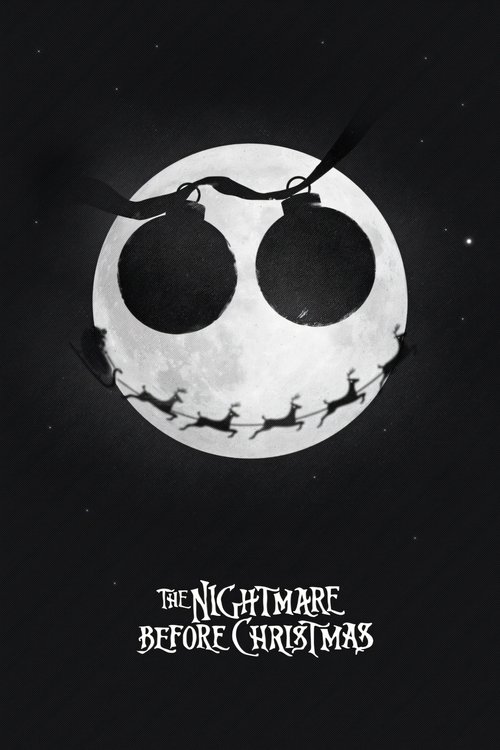
The Nightmare Before Christmas
A hauntingly beautiful stop-motion symphony where the macabre waltzes with the merry, exploring one's purpose in a visually stunning, gothic fairytale.
The Nightmare Before Christmas

"What's this? What's this?"

09 October 1993 United States of America 76 min ⭐ 7.8 (9,995)
Director: Henry Selick
Cast: Danny Elfman, Chris Sarandon, Catherine O'Hara, William Hickey, Glenn Shadix
Animation Family Fantasy
Identity and Self-Discovery Cultural Appropriation vs. Appreciation The Search for Meaning and Fulfillment Love and Understanding
Budget: $18,000,000
Box Office: $75,634,409

The Nightmare Before Christmas - Ending Explained

⚠️ Spoiler Analysis

The central twist of "The Nightmare Before Christmas" is not a sudden reveal, but the gradual and disastrous unfolding of Jack's plan. His attempt to bring Christmas to the world results in terror, with his Halloween-themed toys traumatizing children instead of bringing them joy. This leads to the military being called in to shoot down his sleigh, and Jack is presumed dead by the residents of Halloween Town.

Jack survives the crash, and in a moment of clarity in a graveyard, he realizes his folly. He understands that he was trying to be something he is not and, in doing so, nearly ruined Christmas. More importantly, he rediscovers his love and passion for being the Pumpkin King. This moment of self-realization is the true climax of his character arc. He realizes, "I, Jack, the Pumpkin King!" and rushes back to Halloween Town to set things right.

Meanwhile, Sally has been captured by Oogie Boogie along with Santa Claus. Jack returns to defeat Oogie Boogie by unraveling his burlap sack exterior, revealing him to be nothing more than a mass of bugs, which then disintegrate. Jack rescues Sally and Santa, who then magically restores Christmas. The film's ending sees Jack and Sally finally confessing their love for one another atop Spiral Hill as Santa brings a gentle snowfall to Halloween Town, a symbol of the two holidays coexisting peacefully. This ending reveals that the true meaning Jack was searching for was not in another holiday, but in the love and acceptance that was right in front of him all along.

Alternative Interpretations

One alternative interpretation of the film is that it serves as a critique of colonialism and cultural imperialism. Jack, representing a dominant culture (in his own world), discovers a new "world" (Christmas Town) and, without understanding or respecting its traditions, decides to take it over and remake it in his own image. His failure can be seen as a commentary on the disastrous results of such cultural arrogance.

Another reading views the film through a spiritual or philosophical lens, with Jack's journey representing a quest for Dharma, or one's true calling. His attempt to be something he is not (Santa Claus) is a violation of his inherent nature (as the Pumpkin King). The film's message, in this light, is that true happiness and fulfillment come from embracing one's authentic self and purpose, rather than coveting the roles of others.

A more critical interpretation suggests that Jack's actions are driven by a toxic form of egotism. His existential crisis leads him to wreak havoc on two worlds, all stemming from his personal dissatisfaction. From this perspective, the story is about the chaos that can be caused by powerful individuals who prioritize their own fulfillment over the well-being of others, with characters like Sally representing those who suffer the consequences.