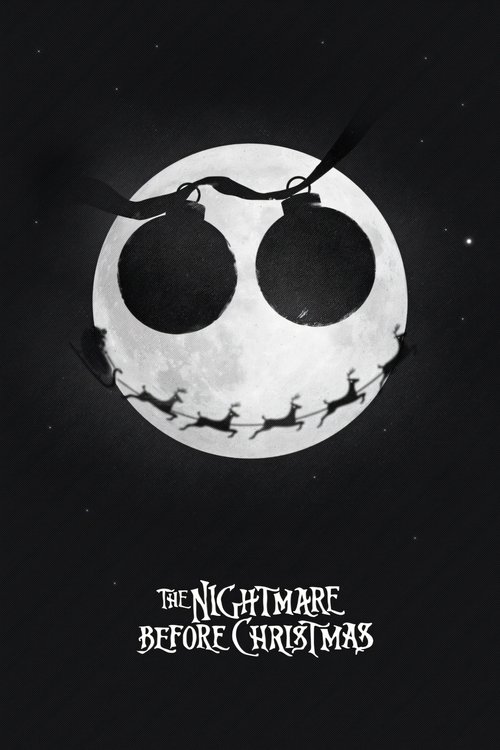
The Nightmare Before Christmas
"What's this? What's this?"
Overview
"The Nightmare Before Christmas" tells the story of Jack Skellington, the celebrated Pumpkin King of Halloween Town. Despite his success and the adoration of his fellow ghouls and monsters, Jack has grown weary of the repetitive nature of Halloween. He longs for something new and exciting to fill an emptiness he feels deep within his bones.
His existential crisis leads him to accidentally discover a portal to Christmas Town, a world filled with bright colors, joy, and a warmth he has never known. Utterly captivated, Jack becomes obsessed with the idea of Christmas and decides that he and the residents of Halloween Town will take over the holiday for a year. His attempts to understand and replicate Christmas through a Halloween lens lead to hilariously disastrous and chaotic results, as his well-intentioned but misguided efforts unleash a spooky version of the holiday upon an unsuspecting world.
Meanwhile, Sally, a lonely and intelligent rag doll who is secretly in love with Jack, has premonitions of his plan ending in disaster. She is the only one who sees the potential downfall of his enthusiastic ambitions. The film follows Jack's journey of self-discovery as he learns the true meaning of his own identity and the importance of appreciating one's own unique qualities.
Core Meaning
The core meaning of "The Nightmare Before Christmas" revolves around the themes of self-discovery, identity, and the importance of embracing one's true nature. The film explores the idea that true fulfillment comes not from imitating others or seeking novelty for its own sake, but from understanding and appreciating one's own purpose and talents. Jack Skellington's journey is a cautionary tale about the dangers of cultural appropriation when done without true understanding. He attempts to replicate the aesthetics of Christmas without grasping its underlying spirit, leading to chaos. Ultimately, the film suggests that genuine happiness is found in being authentic to oneself and that diversity in cultures and traditions should be celebrated and respected, not homogenized. It also touches on the idea that it's possible to appreciate and learn from other cultures without needing to possess them.
Thematic DNA
Identity and Self-Discovery
Jack Skellington's existential crisis and subsequent journey are central to this theme. He is the Pumpkin King, revered in his world, yet he feels a profound emptiness. His attempt to become "Sandy Claws" is a misguided effort to find a new identity he believes will bring him fulfillment. His ultimate realization that he is, and is meant to be, the Pumpkin King, and finding renewed passion in that role, represents a powerful arc of self-acceptance and the discovery of one's true purpose.
Cultural Appropriation vs. Appreciation
The film serves as a fable about cultural appropriation. Jack is enchanted by Christmas Town but fails to understand its true meaning, instead approaching it from his own Halloween-centric perspective. This leads to a disastrous interpretation of the holiday, with shrunken heads and skeletal reindeer. The film illustrates the negative consequences of taking elements from another culture without respect or understanding. The ending, where Santa brings snow to Halloween Town as a gift, suggests a model of cultural appreciation and respectful exchange.
The Search for Meaning and Fulfillment
Jack's initial boredom with his life in Halloween Town speaks to a universal search for meaning beyond routine and expectation. Despite his success, he feels a void, a common human (or skeletal) experience. His journey is driven by a desire for something more, a feeling that many can relate to. The film explores how this search, when misguided, can lead to chaos, but ultimately, through failure, Jack finds a deeper appreciation for his original purpose and the community that loves him.
Love and Understanding
The relationship between Jack and Sally highlights the importance of genuine connection and understanding. Sally is the only character who truly understands Jack's feelings and foresees the potential disaster of his Christmas plans. Her quiet strength and unwavering support, even when Jack is too consumed by his own ambitions to notice, ultimately help him see the truth. Their final union signifies that love is based on mutual understanding and acceptance of each other's true selves.
Character Analysis
Jack Skellington
Chris Sarandon (speaking voice), Danny Elfman (singing voice)
Motivation
Jack's primary motivation is to fill the emptiness he feels inside by finding something new and exciting to replace the monotony of his life. He is driven by a deep sense of longing and a desire for a new purpose, which he mistakenly believes he can find by taking over Christmas.
Character Arc
Jack begins as the beloved but unfulfilled Pumpkin King of Halloween Town. His discovery of Christmas Town leads him on an obsessive quest to claim a new identity, acting impulsively and ignoring the warnings of those who care for him. This leads to disastrous consequences, forcing him to confront his failure. Through this, he rediscovers his love for Halloween and his true self, returning as a more self-aware and appreciative leader. His journey is one from existential ennui to self-acceptance and renewed purpose.
Sally
Catherine O'Hara
Motivation
Sally is motivated by her love for Jack and her innate sense of what is right. She wants to protect him from the disastrous consequences of his actions, which she foresees. Her desire for freedom from Dr. Finkelstein is also a strong motivator.
Character Arc
Initially, Sally is a timid and captive creation of Dr. Finkelstein, yearning for freedom and for Jack to notice her. As the story progresses, she gains confidence, repeatedly defying her creator and attempting to correct Jack's misguided plans. She evolves from a passive admirer to an active and courageous character who risks her own safety to save Santa Claus and, by extension, Jack. Her arc is one of finding her own agency and voice.
Oogie Boogie
Ken Page
Motivation
Oogie Boogie's motivations are rooted in sadism and a love of gambling with others' lives. Unlike the other Halloween Town residents, his desire is not to scare but to cause genuine harm. He seems to be driven by a simple, malevolent pleasure in torturing his victims.
Character Arc
Oogie Boogie does not have a significant character arc; he is a static villain. He represents the darker, more malicious side of Halloween Town, in contrast to the other residents who engage in harmless fun. He is introduced as a threat and remains one until his defeat, serving as the primary antagonist who adds genuine peril to the story.
Dr. Finkelstein
William Hickey
Motivation
His main motivation is to keep Sally under his control, acting as a jealous and overprotective guardian. He is driven by a desire for companionship but on his own tyrannical terms.
Character Arc
Dr. Finkelstein is a static character who primarily serves as an obstacle for Sally. He is a possessive and controlling creator who sees Sally as his property. By the end of the film, he has seemingly accepted Sally's independence by creating a new companion for himself, suggesting a minor shift in his focus, if not his controlling nature.
Symbols & Motifs
The Holiday Doors
The doors to the different holiday worlds represent the existence of diverse cultures and perspectives. They are portals to entirely different ways of being and celebrating. Jack's stumbling upon them symbolizes the discovery of new possibilities and the temptation to escape one's own reality. The distinct shapes of the doors (a Christmas tree, a pumpkin, an Easter egg) visually represent the unique identity of each holiday world.
Early in the film, while wandering in the forest lamenting his existential boredom, Jack discovers a clearing with trees that have doors in the shape of different holiday symbols. He is drawn to the Christmas tree door and falls through it, leading to his discovery of Christmas Town.
Spiral Hill
Spiral Hill is an iconic visual motif that represents Jack's journey of introspection and, ultimately, his connection with Sally. The winding path can be seen as a metaphor for his convoluted path to self-discovery. It is a place of both solitude and romantic fulfillment.
Jack is often seen on Spiral Hill during moments of contemplation, such as during "Jack's Lament." The film's final scene famously takes place atop the hill, where Jack and Sally declare their love for each other under the moonlight.
The Mayor's Two Faces
The Mayor of Halloween Town has a rotating head with two faces: one happy and one worried. This symbolizes the fickle nature of public opinion and perhaps a satirical take on politicians who present different faces depending on the situation. His inability to make decisions without Jack also speaks to a lack of genuine leadership, relying instead on the popular figurehead.
Throughout the film, the Mayor's head spins to reveal his mood, often in a comical fashion. He is overjoyed when Jack's plans seem to be succeeding and terrified when things go wrong.
Sally's Stitches
Sally is a rag doll who is literally stitched together. This can symbolize her feeling of being constrained and controlled by her creator, Dr. Finkelstein. It also represents her resilience and ability to piece herself back together, as she often pulls out her stitches to escape and then sews herself back up. Her stitched-together nature can also be seen as a metaphor for the societal expectations placed upon women.
Sally is frequently seen sewing her own limbs back on after they become detached. She uses a deadly nightshade-filled needle and thread to both create potions and repair herself.
Memorable Quotes
Just because I cannot see it, doesn't mean I can't believe it!
— Jack Skellington
Context:
Jack says this as he tries to explain the concept of Christmas to the bewildered residents of Halloween Town, who struggle to comprehend a holiday not centered around fright and mischief.
Meaning:
This line encapsulates Jack's optimistic and curious nature, as well as his initial, albeit naive, faith in the magic of Christmas. It speaks to the broader theme of belief in the unseen and the power of imagination.
For it is plain as anyone can see, we're simply meant to be.
— Jack and Sally
Context:
Sung as a duet at the climax of the film, after Jack has saved the day and finally recognizes Sally's love and support for him. They are standing on Spiral Hill as snow begins to fall in Halloween Town.
Meaning:
This final line of the film confirms the romantic union of Jack and Sally and provides a heartwarming conclusion to their respective journeys. It signifies their mutual acceptance and the idea that they complement each other perfectly.
I am the master of fright, and a demon of light, and I'll scare you right out of your pants.
— Jack Skellington
Context:
This is part of the opening musical number, where the various residents of Halloween Town are introduced, and Jack makes his grand entrance as the Pumpkin King.
Meaning:
This line from the song "This is Halloween" perfectly establishes Jack's character as the charismatic and celebrated leader of Halloween Town. It showcases his pride in his role and his expertise in the art of scaring.
I sense there's something in the wind, that feels like tragedy's at hand.
— Sally
Context:
Sally sings this to herself early in the film, expressing her anxieties about Jack's newfound obsession with Christmas and her feelings of foreboding.
Meaning:
This line reveals Sally's intuitive and cautious nature. It serves as a premonition of the chaos that Jack's Christmas plans will unleash, establishing her as the voice of reason in the film.
You're jokin', you're jokin'! I can't believe my eyes! You're jokin' me, you gotta be. This can't be the right guy!
— Oogie Boogie
Context:
Oogie Boogie sings this upon the arrival of the kidnapped Santa Claus in his lair, as he prepares to torture him in his casino-themed dungeon.
Meaning:
This quote from "Oogie Boogie's Song" showcases his flamboyant, theatrical, and mocking personality. It highlights his disbelief and delight at having Santa Claus, a figure of pure goodness, in his villainous clutches.
Philosophical Questions
Can one find true happiness by adopting someone else's identity or culture?
The film explores this question through Jack's failed attempt to become Santa Claus. He is initially captivated by the novelty and warmth of Christmas, believing it will cure his existential ennui. However, by simply mimicking the outward symbols of the holiday without understanding its essence, he only creates a perverse and frightening version of it. The film argues that true fulfillment is not found in imitation, but in understanding and embracing one's own unique identity and purpose. Jack only finds peace when he accepts that he is the Pumpkin King and excels at being himself.
What is the line between cultural appreciation and cultural appropriation?
Jack's actions serve as a clear example of cultural appropriation. He takes the elements of Christmas that he finds appealing and re-contextualizes them within his own cultural framework (Halloween) without seeking to understand their original meaning or showing any respect for their source. The result is a mockery of the holiday that terrifies its intended recipients. The film contrasts this with the ending, where Santa brings snow to Halloween Town. This is presented as a gift, an act of sharing, which is joyfully received. This suggests that cultural exchange should be a process of mutual respect and sharing, not a hostile takeover.
Does routine inevitably lead to a loss of passion and meaning?
The film begins with Jack, the best at what he does, feeling empty and bored with the very routine that defines him. This raises the question of whether mastery and repetition can drain the joy out of one's calling. His journey is an attempt to escape this perceived monotony. However, the film concludes that the problem wasn't the routine itself, but Jack's perspective on it. After his disastrous Christmas adventure, he returns to Halloween with a renewed sense of passion and new ideas, suggesting that meaning can be rediscovered within one's established role, often through the perspective gained from new experiences.
Alternative Interpretations
One alternative interpretation of the film is that it serves as a critique of colonialism and cultural imperialism. Jack, representing a dominant culture (in his own world), discovers a new "world" (Christmas Town) and, without understanding or respecting its traditions, decides to take it over and remake it in his own image. His failure can be seen as a commentary on the disastrous results of such cultural arrogance.
Another reading views the film through a spiritual or philosophical lens, with Jack's journey representing a quest for Dharma, or one's true calling. His attempt to be something he is not (Santa Claus) is a violation of his inherent nature (as the Pumpkin King). The film's message, in this light, is that true happiness and fulfillment come from embracing one's authentic self and purpose, rather than coveting the roles of others.
A more critical interpretation suggests that Jack's actions are driven by a toxic form of egotism. His existential crisis leads him to wreak havoc on two worlds, all stemming from his personal dissatisfaction. From this perspective, the story is about the chaos that can be caused by powerful individuals who prioritize their own fulfillment over the well-being of others, with characters like Sally representing those who suffer the consequences.
Cultural Impact
"The Nightmare Before Christmas" initially had a modest box office success but has since grown into a massive cultural phenomenon and a beloved holiday classic. Its unique blend of Halloween and Christmas aesthetics has made it a perennial favorite for both holidays, sparking an ongoing debate about which holiday it truly belongs to. The film's gothic, German Expressionism-inspired visual style was groundbreaking for a mainstream animated feature and has influenced a generation of filmmakers and artists.
The character of Jack Skellington has become an icon, particularly within goth and alternative subcultures, symbolizing a gentle-hearted outsider who is misunderstood. The film's merchandise is ubiquitous, especially at stores like Hot Topic, demonstrating its enduring popularity and transformation into a lifestyle brand for many. This success demonstrated to Disney the lucrative potential of properties with strong subcultural followings, arguably paving the way for their acquisition of brands like Marvel and Star Wars.
The movie was nominated for an Academy Award for Best Visual Effects, a first for an animated film. In 2023, it was selected for preservation in the United States National Film Registry by the Library of Congress as being "culturally, historically, or aesthetically significant." Its critical reception has been overwhelmingly positive, with many praising its artistry, music, and originality. The film's influence can be seen in subsequent stop-motion films like "Corpse Bride" and "Coraline."
Audience Reception
Audience reception for "The Nightmare Before Christmas" has been overwhelmingly positive, solidifying its status as a cult classic. Viewers consistently praise its unique and imaginative visual style, the memorable and catchy songs by Danny Elfman, and its charmingly macabre characters. Many fans appreciate its ability to blend the aesthetics of two major holidays, making it a staple for both Halloween and Christmas viewing. The love story between Jack and Sally is often cited as a heartwarming and central part of the film's appeal.
Points of criticism are relatively few but some viewers, particularly initially, found the film's tone to be too dark for a typical Disney movie. A few critics have pointed out that the emotional depth can sometimes feel secondary to the visual spectacle. However, the vast majority of audience reviews are glowing, with many considering it a masterpiece of stop-motion animation and a timeless holiday film that can be enjoyed by all ages.
Interesting Facts
- Tim Burton did not direct the film; it was his feature directorial debut for Henry Selick. Burton created the story and characters and produced the film.
- The film is based on a three-page poem written by Tim Burton in 1982 while he was working as a Disney animator.
- It took a team of about 100 people over three years to complete the film due to the painstaking nature of stop-motion animation.
- One minute of the film required an entire week of shooting, and the movie was shot at 24 frames per second.
- Jack Skellington's puppet had over 400 interchangeable heads, each with a different facial expression.
- Disney initially released the film under its Touchstone Pictures banner because they thought it would be too dark and scary for children.
- The songs for the film, composed by Danny Elfman, were written before the screenplay was completed.
- There were over 200 puppets created and used for the film.
- Patrick Stewart was originally cast to voice the opening and closing narration, but his recording was ultimately not used in the final film.
- The most difficult shot to film was any scene involving a doorknob turning and the door opening, due to the reflections and the mechanics of the shot.
Easter Eggs
Hidden Mickey and Donald
In a nod to its Disney origins, Mickey Mouse's face can be seen on the pajamas of one of the children who receives a scary present from Jack. Another child appears to be wearing Donald Duck pajamas.
Beetlejuice Cameo
A character that strongly resembles the shrunken-head hunter from the end of Tim Burton's "Beetlejuice" (1988) can be seen inside an upright bass played by one of the Halloween Town musicians.
Danny Elfman's Cameo
The singing voice for Jack Skellington, composer Danny Elfman, has a small visual cameo. A tiny head inside the upright bass of one of the street musicians is said to be a caricature of him.
Ed Wood Reference
The bat-like bowtie Jack wears is a reference to the famous poster for Ed Wood's cult classic film "Plan 9 from Outer Space." Tim Burton would go on to direct the biopic "Ed Wood" a year after "The Nightmare Before Christmas" was released.
⚠️ Spoiler Analysis
Click to reveal detailed analysis with spoilers
Frequently Asked Questions
Explore More About This Movie
Dive deeper into specific aspects of the movie with our detailed analysis pages
Comments (0)
No comments yet. Be the first to share your thoughts!