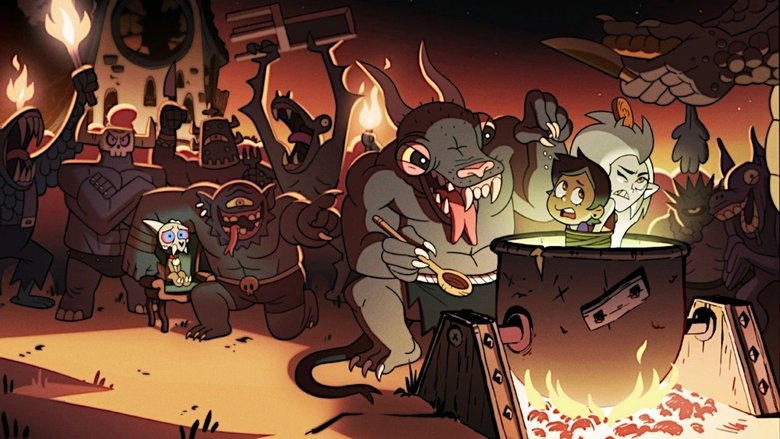
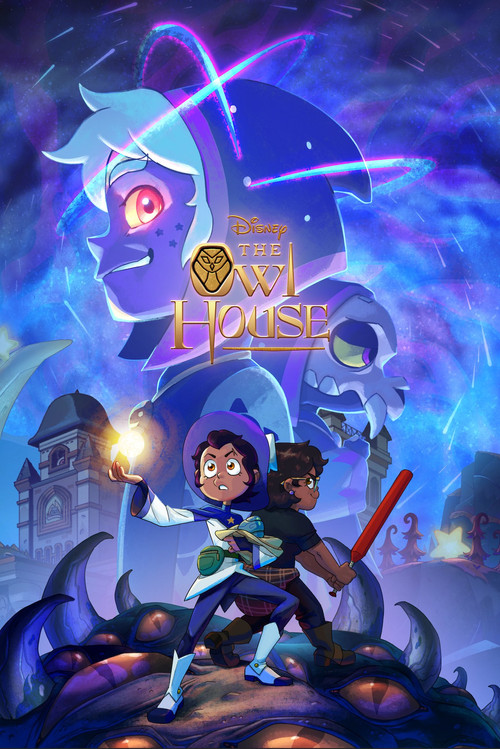
"Us weirdos have to stick together."
The Owl House - Symbolism & Philosophy
Symbols & Motifs
Glyphs
Glyphs symbolize resourcefulness, understanding, and an alternative source of power outside the established system. They represent Luz's unique connection to the magic of the Boiling Isles, proving that power can be attained through study and connection to nature, not just innate ability.
Luz discovers the four primary glyphs (Light, Ice, Plant, and Fire) in Season 1 by observing them in nature. In the finale, her deep understanding of glyphs allows her to communicate with the Titan and gain immense power, solidifying their symbolism as the key to true magic.
The Owl House (Building)
The Owl House, protected by the chaotic but fiercely loyal demon Hooty, symbolizes a sanctuary for misfits and outcasts. It is a home where the main characters can be their authentic selves without judgment, representing the core theme of found family.
From the very first episode, the Owl House is established as Eda's base of operations and a haven for those who don't fit in. Luz finds her first true home here. The house itself is shown to be alive and protective of its inhabitants, literally getting up and walking in one episode.
Eda's Curse
Eda's curse, which transforms her into a ravenous Owl Beast, symbolizes chronic illness, disability, and living with a part of yourself that you cannot control. Her journey with the curse—from fighting it to accepting and partnering with it—is a powerful metaphor for managing and accepting personal struggles.
Introduced early in Season 1, the curse's origin is revealed to be a jealous act by her sister, Lilith. A major turning point occurs in Season 2 when Eda confronts the Owl Beast in her mindscape and learns to work with it, transforming her curse into a source of power (her Harpy form).
Emperor Belos' Mask
The mask worn by Emperor Belos symbolizes deception, false authority, and the hiding of one's monstrous true nature. It presents a calm, divine facade to the public, concealing the decaying, manipulative, and hateful human (Philip Wittebane) underneath.
Belos is never seen without his mask throughout most of the first two seasons. It is finally shattered during his confrontation with Luz in "King's Tide," revealing the monster beneath and symbolizing the unmasking of his lies.
Philosophical Questions
What makes a family?
The series extensively explores this question through the "found family" trope. Luz, Eda, and King form a family unit based on mutual love and support, which is often contrasted with the dysfunctional and abusive biological families of characters like Amity and Hunter. The show strongly posits that family is not about blood ties but about unconditional love, acceptance, and the conscious choice to care for one another.
Does our identity come from our origins or our choices?
This question is central to the arcs of Hunter and King. Hunter discovers he is a Grimwalker, a clone created for a specific purpose, but his journey is about rejecting that function and choosing his own identity. King learns he is a god-like Titan, but he chooses to define himself by his love for his family rather than his powerful lineage. The series consistently argues that who we choose to be is more important than where we come from.
Core Meaning
The core meaning of "The Owl House" is a powerful celebration of nonconformity, self-acceptance, and the creation of a "found family." The creators convey the message that being different or "weird" is a source of strength and creativity, not something to be suppressed. The series champions the idea that individuals should be free to forge their own paths, rather than being forced into rigid, predetermined boxes—a concept literalized by the Coven system in the Boiling Isles. It explores the idea that family is not defined by blood, but by love, support, and mutual acceptance. Through Luz's journey, the show posits that true belonging comes from embracing one's authentic self and finding others who love you for it, building a community of outcasts who become stronger together.