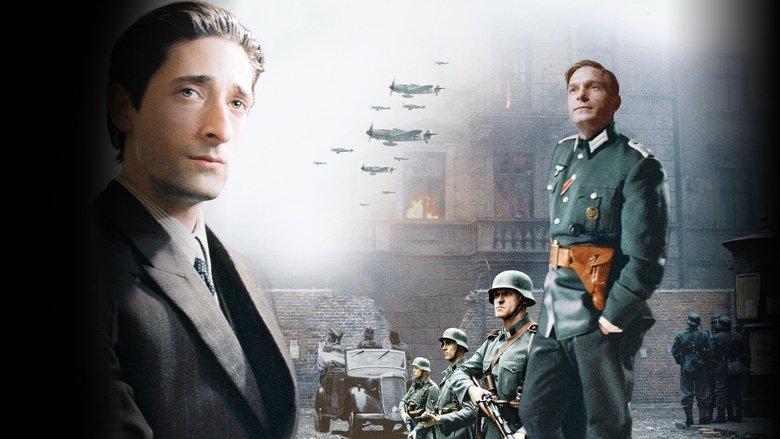

The Pianist
A harrowing descent into the abyss of war, where the enduring melody of a piano becomes a fragile beacon of humanity against a backdrop of devastating silence.
The Pianist
The Pianist

"Music was his passion. Survival was his masterpiece."

17 September 2002 France 150 min ⭐ 8.4 (9,707)
Director: Roman Polanski
Cast: Adrien Brody, Thomas Kretschmann, Frank Finlay, Maureen Lipman, Emilia Fox
Drama War
Survival The Power of Art and Music Dehumanization The Ambiguity of Human Nature
Budget: $35,000,000
Box Office: $120,098,945

The Pianist - Ending Explained

⚠️ Spoiler Analysis

"The Pianist" follows a linear narrative of Władysław Szpilman's survival, so its power lies not in plot twists but in the relentless and harrowing depiction of his journey. The most significant turning point in the latter half of the film is Szpilman's encounter with the German officer, Captain Wilm Hosenfeld. After years of hiding and near-starvation, Szpilman is discovered by Hosenfeld in the ruins of Warsaw. In a moment of intense suspense, Hosenfeld asks Szpilman to play the piano. Szpilman's beautiful performance of Chopin's Ballade No. 1 in G minor moves the officer, who then provides him with food and a safe hiding place, ultimately saving his life.

The ending of the film reveals that after the war, Szpilman resumes his career as a renowned pianist. He learns Hosenfeld's name from a former inmate of a Soviet POW camp and tries to help him, but is unsuccessful. The closing titles state that Captain Wilm Hosenfeld died in a Soviet prison camp in 1952. This bittersweet conclusion underscores the film's themes of loss and the arbitrary nature of fate. While Szpilman survives and his art endures, the man who saved him perishes. This ending avoids a simple, triumphant conclusion, leaving the audience with a profound sense of the human cost of war and the enduring power of a single act of kindness.

Alternative Interpretations

While "The Pianist" is largely seen as a straightforward narrative of survival, some interpretations delve deeper into its allegorical and philosophical layers. One perspective views the film as an allegory for the survival of art and culture in the face of barbarism. Władysław Szpilman, the artist, endures while the world around him crumbles, suggesting that the creative spirit can outlast even the most destructive forces. His final performance in the film can be seen as the triumph of culture over chaos.

Another interpretation focuses on the film's existential themes. Szpilman's survival is often the result of pure chance and the inexplicable kindness of others, rather than his own actions. This can be read as a commentary on the absurdity and randomness of life and death, particularly in the context of the Holocaust. The film avoids providing easy answers or moral lessons, instead presenting a stark portrait of existence in a world devoid of justice and reason. Some critics have also pointed to the film's detached and observational style as a reflection of the trauma of survival, where emotional distance becomes a necessary coping mechanism.