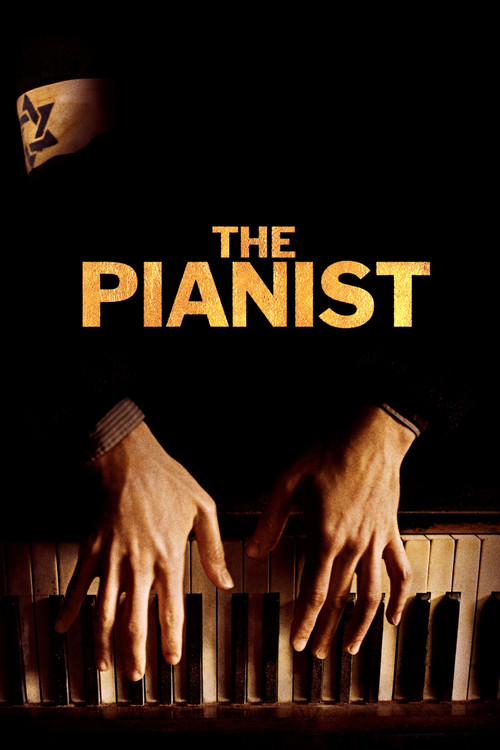
The Pianist
"Music was his passion. Survival was his masterpiece."
Overview
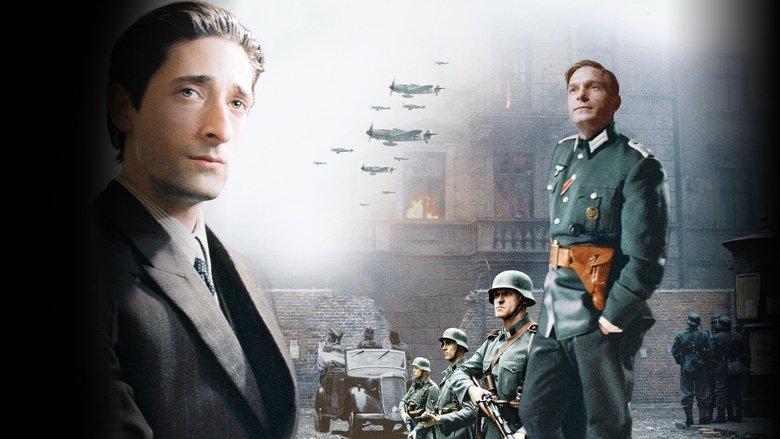
Based on the true story of Władysław Szpilman, "The Pianist" is a poignant and powerful biographical drama directed by Roman Polanski. The film chronicles Szpilman's life as a brilliant Polish-Jewish pianist in Warsaw, whose promising career is brutally interrupted by the outbreak of World War II. The narrative follows his experiences from the initial German invasion, the establishment of the Warsaw Ghetto, and the subsequent horrors of the Holocaust.
As his family is torn apart and sent to concentration camps, Szpilman is left to fend for himself in the ruins of the war-torn city. He endures unimaginable hardship, starvation, and the constant threat of discovery, surviving through a combination of luck and the kindness of strangers. The film is a stark and unflinching portrayal of one man's struggle to survive against all odds, with his passion for music serving as his only solace and connection to his former life.
Core Meaning
"The Pianist" is a profound testament to the resilience of the human spirit and the enduring power of art in the face of unimaginable suffering and dehumanization. Director Roman Polanski, himself a Holocaust survivor, crafts a deeply personal and objective narrative that avoids sentimentality and melodrama. The film's core message is not one of heroism or defiance in the traditional sense, but rather a stark depiction of survival. Władysław Szpilman is not portrayed as a fighter, but as a man who endures through a combination of chance and the compassion of others. The film suggests that in the midst of utter chaos and inhumanity, art, specifically music, can serve as a vital lifeline, a reminder of beauty and a means of preserving one's identity. It also explores the complex spectrum of human behavior, showing both the depths of cruelty and unexpected moments of kindness from individuals on both sides of the conflict. Ultimately, "The Pianist" is a meditation on life, death, and the will to live, asserting that the very act of survival is a victory against the forces of annihilation.
Thematic DNA
Survival
The central theme of "The Pianist" is the raw and desperate struggle for survival. Władysław Szpilman's journey is a testament to human endurance in the face of starvation, disease, and constant danger. He is not depicted as a hero who fights back, but as an ordinary man who uses his instincts and any help he can find to stay alive. The film meticulously portrays the day-to-day realities of his existence, from scavenging for food in the ruins of Warsaw to the psychological toll of prolonged isolation and fear.
The Power of Art and Music
Music is a recurring and vital theme, representing hope, humanity, and Szpilman's connection to his former life. In the midst of unimaginable horror, his passion for the piano is a source of mental and spiritual sustenance. The moment he plays for the German officer, Captain Hosenfeld, is a pivotal scene that demonstrates how art can transcend hatred and create a bond between two individuals on opposing sides of the war. Music is not just his profession; it is his identity and, ultimately, a key to his survival.
Dehumanization
The film unflinchingly portrays the systematic dehumanization of the Jewish people by the Nazi regime. From the initial restrictions and the mandatory wearing of the Star of David armbands to the forced relocation into the Warsaw Ghetto and the brutal violence, Polanski shows the gradual stripping away of rights, dignity, and life. This theme is central to understanding the horrors of the Holocaust and the context of Szpilman's struggle to maintain his sense of self.
The Ambiguity of Human Nature
"The Pianist" avoids a simplistic black-and-white portrayal of good and evil. While it depicts the immense cruelty of the Nazis, it also shows instances of kindness and compassion from unexpected sources, most notably from Captain Wilm Hosenfeld. Conversely, the film also touches upon the morally complex actions of some Jewish ghetto police who collaborated with the Nazis. This nuanced approach highlights the complexities of human behavior under extreme circumstances.
Character Analysis
Władysław Szpilman
Adrien Brody
Motivation
Szpilman's primary motivation is to survive. He is driven by the basic human instinct to live, enduring unimaginable hardships to see the end of the war. His love for music also provides him with a reason to persevere, as he dreams of one day playing the piano again.
Character Arc
Władysław Szpilman begins the film as a celebrated and somewhat detached artist. The war strips him of his family, his profession, and his dignity, reducing him to a state of primal survival. His journey is one of endurance rather than active resistance. He transforms from a cultured musician to a gaunt figure clinging to life. By the end of the film, having survived through immense suffering, he is able to reclaim his identity as a pianist, but is forever changed by his experiences.
Captain Wilm Hosenfeld
Thomas Kretschmann
Motivation
Moved by Szpilman's beautiful piano playing and recognizing his humanity, Hosenfeld is motivated by a sense of moral duty and compassion to help him. He seems to be disillusioned with the war and the atrocities being committed.
Character Arc
Captain Hosenfeld is initially presented as a typical German officer of the occupying force. However, his encounter with Szpilman reveals a compassionate and humane side that defies the stereotype of the cruel Nazi. His decision to help Szpilman is an act of redemption and a demonstration that individual morality can exist even within a monstrous regime.
Father Szpilman
Frank Finlay
Motivation
His main motivation is the safety and well-being of his family. He tries to navigate the increasingly restrictive and dangerous environment to keep his loved ones together and alive.
Character Arc
The father represents the older generation's struggle to comprehend and adapt to the escalating persecution. Initially, he maintains a sense of order and dignity, but as the situation worsens, his authority and ability to protect his family are eroded, leading to his tragic fate.
Symbols & Motifs
The Piano
The piano symbolizes Władysław Szpilman's identity, his passion for life, and the enduring power of art and culture amidst destruction. It is his connection to his past and his hope for the future.
The film opens with Szpilman playing the piano at a radio station as bombs fall on Warsaw. His family is forced to sell their piano for survival, symbolizing the loss of their former life. Later, while in hiding, he silently 'plays' on a tabletop, and his performance for Captain Hosenfeld ultimately saves his life.
The Warsaw Ghetto Wall
The wall is a powerful symbol of imprisonment, segregation, and the dehumanization of the Jewish population. Its eventual destruction signifies the end of Nazi oppression.
The construction of the wall physically and metaphorically separates the Jews from the rest of Warsaw. Szpilman spends a significant portion of the film either within its confines or in hiding in the ruins after its destruction.
Bread and Food
Bread and food in the film represent the most basic human need and the constant, desperate struggle for survival. The act of sharing food becomes a profound gesture of humanity and compassion.
Szpilman's relentless search for food is a recurring motif. Captain Hosenfeld's act of giving Szpilman bread is a pivotal moment that signifies a shift from persecution to aid.
The German Officer's Coat
The coat given to Szpilman by Captain Hosenfeld symbolizes the complex and often ironic nature of survival and identity during the war. It represents both an act of kindness and a source of danger.
Hosenfeld gives Szpilman his coat to keep warm. However, after the liberation of Warsaw, Polish soldiers mistake Szpilman for a German officer because of the coat and almost execute him.
Memorable Quotes
If I'm going to die, I prefer to die in my own home. I'm staying put.
— Władysław Szpilman
Context:
Szpilman says this to his family as they are packing to flee Warsaw after the German invasion. His decision to stay sets the stage for his subsequent ordeal.
Meaning:
This quote, spoken early in the German occupation, reflects Szpilman's initial denial and his deep connection to his home and life in Warsaw. It highlights his initial underestimation of the true horror that is to come.
Thank God, not me. He wants us to survive. Well, that's what we have to believe.
— Captain Wilm Hosenfeld
Context:
Hosenfeld says this to Szpilman after providing him with food and shelter, downplaying his own role in saving the pianist's life.
Meaning:
This line reveals Captain Hosenfeld's humanity and his own need for faith and hope in the midst of the horrors of war. It's a moment of shared humanity between two men who should be enemies.
I'm not going anywhere.
— Władysław Szpilman
Context:
This is part of a conversation with his family when they are being forced to relocate to the ghetto. His earlier sentiment about staying home has now transformed into a will to endure whatever comes.
Meaning:
Repeated in a different context, this quote shows Szpilman's grim determination to survive. It's no longer about comfort, but about a stubborn refusal to be eradicated.
It's a funny time to say this, but I wish I knew you better.
— Władysław Szpilman
Context:
Szpilman says this to his sister Halina as they are being marched to the trains that will take them to the Treblinka extermination camp. It is one of the last things he says to a family member.
Meaning:
This poignant line underscores the tragedy of Szpilman's separation from his family. It's a moment of profound regret and a recognition of the lost opportunities for connection in the face of imminent death.
Philosophical Questions
What is the role of art in the face of extreme suffering?
The film explores this question through Władysław Szpilman's relationship with his music. His piano playing is not just a profession but a source of solace and a connection to his humanity. The pivotal scene where he plays for Captain Hosenfeld suggests that art can transcend conflict and create moments of shared humanity. However, the film also shows the limitations of art; it cannot stop the violence or save his family. This raises questions about whether art is a form of escapism or a vital tool for survival.
To what extent is survival a matter of luck versus agency?
"The Pianist" consistently emphasizes the role of chance in Szpilman's survival. He is saved from deportation by a friend in the Jewish Ghetto Police at the last moment, he finds shelter through the kindness of strangers, and he is spared by a German officer who happens to appreciate his music. While Szpilman demonstrates immense resilience, the film suggests that in the face of such overwhelming and arbitrary violence, individual agency is severely limited. This challenges traditional heroic narratives and presents a more sobering and realistic view of survival during the Holocaust.
Can morality exist in a world of extreme inhumanity?
The film presents a nuanced view of morality. While it graphically depicts the depths of human cruelty, it also highlights acts of kindness and compassion. The character of Captain Wilm Hosenfeld is a prime example of an individual who retains his moral compass within a corrupt system. The film also shows the moral compromises made by some of the Jewish Ghetto Police. This complexity forces the viewer to consider the nature of good and evil and the choices people make under immense pressure.
Alternative Interpretations
While "The Pianist" is largely seen as a straightforward narrative of survival, some interpretations delve deeper into its allegorical and philosophical layers. One perspective views the film as an allegory for the survival of art and culture in the face of barbarism. Władysław Szpilman, the artist, endures while the world around him crumbles, suggesting that the creative spirit can outlast even the most destructive forces. His final performance in the film can be seen as the triumph of culture over chaos.
Another interpretation focuses on the film's existential themes. Szpilman's survival is often the result of pure chance and the inexplicable kindness of others, rather than his own actions. This can be read as a commentary on the absurdity and randomness of life and death, particularly in the context of the Holocaust. The film avoids providing easy answers or moral lessons, instead presenting a stark portrait of existence in a world devoid of justice and reason. Some critics have also pointed to the film's detached and observational style as a reflection of the trauma of survival, where emotional distance becomes a necessary coping mechanism.
Cultural Impact
"The Pianist" was met with widespread critical acclaim upon its release, culminating in three Academy Awards for Best Director, Best Actor, and Best Adapted Screenplay. The film had a significant cultural impact for its unflinching and realistic portrayal of the Holocaust, differing from many previous films on the subject by focusing on the solitary experience of a survivor rather than a narrative of heroic resistance. Roman Polanski's personal history as a survivor of the Kraków Ghetto lent the film a profound sense of authenticity and emotional weight.
The film's reception by critics was overwhelmingly positive, with praise for its powerful storytelling, Adrien Brody's transformative performance, and its refusal to resort to sentimentality. It has been lauded as one of the most important films about the Holocaust, often compared to "Schindler's List" but noted for its more intimate and stark perspective. Audiences also responded strongly to the film's emotional depth and its powerful message of survival. "The Pianist" has become a staple in educational settings for its historical accuracy and its humanistic portrayal of life during the Holocaust. It continues to be regarded as a cinematic masterpiece and a vital historical document.
Audience Reception
Audience reception for "The Pianist" has been overwhelmingly positive, with many viewers finding it to be a deeply moving and powerful film. The aspects most frequently praised are Adrien Brody's Oscar-winning performance, the film's historical accuracy, and its raw, unflinching portrayal of the Holocaust. Many viewers have described the film as a difficult but essential viewing experience that provides a profound insight into the human capacity for both cruelty and compassion. Some audiences have noted the film's slow pace and bleak tone as points of criticism, but these are often acknowledged as contributing to the film's realism and emotional impact. The scene in which Szpilman plays the piano for Captain Hosenfeld is frequently cited as a particularly powerful and memorable moment. Overall, the audience verdict is that "The Pianist" is a masterpiece of filmmaking and a vital historical testament.
Interesting Facts
- Director Roman Polanski is a Holocaust survivor himself. He escaped the Kraków Ghetto as a child, and his mother was killed in a concentration camp. This personal connection deeply informed his direction of the film.
- To prepare for the role, Adrien Brody lost 30 pounds, gave up his apartment and car, and spent hours practicing the piano each day. His dedication to the role earned him the Academy Award for Best Actor, making him the youngest recipient of the award at the time.
- The ruined Warsaw depicted in the film was a combination of sets built at Babelsberg Studio in Germany and the use of old Soviet army barracks that were slated for demolition.
- The hands shown in close-ups during the piano-playing scenes belong to Polish classical pianist Janusz Olejniczak, who also performed the piano pieces for the film's soundtrack.
- The film is based on Władysław Szpilman's autobiography, which was originally published in Poland in 1946 under the title "Death of a City."
- Captain Wilm Hosenfeld, the German officer who helped Szpilman, was a real person. He was posthumously honored by Israel's official memorial to the victims of the Holocaust, Yad Vashem, as one of the Righteous Among the Nations.
⚠️ Spoiler Analysis
Click to reveal detailed analysis with spoilers
Frequently Asked Questions
Explore More About This Movie
Dive deeper into specific aspects of the movie with our detailed analysis pages
Comments (0)
No comments yet. Be the first to share your thoughts!