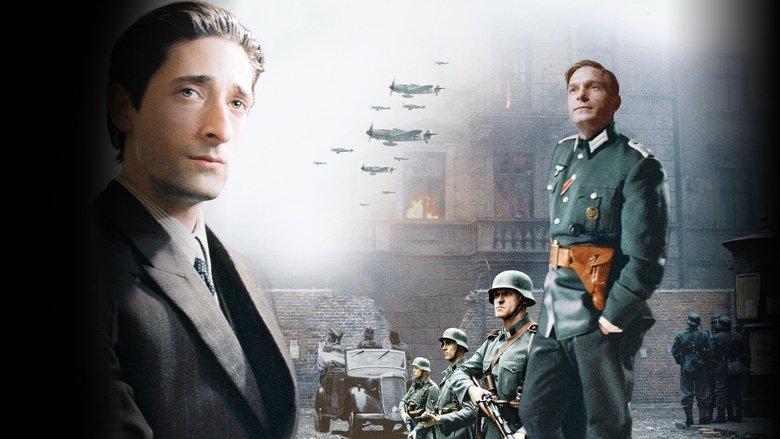

"Music was his passion. Survival was his masterpiece."
The Pianist - Symbolism & Philosophy
Symbols & Motifs
The Piano
The piano symbolizes Władysław Szpilman's identity, his passion for life, and the enduring power of art and culture amidst destruction. It is his connection to his past and his hope for the future.
The film opens with Szpilman playing the piano at a radio station as bombs fall on Warsaw. His family is forced to sell their piano for survival, symbolizing the loss of their former life. Later, while in hiding, he silently 'plays' on a tabletop, and his performance for Captain Hosenfeld ultimately saves his life.
The Warsaw Ghetto Wall
The wall is a powerful symbol of imprisonment, segregation, and the dehumanization of the Jewish population. Its eventual destruction signifies the end of Nazi oppression.
The construction of the wall physically and metaphorically separates the Jews from the rest of Warsaw. Szpilman spends a significant portion of the film either within its confines or in hiding in the ruins after its destruction.
Bread and Food
Bread and food in the film represent the most basic human need and the constant, desperate struggle for survival. The act of sharing food becomes a profound gesture of humanity and compassion.
Szpilman's relentless search for food is a recurring motif. Captain Hosenfeld's act of giving Szpilman bread is a pivotal moment that signifies a shift from persecution to aid.
The German Officer's Coat
The coat given to Szpilman by Captain Hosenfeld symbolizes the complex and often ironic nature of survival and identity during the war. It represents both an act of kindness and a source of danger.
Hosenfeld gives Szpilman his coat to keep warm. However, after the liberation of Warsaw, Polish soldiers mistake Szpilman for a German officer because of the coat and almost execute him.
Philosophical Questions
What is the role of art in the face of extreme suffering?
The film explores this question through Władysław Szpilman's relationship with his music. His piano playing is not just a profession but a source of solace and a connection to his humanity. The pivotal scene where he plays for Captain Hosenfeld suggests that art can transcend conflict and create moments of shared humanity. However, the film also shows the limitations of art; it cannot stop the violence or save his family. This raises questions about whether art is a form of escapism or a vital tool for survival.
To what extent is survival a matter of luck versus agency?
"The Pianist" consistently emphasizes the role of chance in Szpilman's survival. He is saved from deportation by a friend in the Jewish Ghetto Police at the last moment, he finds shelter through the kindness of strangers, and he is spared by a German officer who happens to appreciate his music. While Szpilman demonstrates immense resilience, the film suggests that in the face of such overwhelming and arbitrary violence, individual agency is severely limited. This challenges traditional heroic narratives and presents a more sobering and realistic view of survival during the Holocaust.
Can morality exist in a world of extreme inhumanity?
The film presents a nuanced view of morality. While it graphically depicts the depths of human cruelty, it also highlights acts of kindness and compassion. The character of Captain Wilm Hosenfeld is a prime example of an individual who retains his moral compass within a corrupt system. The film also shows the moral compromises made by some of the Jewish Ghetto Police. This complexity forces the viewer to consider the nature of good and evil and the choices people make under immense pressure.
Core Meaning
"The Pianist" is a profound testament to the resilience of the human spirit and the enduring power of art in the face of unimaginable suffering and dehumanization. Director Roman Polanski, himself a Holocaust survivor, crafts a deeply personal and objective narrative that avoids sentimentality and melodrama. The film's core message is not one of heroism or defiance in the traditional sense, but rather a stark depiction of survival. Władysław Szpilman is not portrayed as a fighter, but as a man who endures through a combination of chance and the compassion of others. The film suggests that in the midst of utter chaos and inhumanity, art, specifically music, can serve as a vital lifeline, a reminder of beauty and a means of preserving one's identity. It also explores the complex spectrum of human behavior, showing both the depths of cruelty and unexpected moments of kindness from individuals on both sides of the conflict. Ultimately, "The Pianist" is a meditation on life, death, and the will to live, asserting that the very act of survival is a victory against the forces of annihilation.