Il postino
"Dreams do come true."
The Postman - Symbolism & Philosophy
Symbols & Motifs
The Bicycle
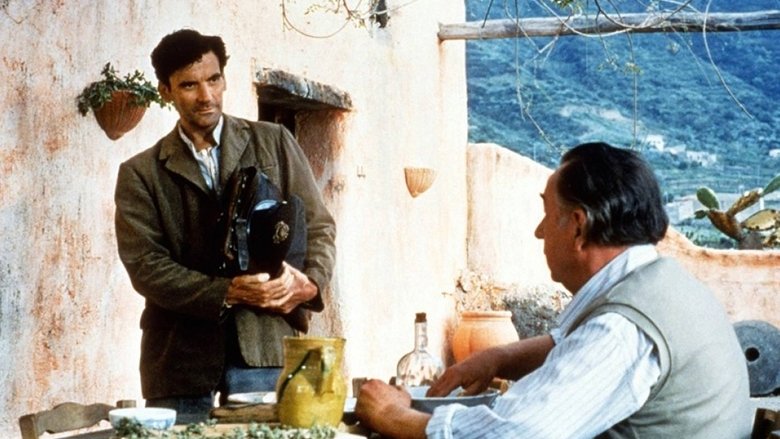
Mario's bicycle symbolizes his modest but determined journey of self-discovery and connection. It represents his bridge between his simple world and the more expansive world of Pablo Neruda and poetry. It is the vehicle of his transformation.
The bicycle is Mario's constant companion as he travels the dusty island roads to deliver mail to Neruda. The physical journey up the hill to the poet's house mirrors his own upward journey of intellectual and emotional growth.
The Island and the Sea
The island represents both isolation and a world of untapped beauty. Initially, for Mario, it's a place of stagnation. The sea is a constant presence, a source of metaphors, and a symbol of the vast, mysterious world beyond his limited experience. Through poetry, he learns to see the profound beauty in his immediate surroundings.
The film is set on a picturesque Mediterranean island. Neruda teaches Mario to observe the sea and his surroundings to find metaphors. Later, Mario records the sounds of the island—the waves, the wind, his son's heartbeat—as a poetic gift for Neruda, showing he has learned to find the extraordinary in his ordinary world.
Metaphors
Metaphors are the central symbol for the power of poetry itself. They represent a new way of understanding and communicating, allowing one to connect disparate ideas and express complex emotions in a beautiful and meaningful way. They are the key that unlocks Mario's heart and mind.
The entire film is a lesson in metaphors. Neruda explicitly defines the term for Mario, who then struggles to create his own. He uses Neruda's metaphors to woo Beatrice, and their power is debated by Beatrice's aunt, who fears their seductive nature. Mario's eventual ability to create his own metaphors signifies his transformation into a poet in his own right.
The Tape Recordings
The sounds of the island that Mario records for Neruda symbolize Mario's unique poetic voice and his deep connection to his home. It is his ultimate poem, created not with words, but with the authentic sounds of his world. This act shows that poetry isn't just written; it's experienced and felt.
When Neruda is away, Mario decides to create a gift for him by recording the distinct sounds of the island: the waves on the cliff, the wind, the church bells, and even the heartbeat of his unborn son. He sends this 'sound poem' to Neruda, a testament to how profoundly the poet's lessons have impacted him. Neruda receives these recordings years later, after Mario's death.
Philosophical Questions
What is the true ownership of art?
The film directly confronts this question through Mario's famous line, "Poetry doesn't belong to those who write it; it belongs to those who need it." "Il Postino" explores the idea that once a work of art is created, its meaning and value are determined by the audience that receives it. It challenges the notion of artistic ownership, suggesting that the emotional utility of a poem, song, or painting is more important than its authorship. The film champions a democratic view of art, where its purpose is to serve human emotional needs, regardless of its origin.
Can art truly bridge the gap between different social classes?
The friendship between Mario and Neruda is the film's primary vehicle for exploring this question. On one hand, the film is optimistic, showing how a shared love for poetry allows a deep, transformative bond to form between a poor postman and a world-renowned intellectual. However, it also subtly hints at the limits of this connection. Neruda leaves and gets swept back into his own world, and Mario is left behind. The film seems to suggest that while art can create profound individual connections that transcend class, the underlying societal structures and distances remain a powerful force.
Is personal transformation inherently linked to social responsibility?
Mario's journey begins as a deeply personal quest for love and self-expression. However, as his consciousness expands through poetry and his conversations with the politically-minded Neruda, his personal growth leads him to a sense of social responsibility. He becomes involved in local politics and ultimately joins a communist demonstration. The film poses the question of whether a true awakening of the self must inevitably lead to an awareness of the world and a desire to improve it, suggesting that personal and social consciousness are intertwined.
Core Meaning
The core meaning of "Il Postino" is the transformative power of art, specifically poetry, to awaken the human spirit and bridge social divides. The film posits that poetry is not an exclusive domain for intellectuals but a universal language that belongs to anyone who needs it to express their emotions. It's a celebration of how language and mentorship can elevate a simple life, fostering self-discovery, love, and even political consciousness. Ultimately, the film suggests that beauty and meaning can be found in the simplest of things when viewed through the lens of art.