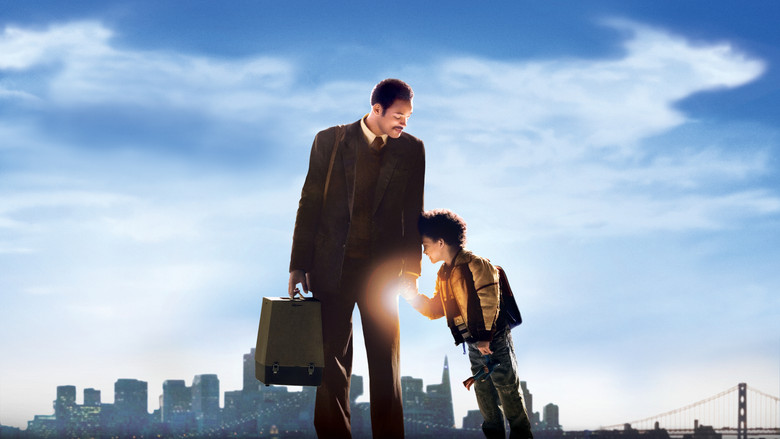
"For his son, one man will reach for the impossible."
The Pursuit of Happyness - Symbolism & Philosophy
Symbols & Motifs
The Bone Density Scanner
The portable bone density scanner symbolizes the heavy burden of Chris's circumstances and his initial, misguided dreams. It is a constant physical and financial weight that he must lug around the city, representing his responsibilities and the financial hole he's in. Selling the last one marks a turning point, freeing him to fully focus on his new career path.
Chris is seen carrying, chasing after, and trying to sell these machines throughout the first half of the film. They are the source of his arguments with Linda and the primary reason for his financial ruin. One is stolen by a homeless man who thinks it's a time machine, leading to a frantic chase.
The Rubik's Cube
The Rubik's Cube symbolizes intelligence, problem-solving ability, and the idea that complex problems can be solved with focus and persistence. It serves as a key that unlocks an opportunity for Chris. By solving the puzzle, he demonstrates his intellectual capabilities in a tangible way, proving he is more than his shabby appearance suggests.
Chris impresses Jay Twistle, a high-level manager at Dean Witter, by solving a Rubik's Cube during a short taxi ride. This singular feat makes him stand out and is instrumental in him getting an interview for the internship.
The Misspelling of 'Happyness'
The intentional misspelling of "Happyness" in the title (and on the mural) symbolizes that happiness is subjective and self-defined. It reflects the idea that happiness isn't about perfection but about the individual's journey. Chris points out the error to his son, but the film's title adopts it, suggesting an embrace of this imperfect, personal pursuit. The 'Y' has been interpreted to represent "You," emphasizing that you are in control of your own happiness.
Chris and his son walk past a mural outside the daycare that has the phrase "The Pursuit of Happyness" incorrectly spelled. This is a recurring visual motif in the film.
Philosophical Questions
What is the true nature of 'happiness'?
The film, through Chris's voiceover about the Declaration of Independence, explicitly questions whether happiness is a state to be achieved or a goal to be pursued. It challenges the audience to consider if true satisfaction comes from the destination or the journey. Is happiness the quiet moment of victory after a long struggle, or is it found in the day-to-day acts of love and sacrifice, like protecting one's child in a subway bathroom? The movie suggests that the 'pursuit' itself is the most meaningful part of life.
Does society truly offer equal opportunity?
The film's plot rests on the premise of the American Dream—that opportunity is available to those who work for it. Chris, an African-American man with no college degree, ultimately succeeds in a white-dominated industry. However, the immense, almost superhuman effort required for his success raises the question of whether the playing field is truly level. The film portrays a world where one man's success requires him to endure hardships that his more privileged colleagues cannot even imagine, prompting the viewer to question the fairness of the system he is so desperate to join.
To what extent is success a product of individual will versus luck?
Chris Gardner's story is a testament to individual will and perseverance. However, the film also subtly highlights the role of chance. What if he hadn't seen the man with the Ferrari? What if he hadn't been able to solve the Rubik's Cube in that specific taxi ride with Jay Twistle? While his hard work is undeniable, these moments of serendipity are crucial turning points. The film explores the intersection of relentless determination and fortunate circumstance, asking how much of our fate we truly control.
Core Meaning
The core meaning of "The Pursuit of Happyness" is an exploration of resilience, paternal devotion, and an unyielding belief in the American Dream, even in the face of systemic barriers and crushing poverty. The director, Gabriele Muccino, conveys that happiness is not a final destination to be reached but a continuous, often painful, pursuit. The film posits that true fulfillment is found in the struggle itself, in the dedication to a better future for a loved one, and in maintaining dignity and hope against overwhelming odds. It's a testament to the idea that self-worth and determination are internal qualities that cannot be stripped away by external circumstances.