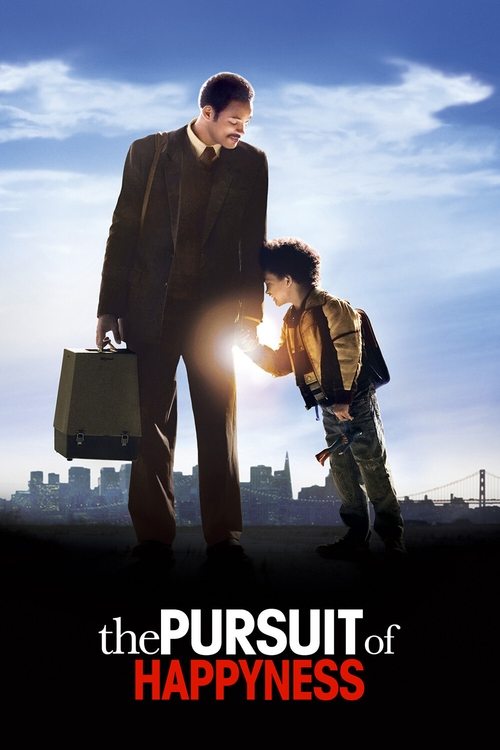
The Pursuit of Happyness
"For his son, one man will reach for the impossible."
Overview
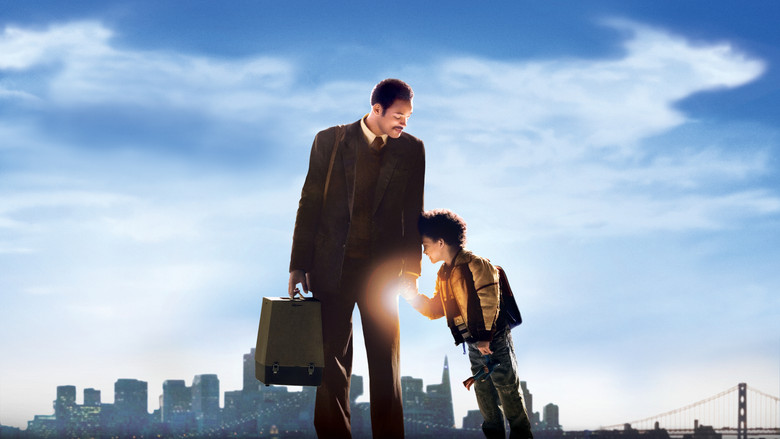
Set in 1981 San Francisco, "The Pursuit of Happyness" chronicles the true story of Chris Gardner, a bright but struggling salesman. Gardner has invested his life savings in portable bone density scanners, a device he finds difficult to sell. As financial pressures mount, his wife Linda (Thandiwe Newton), unable to cope with the hardship, leaves him to raise their five-year-old son, Christopher Jr. (Jaden Smith), on his own.
Facing eviction and with very little money, Chris lands a highly competitive, unpaid six-month internship at the prestigious brokerage firm Dean Witter Reynolds, with only a slim chance of being hired at the end. This decision marks the beginning of an arduous journey. Chris and his son are forced into homelessness, seeking refuge in shelters, public transit bathrooms, and wherever they can find a safe space for the night. All the while, Chris must maintain the facade of a promising intern to his colleagues, study for his licensing exam, and most importantly, protect his son from the harsh reality of their situation, nurturing his spirit with love and imagination.
Core Meaning
The core meaning of "The Pursuit of Happyness" is an exploration of resilience, paternal devotion, and an unyielding belief in the American Dream, even in the face of systemic barriers and crushing poverty. The director, Gabriele Muccino, conveys that happiness is not a final destination to be reached but a continuous, often painful, pursuit. The film posits that true fulfillment is found in the struggle itself, in the dedication to a better future for a loved one, and in maintaining dignity and hope against overwhelming odds. It's a testament to the idea that self-worth and determination are internal qualities that cannot be stripped away by external circumstances.
Thematic DNA
The American Dream
The film is a powerful, albeit controversial, portrayal of the American Dream. It champions the idea that anyone, regardless of their background, can achieve success through hard work, intelligence, and perseverance. Chris Gardner starts with nothing, facing societal and economic barriers, yet his relentless effort eventually leads to immense success. The film frames his journey as a modern-day rags-to-riches story, suggesting that upward mobility is possible for those who refuse to give up.
Paternal Love and Responsibility
At its heart, the film is a story about a father's unwavering love for his son. Having grown up without his own father, Chris is fiercely determined to be a constant, positive presence in Christopher Jr.'s life. Every sacrifice he makes—sleeping in a subway bathroom, donating blood for cash, studying by the dim light of a window—is motivated by his desire to provide a better life and secure future for his son. The film's most poignant moments are the quiet, intimate scenes between father and son that highlight this profound bond.
Perseverance Against Adversity
Chris Gardner's journey is a relentless series of obstacles and setbacks. He loses his wife, his home, his money, and is even jailed for unpaid parking tickets. Despite this, he never loses his resolve. The film meticulously details his daily struggle to sell his scanners, attend his internship, care for his son, and find a place to sleep. His ability to endure humiliation and despair without surrendering his dream is the central pillar of the narrative.
Poverty and Homelessness
The film offers a raw and unflinching look at the realities of being poor in America. It dramatizes the daily struggle for survival: the race to get a spot at a homeless shelter, the indignity of having all your possessions on the street, and the constant, gnawing anxiety of financial insecurity. Muccino doesn't glamorize poverty; he shows its exhausting and demoralizing effects, making Chris's eventual triumph all the more impactful.
Character Analysis
Chris Gardner
Will Smith
Motivation
His primary motivation is the well-being and future of his son, Christopher Jr. Haunted by the absence of his own father, Chris's driving force is to break that cycle and provide his son with security and the knowledge that his father will always be there for him. His pursuit of a career in finance is the vehicle through which he aims to achieve this fundamental goal.
Character Arc
Chris begins as a struggling, down-on-his-luck salesman whose optimism is being crushed by financial failure. He is intelligent and driven but trapped by his circumstances. Throughout the film, he is stripped of everything—his home, his money, his wife—but his resolve hardens. His arc is not one of changing his core values (he is always a loving father) but of channeling his intelligence and incredible perseverance to transform his external reality, moving from utter destitution to the pinnacle of professional success.
Christopher Gardner Jr.
Jaden Smith
Motivation
As a young child, his motivations are simple: to be with his father, to play, and to feel safe. His unconditional love and trust serve as a powerful source of motivation for his father, reminding Chris of what he is fighting for.
Character Arc
Christopher's arc is one of maintaining innocence amidst trauma. He begins as a typical, happy five-year-old. As their situation worsens, he is forced to adapt to a life of instability and fear, yet he never loses his trust and love for his father. Through Chris's efforts to shield him, Christopher's spirit remains largely unbroken, though the progression of the film slowly strips away some of his childhood naivete.
Linda Gardner
Thandiwe Newton
Motivation
Her motivation is to escape the crushing weight of financial instability. She no longer believes in Chris's ability to provide for them and seeks a more stable life, even if it means leaving her family behind. She feels Chris is dragging them down and blames him for her unhappiness.
Character Arc
Linda does not have a significant arc; she represents a point of departure. She starts the film already at her breaking point, exhausted from working double shifts and seeing no future in Chris's ventures. Her decision to leave is not portrayed as malicious but as an act of self-preservation born from despair. She effectively exits the narrative, solidifying Chris's status as a single father.
Symbols & Motifs
The Bone Density Scanner
The portable bone density scanner symbolizes the heavy burden of Chris's circumstances and his initial, misguided dreams. It is a constant physical and financial weight that he must lug around the city, representing his responsibilities and the financial hole he's in. Selling the last one marks a turning point, freeing him to fully focus on his new career path.
Chris is seen carrying, chasing after, and trying to sell these machines throughout the first half of the film. They are the source of his arguments with Linda and the primary reason for his financial ruin. One is stolen by a homeless man who thinks it's a time machine, leading to a frantic chase.
The Rubik's Cube
The Rubik's Cube symbolizes intelligence, problem-solving ability, and the idea that complex problems can be solved with focus and persistence. It serves as a key that unlocks an opportunity for Chris. By solving the puzzle, he demonstrates his intellectual capabilities in a tangible way, proving he is more than his shabby appearance suggests.
Chris impresses Jay Twistle, a high-level manager at Dean Witter, by solving a Rubik's Cube during a short taxi ride. This singular feat makes him stand out and is instrumental in him getting an interview for the internship.
The Misspelling of 'Happyness'
The intentional misspelling of "Happyness" in the title (and on the mural) symbolizes that happiness is subjective and self-defined. It reflects the idea that happiness isn't about perfection but about the individual's journey. Chris points out the error to his son, but the film's title adopts it, suggesting an embrace of this imperfect, personal pursuit. The 'Y' has been interpreted to represent "You," emphasizing that you are in control of your own happiness.
Chris and his son walk past a mural outside the daycare that has the phrase "The Pursuit of Happyness" incorrectly spelled. This is a recurring visual motif in the film.
Memorable Quotes
Don't ever let somebody tell you you can't do something. Not even me. All right? You got a dream, you gotta protect it. People can't do something themselves, they wanna tell you you can't do it. If you want something, go get it. Period.
— Chris Gardner
Context:
Chris says this to his son after briefly discouraging him while they are playing basketball on a rooftop court. He immediately regrets his negativity and uses the moment to teach his son (and himself) a powerful lesson about protecting one's aspirations.
Meaning:
This is arguably the film's most iconic and central quote, encapsulating its core message of determination and self-belief. Chris imparts this wisdom to his son, but he is also speaking to himself, reinforcing his own resolve to protect his dream against all odds and naysayers.
It was right then that I started thinking about Thomas Jefferson on the Declaration of Independence and the part about our right to life, liberty, and the pursuit of happiness. And I remember thinking: How did he know to put the 'pursuit' part in there? That maybe happiness is something that we can only pursue. And maybe we can actually never have it, no matter what.
— Chris Gardner (Voiceover)
Context:
This is part of Chris's narration as he reflects on his struggles. It comes during a moment of deep hardship, providing a philosophical framework for his relentless efforts and the film's title.
Meaning:
This quote reflects the film's philosophical underpinning. It questions the nature of happiness, suggesting it's not a final state to be achieved but an ongoing journey. The 'pursuit' is what gives life meaning, even when the goal itself seems unattainable. It provides a deeper, more nuanced understanding of the film's title and theme.
This part of my life... this little part... is called 'Happiness.'
— Chris Gardner (Voiceover)
Context:
Chris says this in a voiceover at the very end of the film, after he has been offered the full-time stockbroker position. He walks through the crowded streets, fighting back tears of joy, as he realizes he has finally made it. The real Chris Gardner makes a cameo, walking past him in this scene.
Meaning:
This poignant line redefines what 'happiness' means. After enduring immense struggle, the moment of achieving his goal isn't a grand, euphoric celebration but a quiet, profound sense of arrival and relief. It suggests that happiness can be found in small, hard-won moments of triumph rather than a perpetual state of joy.
Philosophical Questions
What is the true nature of 'happiness'?
The film, through Chris's voiceover about the Declaration of Independence, explicitly questions whether happiness is a state to be achieved or a goal to be pursued. It challenges the audience to consider if true satisfaction comes from the destination or the journey. Is happiness the quiet moment of victory after a long struggle, or is it found in the day-to-day acts of love and sacrifice, like protecting one's child in a subway bathroom? The movie suggests that the 'pursuit' itself is the most meaningful part of life.
Does society truly offer equal opportunity?
The film's plot rests on the premise of the American Dream—that opportunity is available to those who work for it. Chris, an African-American man with no college degree, ultimately succeeds in a white-dominated industry. However, the immense, almost superhuman effort required for his success raises the question of whether the playing field is truly level. The film portrays a world where one man's success requires him to endure hardships that his more privileged colleagues cannot even imagine, prompting the viewer to question the fairness of the system he is so desperate to join.
To what extent is success a product of individual will versus luck?
Chris Gardner's story is a testament to individual will and perseverance. However, the film also subtly highlights the role of chance. What if he hadn't seen the man with the Ferrari? What if he hadn't been able to solve the Rubik's Cube in that specific taxi ride with Jay Twistle? While his hard work is undeniable, these moments of serendipity are crucial turning points. The film explores the intersection of relentless determination and fortunate circumstance, asking how much of our fate we truly control.
Alternative Interpretations
While widely seen as an inspirational tale, a significant alternative interpretation views "The Pursuit of Happyness" as a form of propaganda for American capitalism and the myth of the American Dream. This perspective argues that the film conveniently ignores the systemic issues that create poverty and homelessness, such as lack of social safety nets and racial discrimination. By focusing on one exceptional individual's success, the film implies that those who fail simply didn't try hard enough, thereby justifying the existing social hierarchy.
Critics of this view suggest the film's message is a celebration of neoliberal ideology, where the state is portrayed as an antagonist (through taxes and fines) and personal success is equated almost entirely with financial wealth. The narrative conveniently overlooks the fact that for every one Chris Gardner who succeeds against the odds, countless others remain trapped by their circumstances. The film, in this reading, becomes a cautionary tale that champions conformity to a brutal economic system rather than questioning the system itself.
Cultural Impact
"The Pursuit of Happyness" was a significant box office success and resonated deeply with audiences worldwide, largely due to Will Smith's Oscar-nominated performance and the inspiring, true-life story. It reinvigorated the "rags-to-riches" genre for a new generation, becoming a cultural touchstone for motivation and perseverance. The film is often cited in discussions about the American Dream, fatherhood, and overcoming adversity. It solidified Will Smith's status as a serious dramatic actor and launched the career of his son, Jaden Smith. The film's portrayal of homelessness in a major American city also brought mainstream attention to the issue. However, it also sparked debate about its message, with some critics arguing it promotes a simplistic and individualistic view of success that overlooks systemic economic inequalities.
Audience Reception
Audiences responded overwhelmingly positively to "The Pursuit of Happyness," finding it deeply moving and inspirational. Viewers widely praised Will Smith's powerful and emotional performance, often cited as the best of his career, and the authentic chemistry he shared with his real-life son, Jaden. The film's core messages of perseverance, hope, and a father's love resonated strongly, and many found the story to be a motivational affirmation of the power of never giving up on one's dreams. The main points of criticism from some audience members centered on the film's relentless bleakness in its middle acts, which could be emotionally taxing, and a plot that some found predictable. Despite this, the triumphant and cathartic ending left a lasting positive impression on the vast majority of viewers, cementing its status as a beloved modern classic.
Interesting Facts
- The film is based on the real-life story of Chris Gardner, who went from being homeless to founding his own multi-million-dollar brokerage firm, Gardner Rich & Co.
- To make the father-son dynamic more interactive for the film, the writers aged up the character of Christopher Jr. to five years old. In reality, he was just a toddler during the period of their homelessness.
- Will Smith's son, Jaden Smith, had to audition nine separate times for the role of Christopher Jr. The studio was concerned about the appearance of nepotism, but director Gabriele Muccino was adamant that Jaden was perfect for the role.
- The real Chris Gardner makes a cameo appearance in the final scene of the film. He is the well-dressed man who walks past Will Smith and Jaden Smith just before the credits roll.
- Will Smith became proficient at solving the Rubik's Cube for the film, receiving coaching from speed-cubing champions.
- Will Smith initially didn't want to make the movie, questioning who would want to see a film about a man getting a job in the 1980s, but was convinced by his manager.
- The film's title, with "Happyness" misspelled, is taken directly from a mural shown in the film outside of Christopher's daycare. This misspelling is itself a reference to a 1776 essay arguing for racial equality.
Easter Eggs
The real Chris Gardner walks past Will Smith in the film's final shot.
This cameo serves as a powerful, symbolic passing of the torch. It's a nod to the true story the film is based on and a moment of acknowledgment between the real man and the actor portraying him. This subtle moment bridges the gap between the cinematic retelling and the lived reality, grounding the triumphant ending in authenticity.
⚠️ Spoiler Analysis
Click to reveal detailed analysis with spoilers
Frequently Asked Questions
Explore More About This Movie
Dive deeper into specific aspects of the movie with our detailed analysis pages
Comments (0)
No comments yet. Be the first to share your thoughts!