"Dance she did, and dance she must - between her two loves"
The Red Shoes - Symbolism & Philosophy
Symbols & Motifs
The Red Shoes
The red shoes are the film's central and most powerful symbol. They represent the irresistible, all-consuming, and ultimately destructive nature of artistic passion and ambition. In the Hans Christian Andersen tale, they symbolize vanity and worldly temptation. In the film, they represent Vicky's inescapable destiny as a dancer. Once she metaphorically 'puts them on' by dedicating herself to art, she cannot stop. They are a source of immense power and beauty, but they also lead to her destruction, severing her from a normal life and love. The color red itself symbolizes passion, danger, and lifeblood.
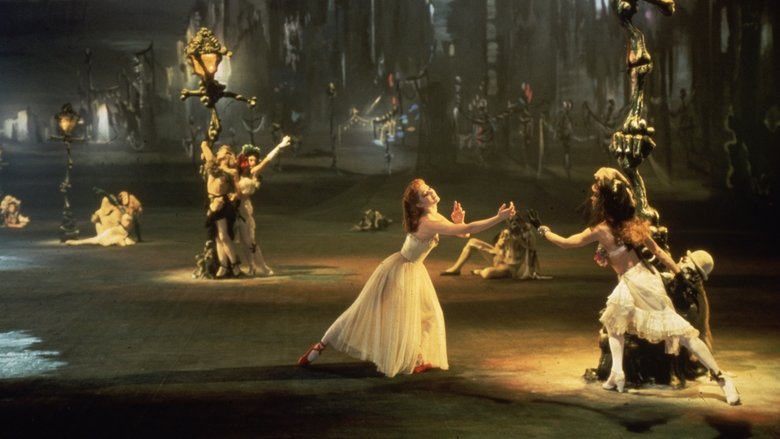
The shoes appear as the central element in the ballet-within-the-film. Vicky's character is given the shoes by a demonic shoemaker (representing Lermontov) and is forced to dance forever, losing her love and her life. This mirrors Vicky's own story. In the film's climax, as she is torn between Lermontov and Julian, she is wearing the red shoes from the ballet, blurring the line between performance and reality. Possessed by them, she leaps to her death, and her final words are a plea to Julian to "Take off the red shoes."
Trains and Train Stations
Trains and stations appear at key moments in the film, symbolizing journeys, transitions, and inescapable fate. They represent points of no return and the powerful, impersonal forces that drive the characters towards their destinies. A train is an object of immense, uncontrollable momentum, much like Vicky's artistic drive.
Lermontov intercepts Vicky's train to persuade her to return to the ballet. The climax of the film takes place at a train station overlooking the sea. Vicky's fatal leap lands her in the path of an oncoming train, a violent and definitive end to her journey and her internal conflict. The arrival and departure of trains mark significant turning points in the narrative.
Mirrors
Mirrors are frequently used to symbolize identity, duality, and the often-fragmented self of the performer. They reflect the conflict between the public persona (the dancer) and the private self (the woman in love). The mirror shows how the character sees themselves, but also how they are seen and objectified by others, particularly Lermontov.
Mirrors are ubiquitous in the backstage and dressing room scenes. We see Vicky's reflection as she prepares to perform, often looking conflicted or lost in thought. During the surreal ballet sequence, mirrors are used to create a disorienting, dreamlike effect, representing Vicky's psychological state and her loss of self into the performance. The final confrontation between Vicky, Julian, and Lermontov occurs in her dressing room, surrounded by mirrors that reflect their fractured relationships.
Philosophical Questions
What is the true cost of artistic greatness?
The film relentlessly explores the idea that achieving the highest level of artistry requires a sacrifice of the self. It asks if it's possible to be a transcendent artist and a 'whole' human being simultaneously. Lermontov argues it is not, that art demands a singular, monastic devotion. Vicky's tragedy suggests he may be right, as her attempt to have both art and love leads to her destruction. The film forces the viewer to question the value society places on artistic genius, showing the profound personal suffering that may be its price.
Can true passion be controlled?
Through the central symbol of the red shoes, the film questions the nature of passion and whether it is a force we wield or a force that controls us. Vicky's desire to dance is portrayed as an innate, uncontrollable compulsion, as essential as breathing. The film suggests that profound passion, whether for art or for another person, operates outside the bounds of reason and can become a destructive obsession. Vicky is ultimately destroyed not by a conscious choice, but by the warring, uncontrollable passions within her.
Where does the performance end and life begin?
"The Red Shoes" masterfully blurs the line between onstage performance and offstage reality. The plot of the ballet Vicky stars in directly mirrors her own life's conflict. Her tragic end is a literal performance of the ballet's finale. The film explores the psychological state of a performer for whom the role and the self merge. It asks if an artist who pours their entire being into their work can ever truly step away from the footlights and live a life separate from their art. Vicky's inability to do so is her central tragedy.
Core Meaning
The core meaning of "The Red Shoes" is the eternal and often tragic conflict between the demands of art and the necessities of life. Director Michael Powell stated that the film is "about dying for art, that art is worth dying for." The film explores the idea that true artistic greatness requires absolute dedication, a level of obsession that can be destructive to personal happiness and relationships. It poses the question of whether one can reconcile a profound artistic vocation with a conventional life filled with human love. The narrative suggests that for some, art is not a choice but a compulsion, a force as powerful and uncontrollable as the magical red shoes themselves, leading to a glorious but ultimately fatal destiny.