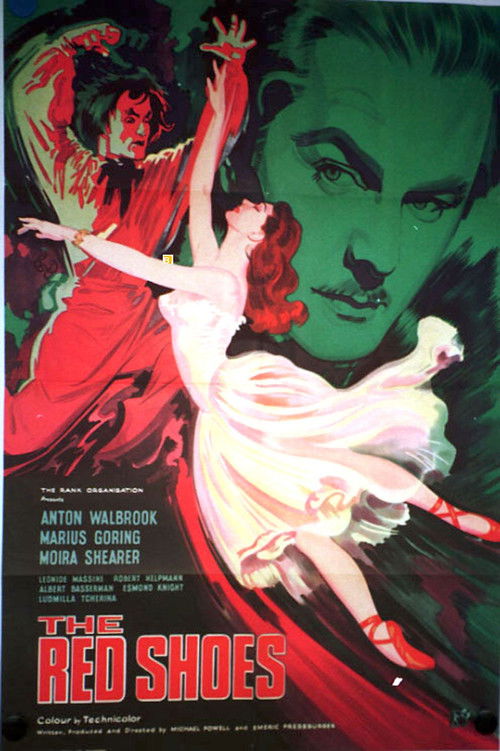
The Red Shoes
"Dance she did, and dance she must - between her two loves"
Overview
"The Red Shoes" tells the story of Victoria 'Vicky' Page, a talented and ambitious young ballerina who joins the world-renowned Ballet Lermontov. The company is run by the brilliant but tyrannical impresario Boris Lermontov, who is dedicated to art above all else. Vicky quickly becomes the star of a new ballet, "The Red Shoes," based on a Hans Christian Andersen fairytale about a pair of magical shoes that compel the wearer to dance until death.
As her career soars, Vicky falls in love with Julian Craster, the gifted young composer of the ballet's score. This romance puts her in direct conflict with Lermontov, who believes that a true artist cannot be distracted by the comforts of human love. Vicky finds herself torn between her all-consuming passion for dance and her love for Julian, a devastating conflict that mirrors the tragic fairytale she performs on stage.
Core Meaning
The core meaning of "The Red Shoes" is the eternal and often tragic conflict between the demands of art and the necessities of life. Director Michael Powell stated that the film is "about dying for art, that art is worth dying for." The film explores the idea that true artistic greatness requires absolute dedication, a level of obsession that can be destructive to personal happiness and relationships. It poses the question of whether one can reconcile a profound artistic vocation with a conventional life filled with human love. The narrative suggests that for some, art is not a choice but a compulsion, a force as powerful and uncontrollable as the magical red shoes themselves, leading to a glorious but ultimately fatal destiny.
Thematic DNA
Art vs. Life
The central theme is the agonizing choice Victoria Page must make between her career as a great ballerina and her personal life with the man she loves. Impresario Boris Lermontov acts as the voice of art, demanding complete and utter devotion. He argues, "A dancer who relies upon the doubtful comforts of human love can never be a great dancer. Never." Her lover, Julian Craster, represents a life of domestic love and partnership. Vicky is caught in the middle, embodying the struggle of an artist, particularly a woman in that era, forced to choose between professional ambition and personal fulfillment. The film tragically concludes that for her, the two are irreconcilable.
Obsession and Artistic Devotion
The film portrays artistic passion as a form of obsession that consumes the artist. This is symbolized by the titular red shoes, which force the wearer to dance endlessly until death. Lermontov is obsessed with creating perfect art through his dancers, Julian is obsessed with his music, and Vicky is ultimately possessed by her need to dance. The film depicts this devotion as both a source of sublime beauty and a destructive, all-consuming force. It explores the psychological toll of such dedication, where the lines between passion and madness, and life and performance, become terrifyingly blurred.
Control and Manipulation
Boris Lermontov is a charismatic but deeply manipulative figure who exerts immense control over his company, treating his dancers as instruments for his artistic vision. His relationship with Vicky is possessive; he is not a romantic rival to Julian but a competitor for her soul and her talent. He isolates Vicky, convincing her that only through him can she achieve greatness. Julian, in his own way, also attempts to control Vicky by demanding she abandon her career for their love. Vicky becomes a tragic figure caught between two controlling men, each demanding she sacrifice a part of herself for their own needs.
Character Analysis
Victoria 'Vicky' Page
Moira Shearer
Motivation
Her primary motivation is an overwhelming, intrinsic need to dance. When Lermontov asks her, "Why do you want to dance?" she replies, "Why do you want to live?" This fundamental drive is later complicated by her deep love for Julian Craster. Her motivation then becomes a desperate, and ultimately failed, attempt to reconcile these two all-consuming passions: her art and her love.
Character Arc
Vicky begins as a passionate, ambitious, but relatively unknown dancer from an aristocratic background. Under Lermontov's mentorship, she transforms into a celebrated prima ballerina, finding in dance a purpose that she equates with life itself. Her arc is a tragic trajectory from aspiring artist to a star consumed by her own art. The introduction of her love for Julian forces upon her an impossible choice. Her internal conflict intensifies until she can no longer distinguish between her identity as a performer and her own self, leading to her mental breakdown and death. Her journey is a literalization of the ballet she performs, a life imitating a tragic art.
Boris Lermontov
Anton Walbrook
Motivation
Lermontov is motivated by a religious devotion to his art. He seeks to create transcendent beauty and believes this can only be achieved through discipline, sacrifice, and the complete sublimation of personal life. He sees human love as a "doubtful comfort" that makes a great artist mediocre. His motivation is to find the perfect vessel for his artistic vision and ensure that vessel remains pure and dedicated solely to its purpose.
Character Arc
Lermontov is a static character in the sense that his core belief never wavers: art is supreme and demands total sacrifice. His character is partly based on the real-life impresario Sergei Diaghilev. He begins as a brilliant, discerning, and demanding impresario who discovers and molds Vicky. As she falls in love, his possessive and manipulative nature becomes more pronounced. He does not seek romantic love from Vicky but demands her complete artistic soul. His arc is one of a creator who, in his obsession, destroys his greatest creation. In the end, after Vicky's death, he is left shaken but announces to the audience that the performance will go on, albeit with a spotlight on an empty space, a testament to his cold, unwavering devotion to art above humanity.
Julian Craster
Marius Goring
Motivation
Initially, Julian's motivation is purely artistic: to create music. After falling for Vicky, his motivation shifts to building a life with her. He believes they can have both love and successful careers, but when faced with Lermontov's ultimatum, he prioritizes their love and asks her to leave the ballet world. His motivation is a desire for a life where love is the central, defining element, a direct contrast to Lermontov's philosophy.
Character Arc
Julian starts as a brilliant, unrecognized music student whose work is plagiarized by his professor. He is discovered by Lermontov and given the opportunity to compose the score for "The Red Shoes," which launches his career. He falls deeply in love with Vicky, initially sharing a harmonious artistic partnership. However, as their love deepens, he becomes a rival to Lermontov, representing the claims of life and love against the demands of art. His arc sees him evolve from a pure artist to a man who, like Lermontov, demands a choice from Vicky, asking her to sacrifice her passion for their life together. He is ultimately left devastated, holding Vicky as she dies, having inadvertently contributed to the impossible pressure that destroys her.
Symbols & Motifs
The Red Shoes
The red shoes are the film's central and most powerful symbol. They represent the irresistible, all-consuming, and ultimately destructive nature of artistic passion and ambition. In the Hans Christian Andersen tale, they symbolize vanity and worldly temptation. In the film, they represent Vicky's inescapable destiny as a dancer. Once she metaphorically 'puts them on' by dedicating herself to art, she cannot stop. They are a source of immense power and beauty, but they also lead to her destruction, severing her from a normal life and love. The color red itself symbolizes passion, danger, and lifeblood.
The shoes appear as the central element in the ballet-within-the-film. Vicky's character is given the shoes by a demonic shoemaker (representing Lermontov) and is forced to dance forever, losing her love and her life. This mirrors Vicky's own story. In the film's climax, as she is torn between Lermontov and Julian, she is wearing the red shoes from the ballet, blurring the line between performance and reality. Possessed by them, she leaps to her death, and her final words are a plea to Julian to "Take off the red shoes."
Trains and Train Stations
Trains and stations appear at key moments in the film, symbolizing journeys, transitions, and inescapable fate. They represent points of no return and the powerful, impersonal forces that drive the characters towards their destinies. A train is an object of immense, uncontrollable momentum, much like Vicky's artistic drive.
Lermontov intercepts Vicky's train to persuade her to return to the ballet. The climax of the film takes place at a train station overlooking the sea. Vicky's fatal leap lands her in the path of an oncoming train, a violent and definitive end to her journey and her internal conflict. The arrival and departure of trains mark significant turning points in the narrative.
Mirrors
Mirrors are frequently used to symbolize identity, duality, and the often-fragmented self of the performer. They reflect the conflict between the public persona (the dancer) and the private self (the woman in love). The mirror shows how the character sees themselves, but also how they are seen and objectified by others, particularly Lermontov.
Mirrors are ubiquitous in the backstage and dressing room scenes. We see Vicky's reflection as she prepares to perform, often looking conflicted or lost in thought. During the surreal ballet sequence, mirrors are used to create a disorienting, dreamlike effect, representing Vicky's psychological state and her loss of self into the performance. The final confrontation between Vicky, Julian, and Lermontov occurs in her dressing room, surrounded by mirrors that reflect their fractured relationships.
Memorable Quotes
Why do you want to dance?
— Boris Lermontov
Context:
This exchange occurs during Vicky and Lermontov's first significant meeting at an after-party. Lermontov is testing her commitment, and her profound, instinctual answer convinces him of her serious dedication to her art.
Meaning:
This question, and Vicky's reply ("Why do you want to live?"), encapsulates the film's central theme. It establishes that for a true artist, the drive to create is not a hobby or a profession, but a fundamental, existential need equivalent to life itself.
A dancer who relies upon the doubtful comforts of human love can never be a great dancer. Never.
— Boris Lermontov
Context:
Lermontov says this to Vicky after the prima ballerina Irina Boronskaya announces her engagement and he dismisses her. It is a warning to Vicky about the choice he believes she will inevitably have to make.
Meaning:
This line is the clearest articulation of Lermontov's rigid philosophy and the central conflict of the film. It presents art and love as mutually exclusive forces and serves as the ultimatum that drives the narrative towards tragedy.
Take off the red shoes.
— Victoria Page
Context:
Vicky says this to Julian after she has thrown herself from a balcony in front of a train. In this moment, the symbolic ballet shoes she wears have become indistinguishable from her fate, and their removal represents her final liberation.
Meaning:
These are Vicky's dying words, a desperate plea for release from the artistic obsession that has consumed and destroyed her. It signifies her final, tragic understanding that the art she lived for has become a curse, and only in death can she be free of its demands.
It is much more disheartening to have to steal than to be stolen from.
— Boris Lermontov
Context:
Lermontov says this to Julian Craster after Julian accuses his professor of plagiarizing his music for the ballet 'Heart of Fire'. Instead of being dismissive, Lermontov shows an understanding that acknowledges Julian's talent, leading to him hiring the young composer.
Meaning:
This quote reveals Lermontov's complex character. While he appears to be offering a magnanimous perspective, it also underscores his supreme confidence and power. He positions himself as the source of genius, so secure in his own creative wellspring that he can afford to be magnanimous about theft.
Philosophical Questions
What is the true cost of artistic greatness?
The film relentlessly explores the idea that achieving the highest level of artistry requires a sacrifice of the self. It asks if it's possible to be a transcendent artist and a 'whole' human being simultaneously. Lermontov argues it is not, that art demands a singular, monastic devotion. Vicky's tragedy suggests he may be right, as her attempt to have both art and love leads to her destruction. The film forces the viewer to question the value society places on artistic genius, showing the profound personal suffering that may be its price.
Can true passion be controlled?
Through the central symbol of the red shoes, the film questions the nature of passion and whether it is a force we wield or a force that controls us. Vicky's desire to dance is portrayed as an innate, uncontrollable compulsion, as essential as breathing. The film suggests that profound passion, whether for art or for another person, operates outside the bounds of reason and can become a destructive obsession. Vicky is ultimately destroyed not by a conscious choice, but by the warring, uncontrollable passions within her.
Where does the performance end and life begin?
"The Red Shoes" masterfully blurs the line between onstage performance and offstage reality. The plot of the ballet Vicky stars in directly mirrors her own life's conflict. Her tragic end is a literal performance of the ballet's finale. The film explores the psychological state of a performer for whom the role and the self merge. It asks if an artist who pours their entire being into their work can ever truly step away from the footlights and live a life separate from their art. Vicky's inability to do so is her central tragedy.
Alternative Interpretations
While the central theme of 'art versus life' is widely accepted, the film allows for several alternative interpretations:
- A Feminist Reading: Some critics view the film as a powerful, albeit tragic, feminist text. Vicky is a talented woman torn between two controlling men, Lermontov and Julian. Both demand she sacrifice a part of herself for their vision of her life. Her suicide can be interpreted not as a choice for one or the other, but as a desperate escape from an impossible patriarchal dilemma where she is denied agency over her own life and career. Her cry, "Why don't you both leave me alone?" supports this reading.
- A Queer Subtext: Lermontov's character, inspired by the gay impresario Diaghilev, can be interpreted through a queer lens. His obsession with Vicky is not romantic or sexual but aesthetic and possessive. He is incapable of participating in the 'normal' life of love and marriage that Julian offers Vicky. His world is the hermetic, all-male 'family' of his company. His tragic flaw is his inability to love Vicky in a conventional way, leading him to try and possess her art completely, viewing her heterosexual romance as a profound betrayal of their artistic bond.
- A Supernatural/Psychological Horror Reading: The film can be read with a supernatural element, where the red shoes are genuinely cursed and possess Vicky, driving her to her death. Alternatively, it can be seen as a psychological horror story. The 'possession' is internal—a metaphor for a complete mental breakdown. The surreal ballet sequence is a visualization of her psyche fracturing under unbearable pressure. Her final leap is not a conscious choice, but the act of a mind that can no longer distinguish between the tragic role she plays on stage and her own reality.
Cultural Impact
"The Red Shoes" had a profound and lasting cultural impact. Released in a post-war Britain dominated by cinematic realism, its spectacular and expressive use of Technicolor was a revolutionary rejection of the mundane. It is considered one of the most beautiful color films ever made.
Its influence on cinema is immense. The film's extended, surreal 17-minute ballet sequence was unprecedented and directly inspired later Hollywood musicals, most notably Gene Kelly's ballet in "An American in Paris" (1951) and sequences in "Singin' in the Rain" (1952). Esteemed directors such as Martin Scorsese, Francis Ford Coppola, and Brian De Palma have cited it as a major influence. Scorsese, in particular, has championed the film, and his Film Foundation was instrumental in its 2009 restoration.
Critically, the film was initially met with a lukewarm response in the UK but was a phenomenal success in the US, running for over two years at a single New York theater. It elevated Powell and Pressburger to international acclaim and created an audience for ballet in both Britain and America. The film inspired countless young people to pursue careers in dance; its influence was so strong that it was repeatedly mentioned by dancers in interviews that formed the basis of the Broadway musical "A Chorus Line". Its themes of artistic obsession and sacrifice have resonated through the years, influencing later films like "Black Swan" (2010). Pop culture has also paid homage, notably with Kate Bush's 1993 album "The Red Shoes."
Audience Reception
Audience reception for "The Red Shoes" was sharply divided by geography upon its initial release. In the United Kingdom, its home country, the film was not a major success. The distributor, the Rank Organisation, had little faith in a highbrow art film with a 17-minute ballet and a tragic ending, and gave it a limited, poorly publicized release.
In stark contrast, the film was a colossal and enduring success in the United States. It opened at a small cinema in New York and ran for 110 weeks, an unprecedented achievement. American audiences and critics embraced its opulent visuals, passionate storytelling, and romantic tragedy. This success cemented the film's international reputation and ultimately made it one of the highest-earning British films of all time. Over the decades, it has become a beloved classic, praised by audiences for its stunning beauty, emotional power, and timeless story. It particularly resonated with aspiring young dancers, with many citing it as their inspiration for entering the profession.
Interesting Facts
- Moira Shearer, a professional ballerina with the Sadler's Wells Ballet, was initially very reluctant to take the role of Victoria Page, fearing it would harm her dancing career. She fought for a year to get away from the film before finally accepting.
- The character of Boris Lermontov was largely inspired by Sergei Diaghilev, the famous Russian impresario who founded the Ballets Russes.
- The filmmakers, Michael Powell and Emeric Pressburger, insisted on casting real dancers who could act rather than actors who would need dance doubles, to give the film authenticity.
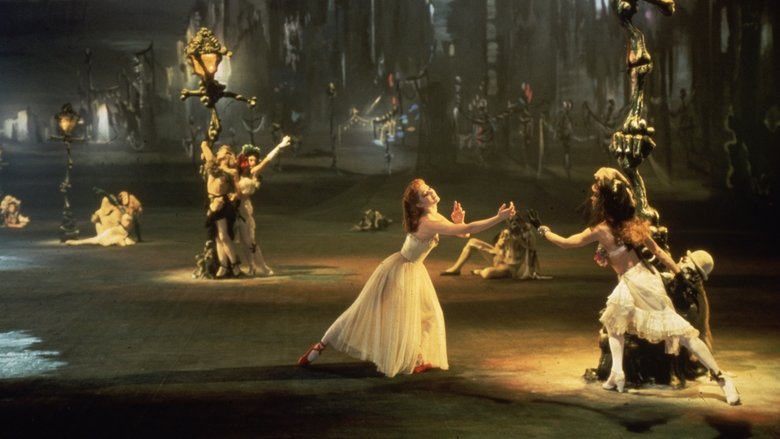
- The 17-minute 'Ballet of the Red Shoes' sequence is a landmark in cinema, blending dance with surreal, expressionistic visuals that could not be achieved on a stage.
- Cinematographer Jack Cardiff deliberately manipulated camera speeds during the ballet sequence to make the dancers appear to hover in mid-air at the peak of their jumps.
- When the film was completed, the studio head J. Arthur Rank hated it, and it was given a very small initial release in Britain. However, it became a massive, long-running success in the United States, which secured its reputation.
- The film won Academy Awards for Best Art Direction and Best Original Score.
- Art director Hein Heckroth was a painter who had never designed a film before. He created a filmed storyboard, or 'animatic', to show the visual mood he intended to create.
⚠️ Spoiler Analysis
Click to reveal detailed analysis with spoilers
Frequently Asked Questions
Explore More About This Movie
Dive deeper into specific aspects of the movie with our detailed analysis pages
Comments (0)
No comments yet. Be the first to share your thoughts!