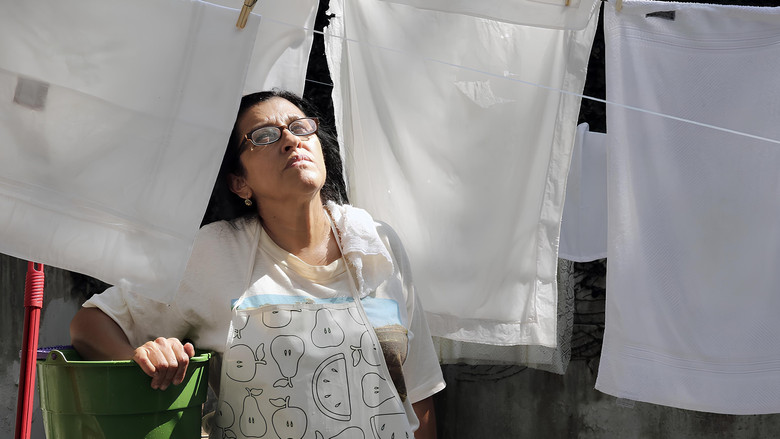

Que Horas Ela Volta?
The Second Mother - Symbolism & Philosophy
Symbols & Motifs
The Swimming Pool
The pool is the most potent symbol of social apartheid and privilege in the household. It represents a space of leisure and ownership that is strictly off-limits to the domestic staff.
Val has never set foot in the pool, despite caring for Fabinho in and around it for years. When Jéssica nonchalantly uses it, it is a major transgression that leads Bárbara to have the pool drained, citing a fictitious rat sighting. Val's own cathartic moment comes at the end when she finally steps into the partially filled pool, symbolizing her liberation.
The Guest Room
The guest room symbolizes status and belonging within the family. Val is expected to house her daughter on a mattress in her own tiny servant's quarters.
When the patriarch, Carlos, offers Jéssica the guest room, it is the first major disruption of the house's social hierarchy. Jéssica's acceptance of the offer signifies her refusal to be relegated to the status of a servant's daughter.
Fabinho's Favorite Ice Cream
The special, expensive ice cream that Val serves only to Fabinho represents the subtle ways in which class distinctions are maintained through material goods and acts of service.
When Jéssica innocently helps herself to the ice cream, Val is horrified, explaining that it is reserved for Fabinho. Jéssica questions this logic, highlighting the absurdity of the invisible rules that govern her mother's life. The sharing, or not sharing, of food becomes a constant, subtle battleground of class.
The Coffee Set
The coffee set Val gives Bárbara for her birthday symbolizes Val's attempt to bridge the class divide through a gesture of generosity, and Bárbara's rejection of it reinforces that divide.
Bárbara's lukewarm reception and her refusal to use the "common" gift at her party is a moment of quiet humiliation for Val. At the end of the film, as Val leaves her job, she takes the unused coffee set with her, an act of reclaiming her dignity and the value of her own taste.
Philosophical Questions
What defines a family: biological ties or the labor of love and care?
The film constantly juxtaposes Val's deep, maternal bond with Fabinho against her estranged relationship with her own daughter, Jéssica. It also contrasts this with Bárbara's biological but emotionally distant relationship with her son. It forces the viewer to question whether the daily acts of nurturing, comforting, and raising a child are more formative of a parent-child bond than blood relations alone.
Are social hierarchies a natural order or an artificial construct that can be dismantled?
The film explores this question through the opposing worldviews of Val and Jéssica. Val believes class divisions are an innate reality one is born into, a set of unspoken rules that must be followed for social harmony. Jéssica challenges this notion at every turn, acting as if these rules do not exist. Her success in the end suggests that these constructs are indeed artificial and can be overcome through ambition, education, and a refusal to accept a subservient position.
Can affection and care be commodified without consequence?
Val is paid to be a housekeeper and nanny, but the emotional labor she provides for Fabinho goes far beyond her job description. The family gets the benefit of her genuine love and affection, which they cannot seem to provide themselves. The film examines the emotional cost of this transaction, both for Val, who sacrifices a relationship with her own daughter, and for Fabinho, who is closer to the paid help than his own mother.
Core Meaning
The central message of "The Second Mother" is a critique of Brazil's deeply ingrained class structure and the invisible walls it creates. Director Anna Muylaert wanted to explore the undervalued and often invisible work of domestic helpers and nannies, who sacrifice relationships with their own children to care for the children of the wealthy. The film questions the notion of family, contrasting the biological ties of a distant mother-daughter relationship with the affectionate, yet transactional, bond between a nanny and her charge. Ultimately, it is a story about the awakening of self-worth and the possibility of social mobility in a new generation that refuses to accept the old hierarchies.